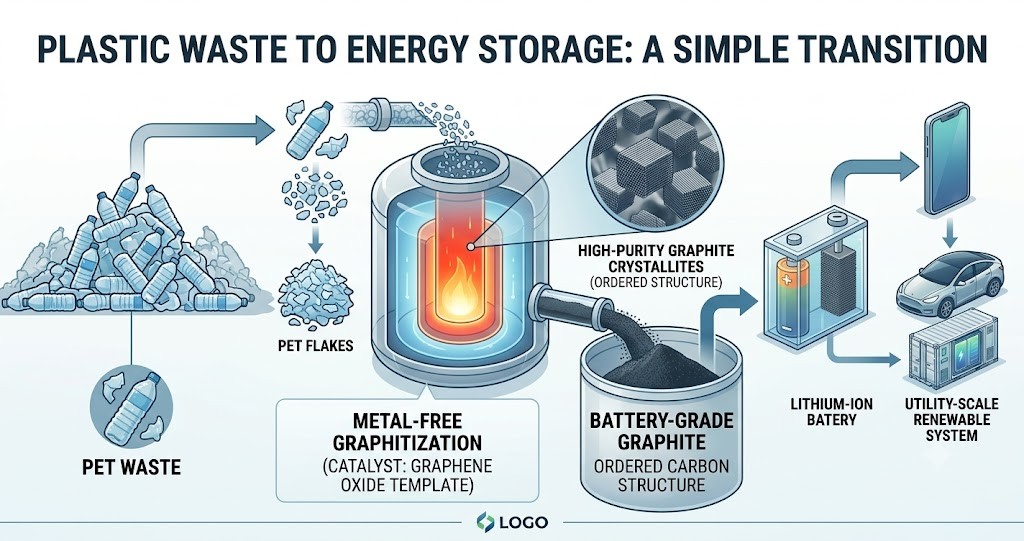
現代のクリーンエネルギー社会において、電気自動車(EV)やスマートフォン、再生可能エネルギー貯蔵システム(ESS)の普及は急加速しています。これらに不可欠なリチウムイオン電池の「負極材(アノード)」として大量に消費されているのがグラファイト(黒鉛)です。
しかし、現在グラファイトの供給は特定の国(主に中国)への依存度が高く、地政学的なリスクや輸出規制(2023年末から強化)により、世界中で「脱中国」および代替サプライチェーンの構築が急務となっています。また、世界的な課題であるプラスチック(PET)廃棄物の処理問題も深刻であり、リサイクルされても価値の低い製品へダウンサイクルされるか、埋め立て処分されるのが現状です。
ペンシルベニア州立大学が発表した今回の研究は、「世界的なプラスチックゴミ問題」と「バッテリー素材の供給リスク」という2つの大きな課題を同時に解決する、画期的なアップサイクル(高付加価値化)技術として大きな注目を集めています。
1. 研究の概要と成果
ペンシルベニア州立大学の研究チームは、一般的な廃棄ペットボトル(ポリエチレンテレフタレート:PET)を、電池グレードの高品質な「高度に秩序だった合成グラファイト」に変換することに成功しました。
- 結晶構造の優位性: 生成されたグラファイトは、炭素層が微細な領域で美しく整列した結晶子(高度に組織化された結晶構造)を持っています。
- 天然グラファイトを超える品質: 電池研究のベンチマークとされる市販の天然グラファイトと比較しても、PET由来のグラファイトの方がより秩序だった結晶構造を有しており、高品質な負極材料として非常に適していることが示されました。
- 掲載誌: 本研究成果は、材料科学の専門誌『ダイヤモンド・アンド・リレイテッド・マテリアルズ(Diamond and Related Materials)』に掲載されました。
2. 独自の技術的ブレイクスルー:金属触媒フリー
今回の研究の最も革新的な点は、「酸化グラフェン」をテンプレートとして利用し、環境負荷の高い金属触媒を排除した点にあります。
従来の合成グラファイト製造との違い
- 従来の方法: 鉄、ニッケル、コバルトなどの金属触媒を用いて黒鉛化(炭素をグラファイト構造に変えること)を促進させます。しかし、完成後に金属の不純物が残るため、電池グレードにするには強力な化学薬品を用いた複雑な精製工程(環境負荷が高い)が必要でした。
- 今回の新アプローチ: 細かく粉砕したPETプラスチックに、重量比でわずか2.5%の酸化グラフェンを混ぜ合わせ、制御された熱処理を行います。
酸化グラフェンの役割
酸化グラフェンシートの端にある「酸素含有官能基」が、グラファイト結晶の横方向の成長を促すスターターとなります。露出したグラフェンの表面が、炭素原子を規則正しく積み重ねるための「型紙(テンプレート)」の役割を果たすため、金属汚染物質を一切導入することなく、極めて高い構造秩序を持つグラファイトが生成されます。
3. 追加情報:グラファイトとPETリサイクルを巡る世界情勢
① グラファイト(黒鉛)の需要激増と地政学的リスク
リチウムイオン電池の約15〜25%の重量をグラファイトが占めています。EVや蓄電池の市場拡大に伴い、電池向けグラファイトアノードの市場規模は、2026年から2031年にかけて年平均20%以上の急速なペースで成長を続けると予測されています。 一方で、中国が世界のグラファイト供給の大半を握っており、近年輸出規制を強化したこと、また米国インフレ抑制法(IRA)などの影響から、北米や欧州をはじめとする各国で「非中国圏」での素材確保が叫ばれています。
② プラスチックリサイクルの現状
全米PET容器資源協会などによると、PETは世界で最も使用されているプラスチックの一つですが、回収されたものの多くは衣類の繊維といった一度きりの製品(ダウンサイクル)になるか、最終的に埋め立て地へ送られています。今回の技術は、廃棄物を最先端のクリーンエネルギー素材へと「アップサイクル」する道を開くものです。
4. 今後の展望と課題
本研究の筆頭著者であるシャクシ・セカール(Sakshi Bhardwaj)氏は、次のように述べています。
「廃プラスチックが先進エネルギー材料の原料になり得るなら、リサイクルに対する私たちの考え方が変わるでしょう。プラスチックを廃棄物問題として捉えるのではなく、クリーンエネルギー技術を支える資源として捉えることができるようになるのです」
実用化に向けた次のステップ
今後は、研究室レベルの実験から「大規模な商業生産(マススケール)」への拡張や、実際にこのグラファイトを用いて作られたバッテリーの長期的な充放電性能・寿命の評価に関するさらなる研究が必要とされています。
このプロセスが商業的に確立されれば、化学物質の使用や廃棄物を大幅に削減したクリーンな製造工程で、世界中で余っているプラスチックゴミから次世代のEV用バッテリーを生み出すという、持続可能な循環型経済(サーキュラーエコノミー)が実現することになります。
出典:https://www.psu.edu/news/research/story/plastic-bottles-could-find-new-life-batteries-graphite
Synthesizing “Battery-Grade Graphite” from Plastic Bottles: Achieving Crystallinity That Surpasses Natural Graphite
In today’s clean energy society, the adoption of electric vehicles (EVs), smartphones, and renewable energy storage systems (ESS) is accelerating rapidly. Graphite is consumed in massive quantities as an indispensable “anode material” for the lithium-ion batteries that power these technologies.
However, the current supply of graphite is heavily dependent on specific countries (primarily China). Due to geopolitical risks and export controls (which have been tightened since late 2023), there is an urgent global need to reduce dependence on China and establish alternative supply chains. At the same time, the management of plastic (PET) waste remains a severe global challenge; currently, even when recycled, most PET is downcycled into low-value products or sent to landfills.
This recent study announced by Pennsylvania State University is drawing significant attention as a breakthrough upcycling technology that simultaneously addresses two major challenges: the global plastic waste problem and the supply chain risks of battery materials.
1. Study Overview and Key Findings
A research team at Pennsylvania State University has successfully converted common waste plastic bottles (polyethylene terephthalate: PET) into high-quality, “highly ordered synthetic graphite” suitable for battery grades.
- Structural Advantages: The generated graphite exhibits crystallites (microscopic regions of aligned carbon layers) that are beautifully ordered across fine domains, demonstrating a highly organized crystalline structure.
- Surpassing Natural Graphite: Compared to commercially available natural graphite—commonly used as a benchmark in battery research—the PET-derived graphite demonstrated a more ordered crystalline structure, proving it highly suitable as a premium anode material.
- Publication: The findings of this study were published in Diamond and Related Materials, a specialized journal in materials science.
2. A Unique Technological Breakthrough: Metal-Catalyst-Free Process
The most innovative aspect of this study lies in its elimination of environmentally damaging metal catalysts by utilizing “graphene oxide” as a template.
Comparison with Conventional Synthetic Graphite Production
- Conventional Methods: These typically rely on metal catalysts such as iron, nickel, or cobalt to promote graphitization (the process of rearranging carbon into a graphite structure). However, residual metal impurities remain after completion, requiring complex, environmentally taxing purification steps with harsh chemicals to reach battery-grade purity.
- The New Approach: The team mixed finely ground PET plastic with a mere 2.5% of graphene oxide by weight and subjected the material to a carefully controlled heat treatment.
The Role of Graphene Oxide
Oxygen-containing functional groups located at the edges of the graphene oxide sheets serve as initiators that trigger and promote the lateral growth of graphite crystals. The exposed graphene surface functions as a “pattern (template)” that guides carbon atoms into a highly organized layered structure, producing graphite with exceptional structural order without introducing any metal contaminants.
3. Additional Context: The Global Landscape of Graphite and PET Recycling
① Surging Graphite Demand and Geopolitical Risks
Graphite accounts for approximately 15% to 25% of a lithium-ion battery’s weight. Driven by the expansion of the EV and energy storage markets, the market size for battery-grade graphite anodes is projected to grow at a rapid compound annual growth rate (CAGR) of over 20% from 2026 through 2031. Conversely, because China controls the vast majority of the world’s graphite supply, countries across North America and Europe are urgently seeking to secure materials from “non-China regions,” motivated further by policies like the U.S. Inflation Reduction Act (IRA).
② The Current State of Plastic Recycling
According to organizations such as the National Association for PET Container Resources, PET is one of the most widely used plastics globally. However, much of what is collected is downcycled into single-use products like clothing fibers or ultimately sent to landfills. This new technology opens a path to “upcycle” this waste into cutting-edge clean energy materials.
4. Future Outlook and Challenges
Sakshi Bhardwaj (Sekhar), the lead author of the study, noted the following:
“If waste plastic can be a feedstock for advanced energy materials, it will change how we think about recycling. Instead of viewing plastic as a waste problem, we can see it as a resource to support clean energy technologies.”
Next Steps Toward Commercialization
Future research must focus on scaling this process from laboratory-level experiments to “mass-scale commercial production,” as well as conducting further evaluations regarding the long-term charge-discharge performance and lifecycle testing of batteries built with this graphite.
Once this process is commercially established, it will realize a sustainable circular economy—generating next-generation EV batteries from the world’s surplus plastic waste through a clean manufacturing process that drastically minimizes chemical usage and waste production.
コメント