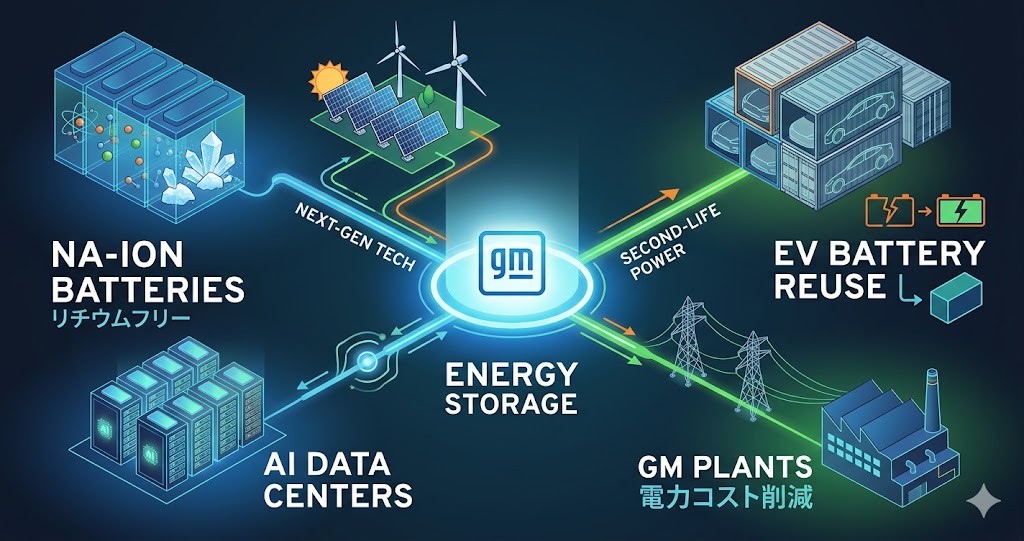
GMは、AIデータセンターの急増に伴う電力需要の拡大や、再生可能エネルギー導入による電力網の不安定化に対応するため、定置型エネルギー貯蔵システム(ESS)市場への本格参入を発表しました。EV開発で得た知見や資産を活用し、新たな収益源の確保を目指します。
2つの主要な提携とプロジェクト
- 米新興企業ピーク・エナジーとの提携(次世代電池開発)
- 内容: AIデータセンターや大規模電力網を対象とした「ナトリウムイオン電池セル」を共同開発。
- 体制: ミシガン州のGM研究施設が主導し、GMが独占的製造権を取得。
- 時期: 2028年以降の本格展開を予定。
- 米レッドウッド・マテリアルズとの協業拡大(EV電池の再利用)
- 内容: EVの使用済みバッテリーを再利用(セカンドライフ)した定置型蓄電システムを構築。
- 初案件: ミシガン州のGM工場に1.5MW出力、7.2MWh容量のシステムを設置。生涯で300万ドル以上の電力コスト削減を計画。
その他のバッテリー戦略
GMはEV向け技術への投資も継続しており、ミシガン州ウォーレンに新たな開発センターを開設しました。ここではEVのコスト削減に繋がるLMR(リチウム・マンガン・リッチ)技術の商用化を進めています。
関連情報(背景と影響)
1. ナトリウムイオン電池が注目される理由
定置型蓄電池の次世代本命とされるのがナトリウムイオン電池です。
- リチウムフリー: 高価で地政学的リスク(供給網の偏り)があるリチウムやコバルトを使用せず、資源量が豊富な塩(ナトリウム)を主原料とします。
- 定置型に最適: 重量やエネルギー密度の面でEV用としては課題が残るものの、動かす必要のないデータセンターや発電所用の蓄電池としては、低コストかつ安全性が高いため極めて有望視されています。
2. なぜ今「AIデータセンター向け」なのか
生成AIの爆発的な普及により、世界中でデータセンターの建設が急増しています。AIの処理には膨大な電力が必要であり、データセンターは24時間安定した電力を求められます。しかし、供給側である太陽光や風力などの再生可能エネルギーは天候に左右されるため、そのギャップを埋める大型蓄電池(ESS)の需要が世界中でミリオンワット(MW)規模で爆発していることが背景にあります。
3. EVバッテリーの「セカンドライフ(二次利用)」市場
EV用のリチウムイオン電池は、容量が初期の70パーセントから80パーセント程度に低下するとEV用としては寿命を迎えます。しかし、定置型蓄電池としては十分な性能を残しています。GMが取り組むこのリサイクル・再利用モデルは、廃棄物を減らすだけでなく、新品よりも安価な蓄電システムを市場に供給できるため、環境と経済性の両面から注目されています。
4. 自動車業界のトレンドと競合動向(テスラ、フォード)
EVの普及ペースが一時的に鈍化するなか、自動車各社は「蓄電ビジネス」を第2の柱に据えようとしています。
- テスラ: すでに「メガパック(Megapack)」と呼ばれる大型蓄電システムが同社のエネルギー部門の収益を大きく牽引しており、先行利益を得ています。
- フォード: ケンタッキー州の工場を転用し、エネルギー貯蔵システムを専門に扱う新子会社「フォード・エナジー」を設立。
- GMの立ち位置: 今回の参入により、GMはテスラを追いかけ、フォードと並ぶ形で「総合エネルギー企業」としての側面を強めることになります。
出典:https://www.sbbit.jp/article/cont1/185693
Moving Beyond Just EVs: The Disruptive Potential of GM’s New “AI Data Center x Next-Gen Storage” Strategy
GM has announced its full-scale entry into the stationary Energy Storage System (ESS) market. This move addresses the surging power demand from the rapid expansion of AI data centers and the growing instability of power grids due to the integration of renewable energy. By leveraging the expertise and assets gained from EV development, the company aims to secure a new revenue stream.
Two Major Partnerships and Projects
- Partnership with US Startup Peak Energy (Next-Gen Battery Development)
- Details: Jointly developing “sodium-ion battery cells” tailored for AI data centers and large-scale power grids.
- Structure: Led by GM’s research facility in Michigan, with GM acquiring exclusive manufacturing rights.
- Timeline: Full-scale deployment is projected to start from 2028 onward.
- Expanded Collaboration with Redwood Materials (EV Battery Re-use)
- Details: Building stationary energy storage systems by giving a “second life” to spent EV batteries.
- Initial Project: Installing a system with 1.5 MW output and 7.2 MWh capacity at a GM manufacturing plant in Michigan. The project plans to slash electricity costs by over 3 million dollars over its lifecycle.
Other Battery Strategies
GM is also continuing its investment in EV-specific technologies. The company opened a new battery cell development center inside its tech center in Warren, Michigan. Here, they are advancing the commercialization of LMR (lithium-manganese-rich) technology, which aims to lower EV manufacturing costs.
Related Information (Background and Impact)
1. Why Sodium-Ion Batteries are Drawing Attention
Sodium-ion batteries are widely considered the next major candidate for stationary energy storage.
- Lithium-Free: They do not rely on lithium or cobalt, which are expensive and come with geopolitical supply chain risks. Instead, they use abundant sodium (salt) as the primary raw material.
- Ideal for Stationary Storage: While challenges remain for EV use due to weight and energy density constraints, they are highly promising for stationary setups like data centers and power plants because they offer a low-cost, highly secure storage solution that does not need to move.
2. Why the Sudden Focus on “AI Data Centers”?
The explosive boom of generative AI has triggered a surge in data center construction worldwide. Processing AI workloads requires a massive amount of power, and these data centers demand a stable, 24-hour supply of electricity. However, the supply side—relying on renewables like solar and wind—is highly weather-dependent. The need for large-scale energy storage systems (ESS) to bridge this gap is exploding globally on a megawatt (MW) scale.
3. The EV Battery “Second Life” Market
An EV’s lithium-ion battery reaches the end of its automotive lifespan when its capacity drops to about 70% to 80% of its original level. However, it still retains plenty of performance capability for stationary energy storage. The recycling and re-use model GM is pursuing cuts down on waste while supplying the market with storage systems that are cheaper than brand-new ones, drawing strong interest for both its environmental and economic benefits.
4. Automotive Industry Trends and Competitor Moves (Tesla, Ford)
As the pace of EV adoption experiences a temporary slowdown, automakers are rushing to position the energy storage business as their second core pillar.
- Tesla: Its large-scale storage system, known as the “Megapack,” is already heavily driving revenues for its energy division, allowing Tesla to reap early-mover advantages.
- Ford: Ford has announced the creation of “Ford Energy,” a new subsidiary dedicated to energy storage systems, by repurposing its battery plant in Kentucky.
- GM’s Position: With this entry, GM is chasing Tesla and aligning with Ford to strengthen its identity as a comprehensive energy company.
コメント