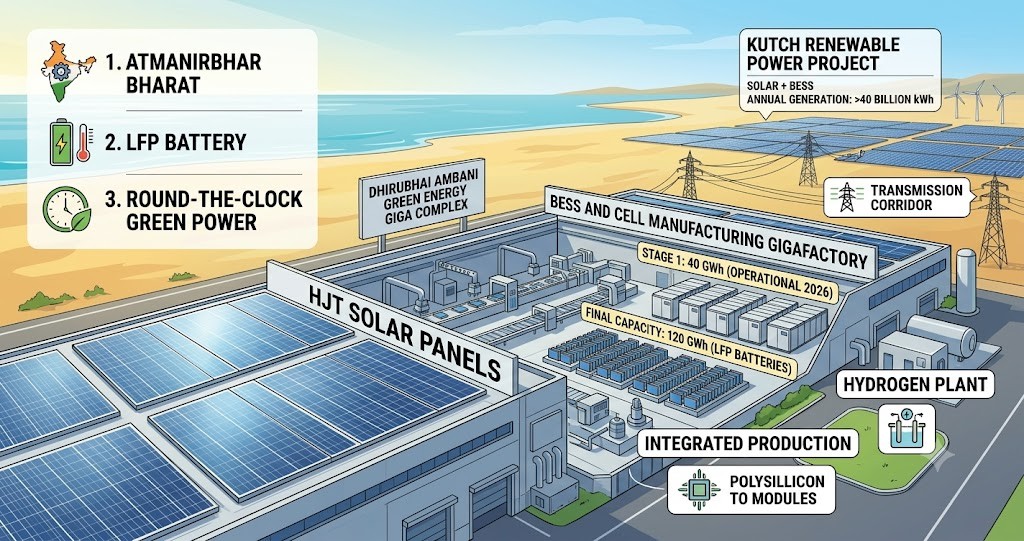
インドの民間最大手企業リライアンス・インダストリーズ(RIL)が、クリーンエネルギー分野において驚異的な規模の拡大を進めています。同社はバッテリーエネルギー貯蔵システム(BESS)および電池セルの年間製造能力を最終的に120GWh(ギガワット時)まで拡大する壮大な計画を発表しました。
すでに第1段階である40GWh規模の工場の稼働に向けた準備が最終段階に入っており、インド国内だけでなく世界のエネルギー市場の勢力図を塗り替える可能性を秘めています。本記事では、この最新ニュースの要点に加えて、リライアンス社の戦略とインドのエネルギー事情に関する関連情報を交えてまとめます。
ニュースの要約:リライアンス社の巨大ギガファクトリー計画
リライアンス社のアニュアル総会にて、ムケシュ・アンバニ会長より以下の進捗と計画が明かされました。
- 電池製造能力を120GWhへ: 当初計画を大幅にスケールアップし、最終的に年間120GWhのBESSおよびセル製造能力を目指します。フル稼働時には世界最大級のリン酸鉄リチウム(LFP)電池メーカーとなる見込みです。
- 第1段階(40GWh)は今年中に開始: 年間40GWh規模の第1段階工場は、すべての設備が現地に搬入されており、2026年度中の稼働開始に向けて順調に進行しています。
- 世界最大級の複合施設: グジャラート州の「ディルバイ・アンバニ・グリーン・エナジー・ギガコンプレックス(約5000エーカー)」にて、太陽光、水素、燃料電池、蓄電池、パワーエレクトロニクスを網羅した、完全に統合されたクリーンエネルギー製造拠点を構築中です。
- 先進的な太陽光モジュール(HJT)の生産: 太陽光セルの製造ラインはすでに稼働しており、次世代のヘテロ接合技術(HJT)モジュールを約1GW生産。高効率(最大25.6%)かつ劣化が少ない特性を持ち、インド政府のALMM(承認モデル・製造業者リスト)認証を初の先進セルとして取得しました。
- 24時間連続のグリーン電力供給: カッチ地方の広大な敷地で太陽光と蓄電池を組み合わせたギガワット規模の拠点を開発中。フル稼働時には年間400億kWh以上の電力を発電し、インド全体の年間電力需要の約3%を賄う計画です。
関連情報:リライアンスの戦略とインドの市場背景
このニュースの規模感と重要性を理解するための、3つの関連情報です。
1. 「アトマニルバル・バーラト(自立したインド)」と中国依存からの脱却
アンバニ会長が発言した「自立したインド」は、インド政府が推進する重要政策です。現在、世界の太陽光パネルやリチウムイオン電池のサプライチェーンは中国が圧倒的なシェアを握っています。リライアンス社が原材料(ポリシリコンなど)から最終製品までをインド国内で「完全統合型」で生産することは、エネルギー安全保障の観点からインド国家にとって極めて重要な意味を持ちます。
2. リン酸鉄リチウム(LFP)電池が選ばれる理由
リライアンス社が製造を予定しているLFP電池は、コバルトやニッケルを使用しないため、従来の三元系(NMC)電池に比べて「熱安定性が高く安全」「長寿命」「低コスト」という特徴があります。特にインドのような高温地域での大型蓄電システム(BESS)やEV(電気自動車)において、現在最も需要が伸びている技術です。
3. インドの再生可能エネルギー目標と「24時間供給(Round-the-Clock)」
インド政府は2030年までに500GWの非化石燃料による発電容量を達成目標として掲げています。しかし、太陽光は夜間に発電できません。リライアンス社が目指す「蓄電池を組み合わせた24時間体制のグリーン電力供給」は、インドの急増する電力需要を満たしつつ、不安定な再生可能エネルギーをベースロード電源(基幹電源)化するための鍵となります。
今後の課題と展望
リライアンス社の参入により、インドは世界のクリーンエネルギー製造ハブとしての地位を確固たるものにしつつあります。カッチの発電拠点からジャムナガルの製造拠点を結ぶ専用の送電回廊の建設もEPC(設計・調達・建設)契約が締結され、インフラ整備も急ピッチで進んでいます。
2026年度は同社にとって「建設から稼働への移行期」となり、メガスケールでの生産が本格化します。低コストなグリーン電力の供給が実現すれば、インド国内の産業競争力を高めるだけでなく、世界のクリーンエネ市場における価格破壊と普及をさらに加速させることになりそうです。
From India to the World! Reliance Announces Massive 120GWh Annual Battery Production Plan
Reliance Industries Limited (RIL), India’s largest private sector enterprise, is driving an astonishing expansion in the clean energy sector. The company has announced an ambitious plan to scale its annual manufacturing capacity for Battery Energy Storage Systems (BESS) and battery cells to an ultimate target of 120GWh (gigawatt-hours).
With preparations for the first phase—a 40GWh mega-factory—already in their final stages, this move has the potential to reshape the energy market landscape not just in India, but globally. This article breaks down the key highlights of this latest news, supplemented by crucial context regarding Reliance’s strategy and the Indian energy market.
News Summary: Reliance’s Massive Gigafactory Project
At Reliance’s Annual General Meeting (AGM), Chairman and Managing Director Mukesh Ambani revealed the following progress and strategic plans:
- Scaling Battery Capacity to 120GWh: Considerably scaling up its initial targets, the company now aims for an ultimate annual production capacity of 120GWh for BESS and cells. Once fully operational, Reliance is poised to become one of the world’s largest Lithium Iron Phosphate (LFP) battery manufacturers.
- Phase 1 (40GWh) to Begin This Year: The first phase of the gigafactory, with an annual capacity of 40GWh, is progressing smoothly toward starting operations within fiscal year 2026. All required machinery and equipment have already been delivered to the site.
- One of the World’s Largest Clean Energy Hubs: At the 5,000-acre Dhirubhai Ambani Green Energy Giga Complex in Jamnagar, Gujarat, the company is building a fully integrated clean energy manufacturing ecosystem. This includes gigafactories for an end-to-end integrated solar PV value chain, fuel cell systems, green hydrogen electrolyzers, energy storage systems, and power electronics.
- Advanced Solar Module (HJT) Production: The solar cell manufacturing lines are already operational, producing around 1GW of next-generation Heterojunction Technology (HJT) modules. These modules offer high efficiency (up to 25.6%), low degradation, and superior temperature performance. Reliance has also become the first company in India to secure ALMM (Approved List of Models and Manufacturers) certification for this advanced cell type.
- 24/7 Round-the-Clock Green Power Supply: The group is developing a gigawatt-scale renewable energy hub across 550,000 acres in the Khavda region of Kutch. Combining solar power with battery storage, the integrated hub will generate over 40 billion kWh of green electricity annually upon full completion—equivalent to roughly 3% of India’s total electricity demand.
Related Context: Reliance’s Strategy and the Indian Market Landscape
To grasp the true scale and significance of this announcement, here are three essential pieces of context surrounding the market:
1. “Atmanirbhar Bharat” (Self-Reliant India) and Decoupling from China
The concept of a “Self-Reliant India” mentioned by Chairman Ambani is a cornerstone policy of the Indian government. Currently, China dominates the global supply chain for solar panels and lithium-ion batteries. Reliance’s push to establish a fully integrated domestic supply chain—stretching from raw materials like polysilicon to finished products—carries immense strategic weight for India’s national energy security.
2. Why Lithium Iron Phosphate (LFP) Batteries?
The LFP batteries slated for production by Reliance do not rely on cobalt or nickel. Compared to traditional Nickel Manganese Cobalt (NMC) chemistries, LFP technology boasts higher thermal stability, enhanced safety, longer cycle life, and lower production costs. This makes it the technology of choice for utility-scale BESS and electric vehicles (EVs) in high-temperature environments like India.
3. India’s Renewable Energy Goals and “Round-the-Clock” Supply
The Indian government has set an ambitious target of reaching 500GW of non-fossil fuel energy capacity by 2030. However, solar power is unavailable at night. Reliance’s goal of delivering a 24/7 round-the-clock green power supply by pairing renewables with massive battery storage is vital to meeting India’s skyrocketing power demands while turning intermittent renewables into reliable base-load power.
Future Challenges and Outlook
With Reliance’s grand entry, India is firmly establishing its position as a global clean energy manufacturing hub. Infrastructure development is moving at a rapid pace, with EPC (Engineering, Procurement, and Construction) contracts already locked in for a dedicated transmission corridor connecting the generation hub in Kutch to the manufacturing hub in Jamnagar.
Fiscal year 2026 marks a pivotal transition for the company as it shifts from the construction phase to active operations, paving the way for mega-scale production. If Reliance succeeds in delivering ultra-low-cost green power at this scale, it will not only boost India’s industrial competitiveness but could also trigger a global shift in clean energy affordability and adoption.
コメント