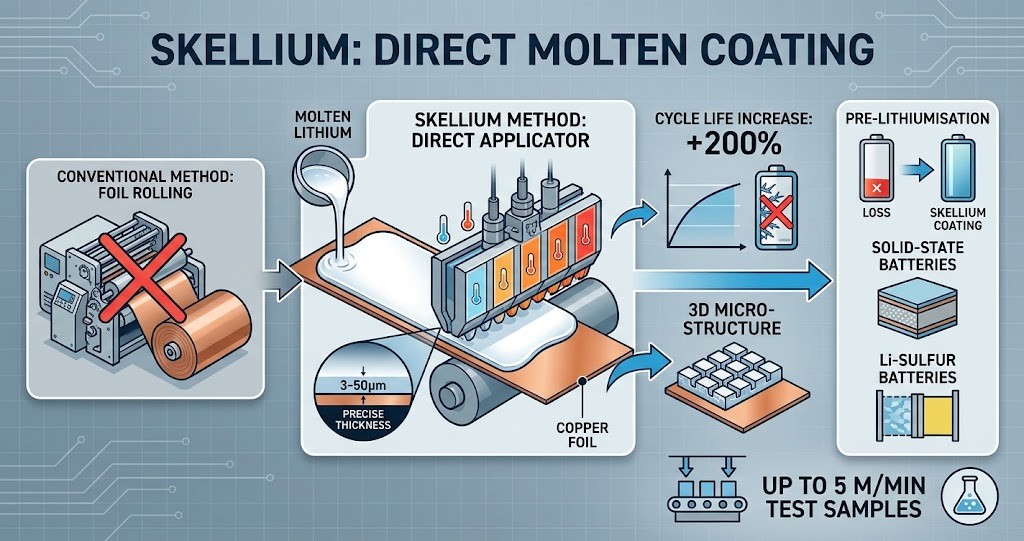
リチウム金属負極は次世代電池の高エネルギー密度化の切り札として期待される一方、高価格や加工の難しさが量産化への大きな壁となっていました。アーヘン工科大学のPEM研究所からスピンオフしたSkellium社は、この課題を打破する「溶融コーティング法」を開発し、製造プロセスの効率化と品質向上に挑んでいます。本記事では、同社の技術的特徴や開発の背景、今後の展望について整理します。
Skellium社によるリチウム金属負極の溶融コーティング技術
- 開発の背景とアイデア:
- 従来のリチウム金属箔の製造(圧延法や気相堆積法)は、薄膜化が難しく高コストであるか、あるいは真空環境が必要で時間がかかるという課題がありました。
- 創業者兼CEOのゲリット・ボッキー氏は、生産技術の観点から「なぜリチウムを一度箔状に丸めてから積層するのか、本来あるべき場所に直接塗布すればよいのではないか」という着想に至り、不活性ガス雰囲気下で液体リチウムを銅箔などの集電体に直接塗布する溶融プロセスを開発しました。
- 技術的特徴とメリット:
- 銅箔上に直接、厚さ3から50マイクロメートルの層を形成することが可能です。
- 製造工程中にその場で3D構造を形成することでデンドライト(樹枝状結晶)の成長を抑制し、エステル系電解液を用いた試験ではサイクル寿命が最大200%増加しました。
- 最大の技術的難関であった「正確な温度制御」をクリアするため装置内の温度ゾーンを精密に管理し、酸素・水分だけでなく窒素とも反応する液体リチウムの特性に合わせて徹底した不活性ガス雰囲気での制御を実現しています。
- 想定されるターゲット市場:
- 短期的需要: シリコンやグラファイト負極の初回充電時のリチウムロスを補う「プレリチウム化」の分野。
- 中期的需要: 薄く均一な層が不可欠となる「全固体電池」および「リチウム硫黄電池」向けの真のリチウム金属負極。
- 現在の状況と次の目標:
- アーヘンにある自社工場にて、最大5m/分の速度でリチウムおよびリチウム合金アノードの試験用サンプルを製造しています。
- 今後は両面コーティングへの対応や、モジュール方式による生産ラインの拡張を計画しています。
補足情報:リチウム金属負極が持つポテンシャルと技術的背景
- 理想的な特性:
- リチウム金属は、容量が約3860 mAh/gと非常に大きく、全負極材料の中で最も低い標準電位を持つため、バッテリーの飛躍的な高エネルギー密度化(軽量化・小型化)を実現する究極の負極材料とされています。
- 従来の製造方法が抱えるハードル:
- 圧延法: 箔を薄くするほど加工難易度とコストが跳ね上がる。
- 気相堆積法(真空蒸着など): 非常に薄い層を作れる一方で、大面積化やスループット(生産速度)の面で時間がかかる。
- 次世代電池エコシステムにおける位置づけ:
- 前述のCATL社などが進める500 Wh/kg級の超高エネルギー密度セルや全固体電池の実現には、リチウム金属アノードの安定供給と低コスト化が不可欠であり、Skellium社のような川上・製造プロセス技術の革新が業界全体の進展を左右する鍵となっています。
出典:https://battery-news.de/en/2026/10/30/skellium-develops-lithium-metal-anodes-using-melt-coating/
Challenge of Aachen-based Startup Skellium: Aiming for Mass Production of Lithium Metal Anodes through Direct Coating on Copper Foil
While lithium metal anodes are anticipated as a trump card for achieving high energy density in next-generation batteries, high costs and processing difficulties have posed major barriers to mass production. Spun off from the PEM Chair of RWTH Aachen University, Skellium has developed a “melt coating method” to break through these challenges, tackling efficiency improvements and quality enhancements in the manufacturing process. This article organizes the company’s technical features, development background, and future prospects.
Skellium’s Melt Coating Technology for Lithium Metal Anodes
- Development Background and Idea:
- Conventional lithium metal foil manufacturing methods (rolling or vapor deposition) face challenges: rolling makes thinning difficult and costly, while vapor deposition requires a vacuum environment and is time-consuming.
- Co-founder and CEO Gerrit Buchheim approached this from a production technology perspective, wondering, “Why roll lithium into a foil and then laminate it? Why not apply it directly where it should be?” This led to the development of a melting process that directly applies liquid lithium onto current collectors such as copper foil under an inert gas atmosphere.
- Technical Features and Benefits:
- Capable of forming a layer with a thickness of 3 to 50 micrometers directly on copper foil.
- By forming 3D structures in situ during the manufacturing process, dendrite growth is suppressed, and tests using ester-based electrolytes showed up to a 200% increase in cycle life.
- To overcome the biggest technical hurdle of “precise temperature control,” the company precisely manages temperature zones within the equipment and achieves thorough inert gas atmospheric control tailored to the properties of liquid lithium, which reacts not only with oxygen and moisture but also with nitrogen.
- Expected Target Markets:
- Short-term demand: The field of “pre-lithiation,” compensating for lithium loss during the initial charge of silicon and graphite anodes.
- Medium-term demand: True lithium metal anodes for “all-solid-state batteries” and “lithium-sulfur batteries,” where thin, uniform layers are indispensable.
- Current Status and Next Goals:
- Manufacturing test samples of lithium and lithium alloy anodes at speeds of up to 5 m/min at its in-house plant in Aachen.
- Future plans include supporting double-sided coating and expanding the production line using a modular approach.
Supplementary Information: Potential and Technical Background of Lithium Metal Anodes
- Ideal Properties:
- Lithium metal is considered the ultimate anode material to achieve dramatic high energy density (lightweighting and miniaturization) in batteries, boasting an exceptionally large capacity of approximately 3,860 mAh/g and the lowest standard potential among all negative electrode materials.
- Hurdles of Conventional Manufacturing Methods:
- Rolling method: The thinner the foil, the higher the processing difficulty and cost skyrocket.
- Vapor deposition method (such as vacuum deposition): While capable of creating very large areas of extremely thin layers, it takes time in terms of large-area scaling and throughput (production speed).
- Positioning in the Next-Generation Battery Ecosystem:
- The stable supply and cost reduction of lithium metal anodes are indispensable for realizing ultra-high energy density cells in the 500 Wh/kg class and all-solid-state batteries pursued by companies like CATL. Innovations in upstream and manufacturing process technologies, such as those by Skellium, are key factors driving overall industry progress.

コメント