再生可能エネルギーの導入拡大や電動モビリティの普及に伴い、大容量で安全かつ安価な蓄電池の必要性が高まっています。現在主流のリチウムイオン電池は優れた性能を持ちますが、主原料であるリチウムやコバルトの地域的偏在、資源枯渇リスク、価格高騰が課題となっています。
これに代わる次世代蓄電池として注目されているのが「ナトリウムイオン電池」です。ナトリウムは海水や塩から豊富に得られるため資源的制約が少なく、大幅なコスト低減が見込まれます。しかし、ナトリウムイオンはリチウムイオンに比べてイオン半径が大きいため、充放電時に正極材料が大きく膨張・収縮しやすく、結晶構造が崩れて寿命(サイクル特性)が低下しやすいという大きな技術課題がありました。
東京理科大学の駒場慎一教授らの研究グループは、コバルトを含まない高容量正極材料「O3型 NaNi1/2Mn1/2O2」において、スカンジウム(Sc)を用いた新しい材料設計手法を開発しました。以下に本研究の要点と関連情報をまとめて解説します。
研究の要点とメカニズムの解明
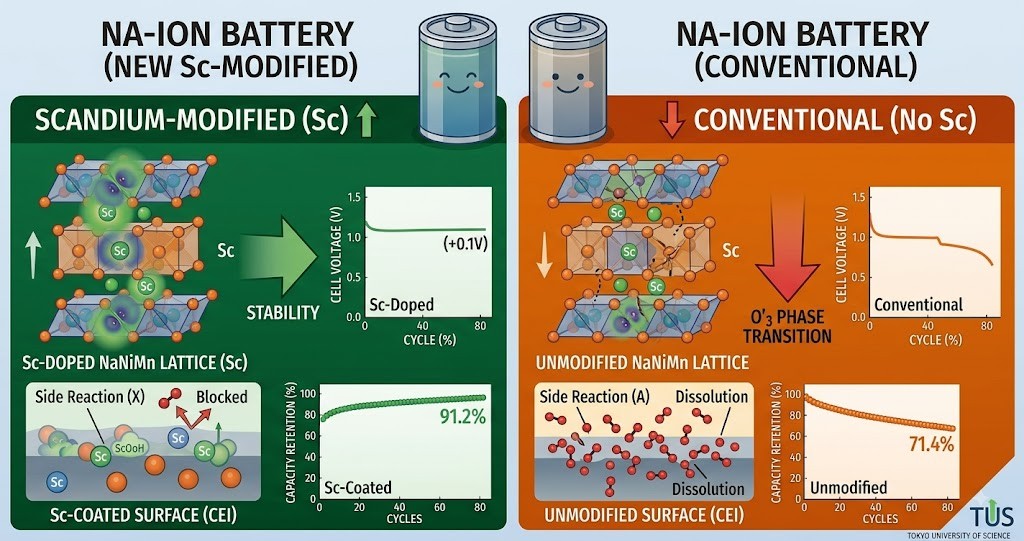
1. ドーピングとコーティングの異なる効果を明確に分離 従来の研究では、添加元素による「結晶内部の元素置換(ドーピング)」と「表面の改質(コーティング)」の効果が混ざり合って評価されることが多く、それぞれの役割を区別することが難しくなっていました。本研究ではこの2つを意図的に分けて作製・評価し、全く異なる2つのメカニズムで性能が向上していることを世界で初めて解明しました。
- 結晶内部置換(ドーピング): 充放電に伴う結晶構造の激しい膨張・収縮(格子ひずみ)を和らげ、正極材料内部の構造安定性を高めます。
- 表面修飾(コーティング): 電極と電解液が接する界面で生じる不要な副反応を抑え、長期間使用した際の電極の劣化を防ぎます。
2. ボトルネックとなる相転移の抑制と高電位化 東京科学大学との共同研究による理論計算(第一原理DFT計算)と実験を組み合わせた結果、スカンジウムの結晶内部置換は、電池反応のボトルネックとなっていた「O’3相」への相転移を抑えることが判明しました。これにより、放電プラトー電圧が約0.1 V上昇し、より高い電圧で安定して電気を取り出せるようになりました。
3. 長寿命化の実証(300サイクル試験) コイン型フルセルを用いた300サイクルの長期耐久試験において、未添加の材料に比べて高い容量維持率を達成しました。
- スカンジウム結晶内部置換試料:300サイクル後に71.4%の容量を維持
- スカンジウム表面修飾試料:300サイクル後に91.2%の容量を維持
今後の展望と応用可能性
本研究は、これまで一括りに議論されがちだった内部置換と表面修飾の役割を明確に切り分けたことで、目的に応じた効率的な正極材料の設計指針を提示しました。
ナトリウムイオン電池は、特に長期間の運転と低コスト性が求められる太陽光・風力発電向けの「定置型大容量蓄電池」や、急速充放電が求められる産業用モビリティへの応用が期待されています。今後は、結晶内部置換と表面修飾を組み合わせたさらなる相乗効果の検証が進むことで、実用化に向けた開発がより一層加速すると見込まれます。
出典:https://onlinelibrary.wiley.com/doi/10.1002/smll.75049
Extending Sodium-Ion Battery Lifespan! Performance Boost via Dual Approaches of Crystal Substitution and Surface Modification
With the expansion of renewable energy adoption and the spread of electric mobility, the need for large-capacity, safe, and low-cost rechargeable batteries is growing. While currently dominant lithium-ion batteries offer excellent performance, they face challenges such as geographical concentration of main raw materials like lithium and cobalt, resource depletion risks, and soaring prices.
“Sodium-ion batteries” are attracting attention as a next-generation rechargeable battery to replace them. Because sodium can be abundantly obtained from seawater and salt, it faces few resource constraints and is expected to significantly reduce costs. However, since sodium ions have a larger ionic radius than lithium ions, the cathode material easily undergoes significant expansion and contraction during charge and discharge. This leads to a major technical challenge: the crystal structure tends to collapse, decreasing lifespan (cycle performance).
A research group led by Professor Shinichi Komaba at Tokyo University of Science has developed a new material design strategy using scandium (Sc) in the cobalt-free, high-capacity cathode material “O3-type NaNi1/2Mn1/2O2”. Key points and relevant information regarding this study are summarized below.
Key Study Points and Elucidation of Mechanisms
1. Clear Separation of Distinct Effects of Doping and Coating In conventional research, the effects of “elemental substitution inside the crystal (doping)” and “surface modification (coating)” by additive elements were often evaluated together in a mixed state, making it difficult to distinguish their respective roles. In this study, the team intentionally prepared and evaluated the two separately, becoming the first in the world to clarify that performance is improved through two completely different mechanisms:
- Crystal Interior Substitution (Doping): Mitigates intense expansion and contraction (lattice strain) of the crystal structure during charge and discharge, enhancing the internal structural stability of the cathode material.
- Surface Modification (Coating): Suppresses unnecessary side reactions occurring at the interface between the electrode and electrolyte, preventing electrode degradation during long-term use.
2. Suppression of Bottleneck Phase Transitions and Potential Elevation Combining theoretical calculations (first-principles DFT calculations) through joint research with Institute of Science Tokyo and experiments revealed that scandium substitution inside the crystal suppresses the phase transition to the “O’3 phase,” which was a bottleneck in the battery reaction. As a result, the discharge plateau voltage increased by approximately 0.1 V, allowing stable electricity extraction at higher voltages.
3. Demonstration of Extended Lifespan (300-Cycle Test) In long-term durability tests of 300 cycles using coin-type full cells, high capacity retention rates were achieved compared to pristine materials:
- Scandium crystal interior substitution sample: Retained 71.4% capacity after 300 cycles
- Scandium surface modification sample: Retained 91.2% capacity after 300 cycles
Future Outlook and Potential Applications
By clearly separating the roles of internal substitution and surface modification that were previously discussed together, this study presents efficient design guidelines for cathode materials tailored to specific purposes.
Sodium-ion batteries are expected to find applications in “stationary large-capacity energy storage systems” for solar and wind power generation—where long-term operation and low cost are particularly required—as well as in industrial mobility requiring fast charge and discharge capabilities. In the future, further verification of synergistic effects combining crystal substitution and surface modification is expected to accelerate development toward commercialization even further.


コメント