CATL社が全固体電池の分野において新たな一歩を踏み出しました。本記事では、20Ahセルによるサンプル試験の開始や高エネルギー密度化への挑戦といった最新動向を整理し、競合他社の動きや技術的な背景などの関連情報を加えて分かりやすくまとめました。
CATL社の全固体電池開発の最新動向
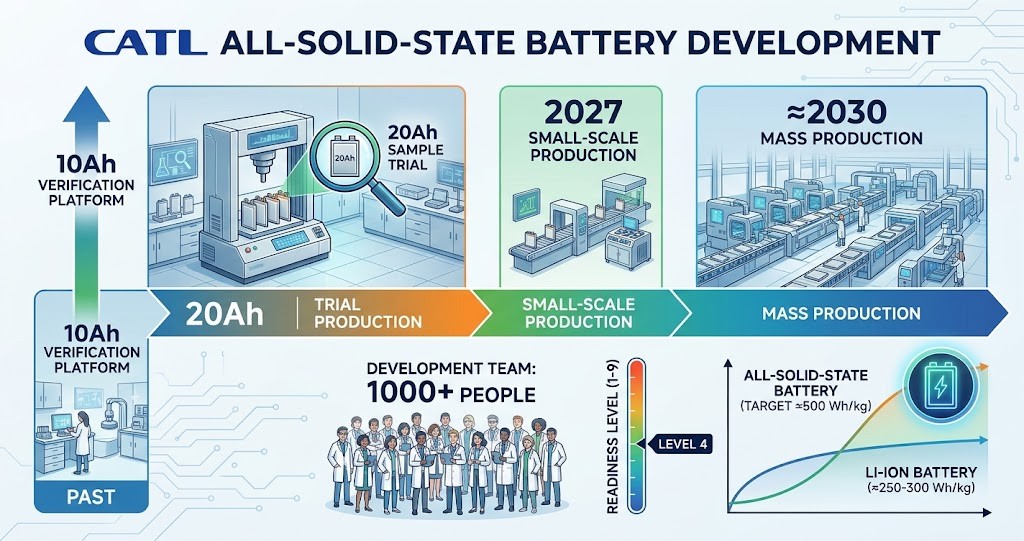
- 開発ステージの移行: CATLは、従来の10Ahクラスの検証プラットフォームから、20Ahのサンプル試験フェーズへと開発を進めました。
- ロードマップ: 2027年に少量生産を開始し、2030年頃の大規模生産(量産)を計画しています。
- 開発体制と目標値: 1,000人以上の開発チームを擁し、目標とするエネルギー密度は約500 Wh/kgに設定されています。
- 現在の技術評価: CATLのロビン・ゼン会長は、同社の固体電池技術を9段階の準備段階評価において「レベル4」と位置づけています。
技術的課題と注目のポイント
- 硫化物系電解質の課題
- CATLが採用する可能性のある硫化物系電解質は、リチウムイオンの伝導性に優れる一方、充放電時の膨張・収縮による界面の損傷や接触抵抗の増加といった課題があります。
- また、水分と反応して有毒な硫化水素(H2S)が発生するリスクがあるため、製造時や取り扱い時に厳格な湿気対策が求められます。
- 高エネルギー密度(500 Wh/kg)実現のハードル
- この高いエネルギー密度をセルレベルで達成するためには、リチウム金属アノードやアノードレス設計など、次世代の高度なアノード構造の採用が必要になると見られています。
- 総合的な性能の証明
- エネルギー密度の高さだけでなく、実際の車載環境に耐えうる耐久性、製造歩留まり、コスト競争力、そして安全性を商業ベースでクリアしていく必要があります。
競合他社とのスケジュール比較
全固体電池の実用化を目指す主なメーカーの動向は以下の通りです。
| 企業名 | 目標時期 | 特記事項・主な戦略 |
| CATL | 2027年(少量生産) 2030年頃(大規模生産) | 開発チーム1,000人以上、エネルギー密度約500 Wh/kgを目指す。 |
| トヨタ & 出光興産 | 2027年 〜 2028年 | 硫化物系全固体電池をEV向けに商用化することを目指す。 |
| サムスンSDI | 2027年後半 | EV開発を進めつつ、初期応用分野としてヒューマノイドロボットも視野に入れている。 |
補足情報:全固体電池と半固体電池の違い
- 全固体電池(All-Solid-State Battery): 電解質に一切の液体を使用せず、すべて固体材料で構成されるバッテリーです。高い安全性と高エネルギー密度が期待される一方、製造技術の難易度が高くなります。
- 半固体電池(Semi-Solid Battery): 電解質の一部に液体成分を含むハイブリッド型のバッテリーです。定義や構成はメーカーごとに異なりますが、全固体電池に比べると現行の液体リチウムイオン電池の製造ラインを流用しやすいという特徴があります。ただし、半固体電池での成功が、そのまま全固体電池特有の課題(界面の安定性や耐久性など)の完全な解決を意味するわけではありません。
CATL Advances 20Ah Solid-State Battery Cells Targeting 2027 Prototype Launch: The Challenge of 500 Wh/kg Energy Density and Technical Hurdles
CATL has taken a new step forward in the field of all-solid-state batteries. This article organizes the latest trends, such as the launch of sample testing with 20Ah cells and the challenge of higher energy density, and summarizes them clearly with additional related information, including competitor movements and technical background.
Latest Trends in CATL’s Solid-State Battery Development
- Transition in Development Stage: CATL has advanced its development from the conventional 10Ah-class verification platform to the 20Ah sample testing phase.
- Roadmap: Small-scale production is planned for 2027, followed by large-scale production (mass production) around 2030.
- Development Team and Target Values: Supported by a development team of over 1,000 people, the target energy density is set at approximately 500 Wh/kg.
- Current Technical Assessment: CATL Chairman Robin Zeng has positioned the company’s solid-state battery technology at “Level 4” on a 9-stage readiness level assessment.
Technical Challenges and Key Points
- Challenges of Sulfide-Based Electrolytes
- While sulfide-based electrolytes potentially adopted by CATL offer excellent lithium-ion conductivity, they face challenges such as interface damage and increased contact resistance caused by expansion and contraction during charging and discharging.
- In addition, because reacting with moisture risks generating toxic hydrogen sulfide (H2S), strict moisture control measures are required during manufacturing and handling.
- Hurdles to Achieving High Energy Density (500 Wh/kg)
- Achieving this high energy density at the cell level is expected to require the adoption of advanced next-generation anode structures, such as lithium metal anodes or anode-free designs.
- Proving Comprehensive Performance
- Beyond high energy density, batteries must commercially clear durability, manufacturing yield, cost competitiveness, and safety under actual in-vehicle operating environments.
Schedule Comparison with Competitors
The movements of major manufacturers aiming to commercialize all-solid-state batteries are as follows:
| Company Name | Target Timeline | Special Notes & Main Strategies |
|---|---|---|
| CATL | 2027 (Small-scale production) Around 2030 (Large-scale production) | Employs a development team of over 1,000, targeting an energy density of approximately 500 Wh/kg. |
| Toyota & Idemitsu Kosan | 2027 〜 2028 | Aims to commercialize sulfide-based all-solid-state batteries for EVs. |
| Samsung SDI | Latter half of 2027 | Continuing EV development while identifying humanoid robots as an initial application field. |
Supplementary Information: Differences Between All-Solid-State and Semi-Solid Batteries
- All-Solid-State Battery: A battery that uses no liquid whatsoever in the electrolyte and is composed entirely of solid materials. While high safety and high energy density are expected, manufacturing technology is highly difficult.
- Semi-Solid Battery: A hybrid-type battery containing liquid components in part of the electrolyte. Although definitions and configurations vary by manufacturer, semi-solid batteries have the characteristic of being easier to adapt from existing liquid lithium-ion battery manufacturing lines compared to all-solid-state batteries. However, success in semi-solid batteries does not automatically mean the complete resolution of challenges specific to all-solid-state batteries, such as interface stability and durability.
コメント