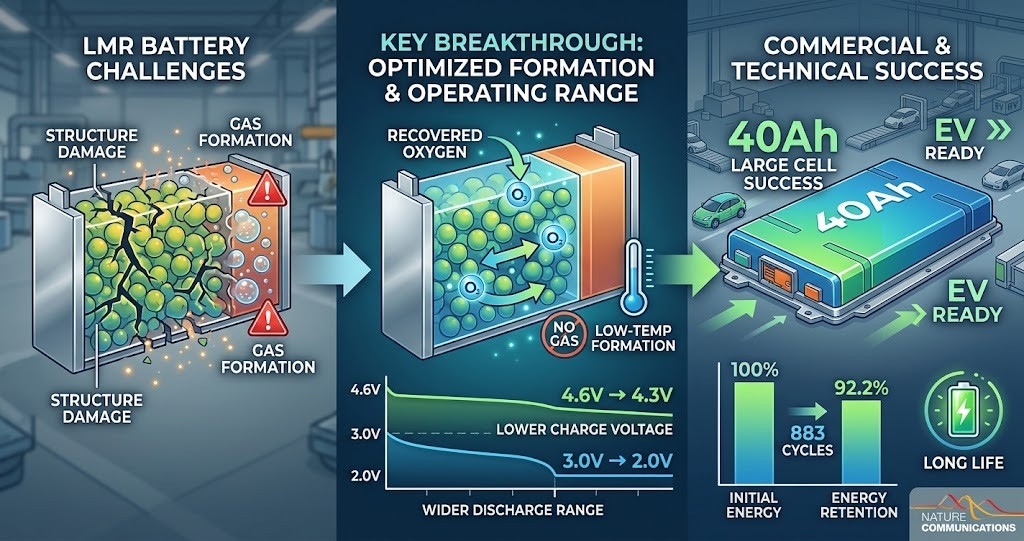
LG Energy Solutionとソウル大学校の研究チームが、次世代バッテリーとして期待される「リチウムマンガンリッチ(LMR)電池」の商用化に向けた大きな課題を解決しました。本記事の要点と、技術的・市場的な背景情報を加えてまとめています。
要約と関連解説
1. 今回の技術成果の要点
- 難題の解決: 充放電時に発生する内部構造の損傷と「ガス発生」を抑制することに成功しました。
- 運転条件の最適化:
- 充電上限電圧を従来の4.6 Vから4.3 Vに引き下げ、放電下限電圧を3.0 Vから2.0 Vまで拡大。
- 酸素還元率を86 %から97 %へと大幅に向上させ、酸素をほぼ元の状態へ回復可能にしました。
- 活性化(Formation)工程で温度を下げる手法を導入し、ガス発生を大幅に抑え込んでいます。
- 実用サイズの検証: 実験室レベルの小型セルではなく、電気自動車(EV)にそのまま搭載できる40 Ah級の大型セルで効果を実証。
- 優れた長寿命性能: 883回の充放電サイクル後も、初期エネルギーの92.2 %を維持しました。
- 学術的評価: 本研究成果は国際学術誌「Nature Communications」に掲載されました。
2. 関連情報・背景解説
なぜLMR電池が注目されるのか?
現在主流のニッケル・コバルト・マンガン(NCM)三元系電池は、エネルギー密度が高い反面、コバルトのコスト高さとサプライチェーンリスクが課題となっています。コバルトは産出がコンゴ民主共和国などに偏っており、人権問題や地政学リスクが絶えません。
LMR(Lithium-Manganese-Rich)電池は、高価なコバルトを不使用(コバルトフリー)とし、安価で豊富なマンガンを主原料とします。金属イオンだけでなく材料内部の「酸素」まで電気化学反応(アニオン酸化還元)に活用するため、NCMを超える高エネルギー密度と大幅なコスト削減を両立できる「ポストNCM」の有力候補です。
なぜガス発生の克服が重要だったのか?
LMR電池は高電圧で充電する際、正極材中の酸素が酸化されます。これが放電時に十分還元されないと、酸素ガスとして放出されてしまいます。
密閉されたEV用大型セル内部でガスが発生すると、セル膨張、内部圧力の上昇、電解液の枯渇、急速な性能劣化を引き起こし、最悪の場合は安全上の懸念に繋がります。今回の研究は、新材料を追加するのではなく電圧制御と工程プロトコルの工夫のみでこの課題をクリアしたため、既存の製造ラインへ早期に応用しやすいという強みがあります。
EV市場へのインパクトと展望
EV市場では現在、安価なリン酸鉄リチウム(LFP)電池と、高航続距離を実現するNCM電池への二極化が進んでいます。LMR電池が商用化されれば、「LFP並みの低コスト」と「NCM並み(あるいはそれ以上)の航続距離」を同時に達成できるため、次世代EVの価格破壊と普及を加速させるキーテクノロジーとなると期待されています。
今後は、量産レベルでの工程最適化や、さらに長期にわたる信頼性・安全性の検証が実用化に向けたステップとなります。
出典:https://finance.biggo.jp/news/b738fe09-005a-4f93-9eba-2fa68f4d8bf3
LG Energy Solution Overcomes Gas Generation Issue in LMR Batteries: Achieving 92.2% Capacity Retention Over 883 Cycles in 40 Ah Large-Format Cells
A joint research team from LG Energy Solution and Seoul National University has resolved a major hurdle toward the commercialization of Lithium-Manganese-Rich (LMR) batteries, a promising next-generation battery technology. Below is a summary of the key technical takeaways alongside relevant technical and market context.
Summary and Contextual Overview
- Key Technical Breakthroughs
- Solution to a Major Challenge: Successfully suppressed internal structural degradation and gas generation occurring during charge-discharge cycles.
- Optimization of Operating Conditions:
- Reduced upper cutoff voltage from 4.6 V to 4.3 V and lowered lower cutoff voltage from 3.0 V to 2.0 V.
- Significantly increased oxygen reduction efficiency from 86% to 97%, enabling oxygen to recover almost completely to its original state.
- Introduced a temperature reduction step during the formation process, effectively curbing gas evolution.
- Validation in Commercial-Scale Cells: Demonstrated efficacy not in small laboratory coin cells, but in 40 Ah large-format cells suitable for direct integration into electric vehicles (EVs).
- Outstanding Cycle Life Performance: Retained 92.2% of initial energy capacity after 883 charge-discharge cycles.
- Academic Recognition: The study was published in the international scientific journal Nature Communications.
- Related Context and Background Analysis
Why Are LMR Batteries Drawing Attention? The currently dominant nickel-cobalt-manganese (NCM) ternary batteries offer high energy density, but suffer from high cobalt costs and supply chain vulnerabilities. Cobalt production is heavily concentrated in regions like the Democratic Republic of the Congo, facing persistent human rights and geopolitical concerns.
LMR batteries eliminate expensive cobalt entirely (cobalt-free) and utilize low-cost, abundant manganese as their primary raw material. By involving not only transition-metal cations but also lattice oxygen anions in the electrochemical reactions (anionic redox), LMR cathodes achieve energy densities exceeding standard NCM at significantly reduced costs, making them a leading “post-NCM” candidate.
Why Was Overcoming Gas Generation Critical? When LMR batteries are charged at high voltages, oxygen anions in the cathode lattice undergo oxidation. If this oxidized oxygen is not fully reduced during discharge, it releases as oxygen gas.
Inside sealed, large-format EV cells, gas generation leads to swelling, internal pressure buildup, electrolyte depletion, and rapid performance degradation, raising potential safety concerns. A major advantage of this study is that it solves this challenge purely through voltage tuning and process protocol design without introducing new additive materials, facilitating easier adaptation to existing manufacturing lines.
EV Market Impact and Future Outlook The EV battery market is currently polarizing into low-cost lithium iron phosphate (LFP) batteries and long-range NCM batteries. If commercialized, LMR batteries could deliver both LFP-level cost efficiency and NCM-level (or higher) driving range, positioning them as a key technology to drive down EV costs and accelerate adoption.
Future steps toward full commercial deployment will involve further process optimization at mass-production scale and long-term reliability and safety evaluations.
コメント