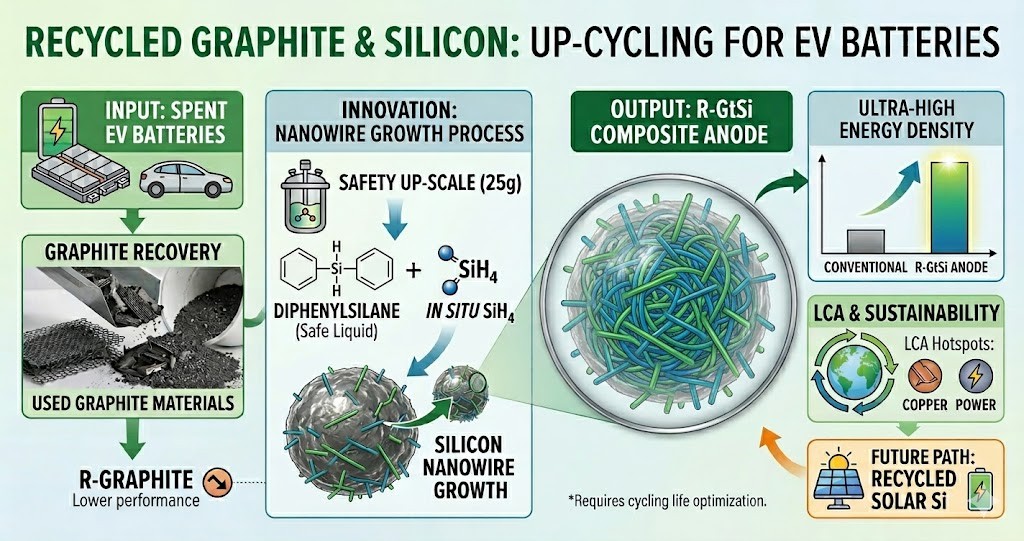
電気自動車(EV)市場の急拡大に伴い、リチウムイオン電池(LIB)のさらなる「高エネルギー密度化」と、資源の「持続可能性(リサイクル)」の両立が世界的な最優先課題となっています。特に負極(マイナス極)材料として主流の黒鉛(グラファイト)は需要が激増していますが、欧州の新しい電池規則(EU 2023/1542)が示す通り、使用済み電池からの効率的な回収と再利用が強く求められています。
本研究は、使用済み電池からリサイクルされた黒鉛を単に再利用するだけでなく、次世代の超高容量材料である「シリコン(Si)」と複合化させ、より高性能なアノード(負極)材料へとアップサイクル(価値を高めるリサイクル)する技術に関するものです。実験室レベル(数百ミリグラム)にとどまっていた合成プロセスを「25グラム規模」へと安全にスケールアップし、実際の工場に近い製造ライン(ロールツーロール方式)でのセル試作、さらには環境負荷を評価するライフサイクルアセスメント(LCA)までを網羅した、産業化を見据えた革新的な研究成果です。
1. 研究の背景と目的:なぜリサイクル黒鉛とシリコンなのか?
シリコンという「ハイリターン・ハイリスク」な材料
現在の黒鉛負極(理論容量 372 mAh g)に対し、シリコン(Si)は約3579 mAh gという10倍近い圧倒的な理論容量を持ちます。しかし、リチウムを吸蔵した際に約280パーセントもの猛烈な体積膨張を起こし、材料が微粉化して電池がすぐに劣化するという致命的な欠点があります。
解決策としての「グラファイト-シリコン(GtSi)複合材料」
黒鉛の構造内にナノサイズのシリコンワイヤ(SiNW)を直接成長させることで、シリコンの膨張を黒鉛がクッションのように緩和します。本研究では、シリコンを重量比20パーセント混合し、従来の倍にあたる約1000 mAh gの容量を目指しました。
リサイクル黒鉛の課題
正極のレアメタル(コバルトやニッケルなど)に比べ、黒鉛は経済的価値が低いためリサイクルが遅れていました。また、リサイクルされた黒鉛は純度が低く、新品に比べて性能が劣る(本研究でも初期効率が新品の88パーセントに対し80.5パーセントに低下)という課題があります。本研究では、このリサイクル黒鉛をベースに用いています。
2. 安全なシリコンナノワイヤ成長技術の確立(スケールアップ)
実験室でシリコンナノワイヤを大量合成(25グラム規模)するにあたり、最大の障壁は「安全性」です。
危険なシランガスの代わりに「ジフェニルシラン」を採用
工業的にはシランガス(SiH4)が使われますが、空気中で自発的に発火する極めて危険なガスであり、一般的な研究室では扱えません。そこで研究チームは、常温で安全に保管できる液体有機シラン「ジフェニルシラン」を採用しました。これを加熱(350から435度)することで、反応器の内部で安全にシランガスをその場発生(in situ生成)させます。
化学ダイナミクスの解明と圧力制御
ジフェニルシランの熱分解(不均化反応)の速度論と熱力学パラメータを詳しく解析し、安全な運用限界を明確にしました。
- 密閉型から「半開放型」反応器への移行: 反応中に発生する副生成物の水素(H2)ガスによる異常高圧リスクを避けるため、安全弁(スピルウェイ)を備えた半開放型システムを構築。内部圧力を10 bar未満に抑えつつ、投入量を25倍にスケールアップすることに成功しました。
- リサイクル黒鉛の不純物の影響: リサイクル黒鉛に含まれる微量のニッケル(Ni)やアルミニウム(Al)といった不純物が、シリコンの成長を邪魔しないことを確認しました。
3. ロールツーロール製造と電池性能テスト
合成した複合材料(新品黒鉛ベースの n-GtSi、リサイクル黒鉛ベースの R-GtSi)を用い、実際の電池工場と同じ「ロールツーロール方式」の連続コーティング機で厚い電極シートを作製しました。高ニッケル正極(NMC811)と組み合わせた単層ポーチセル(40 mAh)を組み立てて評価を行いました。
驚異的な初期エネルギー密度
試作したセルは、電気化学コアレベルで984 Wh Lという極めて高い体積エネルギー密度を実証しました。これは従来の黒鉛負極の2倍、最新のシリコン負極と比較しても50パーセント高い値です。
サイクル劣化の原因特定
一方で、充放電を繰り返すと容量が急激に低下する課題も浮き彫りになりました。
- 原因は「クッション性の不足」: 充放電に随伴するシリコンの膨張により、11サイクルで負極の多孔度が約60パーセントにまで異常増大(スカスカに変形)していました。
- 導入したリサイクル黒鉛(R-GtSi)は、新品(n-GtSi)に比べてさらに膨張が激しいことが判明しました。これは、リサイクル黒鉛の内部に元々隙間(空隙)が少なかったため、シリコンの膨張圧力を吸収しきれなかったことが原因であると推測されています。今後は、強固なバインダーの選択や炭素コーティングなどの追加対策が必要です。
4. ライフサイクルアセスメント(LCA)による環境負荷評価
「ゆりかごからゲートまで(原料採掘からセル製造まで)」の視点で、環境影響(気候変動、資源利用など)を定量的に評価しました。新規材料の開発段階からLCAデータを透明に公開することは、業界のデータギャップを埋める上で貴重な貢献です。
セル全体での環境ホットスポット
- 銅集電体(銅箔): 酸性化の47パーセント、鉱物・金属資源消費の81パーセントを占め、最大の負荷となっています(銅の採掘・精錬によるもの)。
- 電力消費: 気候変動の38パーセント、化石資源消費の50パーセントを占めています。
R-GtSi 複合材料単体での環境ホットスポット
負極材料の合成だけにフォーカスすると、シラン(SiH4)の製造プロセスが環境負荷の70パーセント以上を占めていることが分かりました。これは、金属シリコンを還元精錬する際の熱力学的コスト(莫大なエネルギー)に起因します。
持続可能な未来への提案
この環境負荷を劇的に下げるアプローチとして、研究チームは「廃棄ソーラーパネルから回収されたリサイクル・シリコン」の活用を提案しています。現在、使用済み太陽光パネルからのシリコン回収ルートが確立されつつあり、これをシランの原料やナノワイヤ成長に直接利用することで、真の循環型かつ低炭素なバッテリーサプライチェーンが実現可能になります。
5. 結論
本研究は、リサイクル黒鉛を次世代の高性能シリコン複合負極(GtSi)へと昇華させるプロセスを、25グラム規模で安全にスケールアップできることを証明しました。 サイクル寿命の維持(シリコンの膨張抑制)には課題が残るものの、超高エネルギー密度の達成、シラン代替による安全な合成プロセスの確立、そしてLCAによる将来の環境対策(リサイクルシリコンの活用提案)など、実験室の基礎研究と未来のグリーンバッテリー産業を結ぶ重要な架け橋となる成果です。
出典:https://pubs.rsc.org/en/content/articlelanding/2026/eb/d6eb00002a
[Paper Review] Energy Density of 984 Wh L Demonstrated via Composite of Recycled Graphite and Silicon
With the rapid expansion of the electric vehicle (EV) market, simultaneously achieving higher energy density in lithium-ion batteries (LIBs) and resource sustainability (recycling) has become a top global priority. In particular, demand for graphite, the mainstream material for anodes (negative electrodes), is skyrocketing. As indicated by the new European Battery Regulation (EU 2023/1542), efficient recovery and reuse from end-of-life batteries are strongly demanded.
This study introduces a technology that goes beyond merely reusing graphite recycled from spent batteries; it upcycles it into a higher-performance anode material by forming a composite with silicon (Si), a next-generation ultra-high-capacity material. This innovative research, geared toward industrialization, successfully scales up the synthesis process—previously limited to the laboratory level (hundreds of milligrams)—to a 25-gram scale. It comprehensively covers cell prototyping on a production line close to an actual factory (roll-to-roll method) and a life cycle assessment (LCA) to evaluate environmental impact.
1. Research Background and Purpose: Why Recycled Graphite and Silicon?
Silicon: A “High-Return, High-Risk” Material Compared to current graphite anodes (theoretical capacity of 372 mAh g), silicon boasts an overwhelming theoretical capacity of approximately 3579 mAh g, which is nearly 10 times higher. However, it suffers from a fatal flaw: it undergoes a massive volume expansion of about 280 percent during lithiation, causing the material to pulverize and leading to rapid battery degradation.
The Solution: Graphite-Silicon (GtSi) Composite Materials By growing nano-sized silicon nanowires (SiNWs) directly within the graphite structure, the graphite acts as a cushion to mitigate the expansion of the silicon. In this study, the team aimed for a capacity of approximately 1000 mAh g—double that of conventional anodes—by mixing silicon at a weight ratio of 20 percent.
Challenges of Recycled Graphite Compared to rare metals in cathodes (such as cobalt and nickel), recycling graphite has lagged due to its lower economic value. Additionally, recycled graphite faces the challenge of lower purity and inferior performance compared to pristine graphite (in this study, the initial efficiency dropped to 80.5 percent compared to 88 percent for the pristine material). This study utilizes this recycled graphite as its base.
2. Establishment of Safe Silicon Nanowire Growth Technology (Scale-Up)
The biggest barrier to synthesizing silicon nanowires in large quantities (25-gram scale) in a laboratory is safety.
Adopting “Diphenylsilane” Instead of Hazardous Silane Gas Industrially, silane gas (SiH4) is used, but it is an extremely hazardous gas that ignites spontaneously in air, making it unmanageable in standard laboratories. Therefore, the research team adopted diphenylsilane, a liquid organosilane that can be stored safely at room temperature. By heating it to between 350 and 435 degrees Celsius, silane gas is generated safely in situ inside the reactor.
Elucidation of Chemical Dynamics and Pressure Control The kinetics and thermodynamic parameters of the thermal decomposition (disproportionation reaction) of diphenylsilane were analyzed in detail to clarify safe operating limits.
- Transition from Closed to “Semi-Open” Reactor: To avoid the risk of abnormal high pressure caused by hydrogen (H2) gas, a byproduct generated during the reaction, a semi-open system equipped with a safety valve (スピルウェイ/spillway) was constructed. The team successfully scaled up the input by 25 times while keeping the internal pressure below 10 bar.
- Impact of Impurities in Recycled Graphite: The team confirmed that trace impurities such as nickel (Ni) and aluminum (Al) contained in the recycled graphite do not interfere with silicon growth.
3. Roll-to-Roll Manufacturing and Battery Performance Testing
Using the synthesized composite materials (n-GtSi based on pristine graphite and R-GtSi based on recycled graphite), thick electrode sheets were fabricated using a continuous roll-to-roll coating machine identical to those used in actual battery factories. Single-layer pouch cells (40 mAh) were assembled and evaluated in combination with high-nickel cathodes (NMC811).
Astonishing Initial Energy Density The prototyped cell demonstrated an extremely high volumetric energy density of 984 Wh L at the cell electrochemical core level. This value is twice that of conventional graphite anodes and 50 percent higher than the latest generation of silicon-based anodes.
Identifying the Cause of Cycle Degradation On the other hand, a challenge emerged where the capacity dropped sharply under repeated charging and discharging.
- The Cause is “Lack of Cushioning”: Due to the expansion of silicon accompanying charge and discharge, the porosity of the anode abnormally increased to about 60 percent (deforming into a spongy state) by the 11th cycle.
- It was revealed that the introduced recycled graphite (R-GtSi) expanded even more severely than the pristine material (n-GtSi). This is presumed to be because the recycled graphite inherently possessed fewer internal gaps (voids) to begin with, failing to absorb the expansion pressure of the silicon. Future additional measures, such as selecting robust binders or applying carbon coatings, are required.
4. Environmental Impact Evaluation via Life Cycle Assessment (LCA)
Environmental impacts (climate change, resource use, etc.) were quantitatively evaluated from a “cradle-to-gate” perspective (from raw material extraction to cell manufacturing). Disclosing LCA data transparently right from the development stage of novel materials is a valuable contribution to filling data gaps in the industry.
Environmental Hotspots Across the Entire Cell
- Copper Collector (Copper Foil): Accounts for 47 percent of acidification and 81 percent of mineral and metal resource consumption, representing the largest burden due to the energy- and emission-intensive processes of copper extraction and refining.
- Electricity Consumption: Dominates climate change at 38 percent and fossil resource use at 50 percent.
Environmental Hotspots of the R-GtSi Composite Alone Focusing solely on the synthesis of the anode material, the manufacturing process of silane (SiH4) accounted for over 70 percent of the environmental impact. This is attributed to the high thermodynamic cost (massive energy consumption) associated with the reduction and refining of metallic silicon.
Proposals for a Sustainable Future As an approach to drastically reduce this environmental burden, the research team proposes utilizing “recycled silicon recovered from end-of-life solar panels.” Currently, recovery routes for silicon from spent photovoltaic panels are being established. By directly utilizing this as a raw material for silane or for nanowire growth, a truly circular and low-carbon battery supply chain becomes viable.
5. Conclusion
This study proves that the process of elevating recycled graphite into a next-generation, high-performance silicon composite anode (GtSi) can be safely scaled up to a 25-gram scale. Although challenges remain in maintaining cycle life (suppressing silicon expansion), this work serves as an important bridge between laboratory innovation and the future green battery industry by achieving ultra-high energy density, establishing a safe synthesis process via silane substitution, and offering future environmental countermeasures through LCA (proposing the use of recycled silicon).
コメント