全南大学校の研究チームが発表した次世代「ナトリウム金属電池」について、ご要望に合わせて正極材料や電解液の成分、重合プロセスなどの技術的な詳細をより深掘りして分かりやすくまとめ直しました。
1. 電解液と電解質の技術詳細(組成と重合プロセス)
今回の技術の核心は、液体から固体へと変化する特殊な電解質設計にあります。
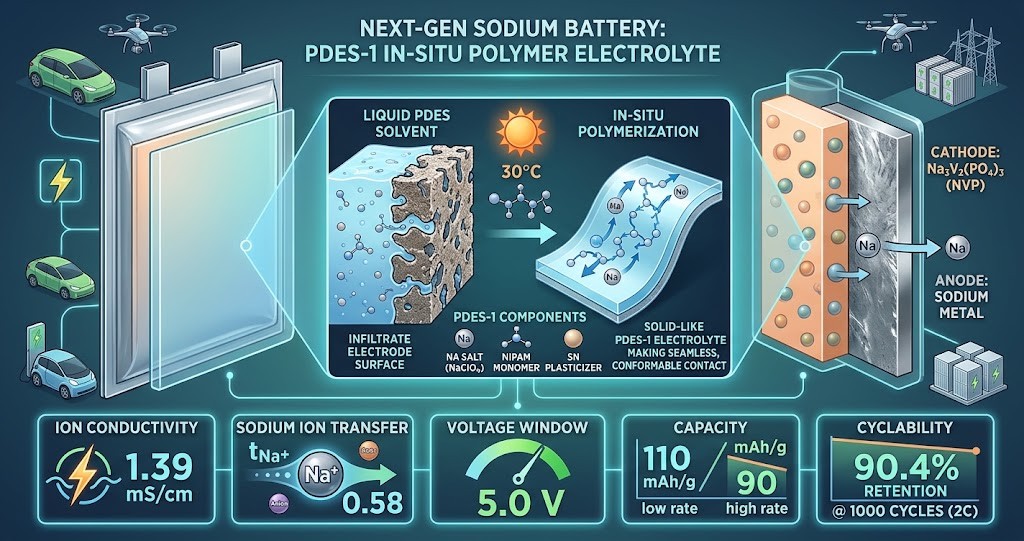
- 開発された電解質名:PDES-1(重合性深共晶溶媒 / PDESを利用)
- 3つの主な構成成分:
- ナトリウム塩(過塩素酸ナトリウム / NaClO4):電荷の運び手となるナトリウムイオンを供給します。
- 重合性モノマー(N-イソプロピルアクリルアミド / NIPAM):分子内のカルボニル基(C=O)を介してナトリウムイオンと配位し、塩の解離を促進すると同時に、高分子マトリックスの骨格を形成します。
- 可塑剤(スクシノニトリル / SN):高分子鎖の柔軟な運動性を維持し、マトリックス内部でのイオン移動をサポートします。
- 原位置(in-situ)重合プロセス: 注入時は液体の深共晶溶媒であるため、電極表面の微細な凹凸や細孔の内部までスムーズに浸透します。その後、電池内部で加熱して重合反応を起こすことで、柔軟な高分子マトリックスを持つ電解質へと変化させ、固体電解質で問題になりやすい「電極との接触不良」を軽減しています。
2. 電極材料の構成
- 正極材料:リン酸バナジウムナトリウム(Na3V2(PO4)3、通称 NVP)が使用されています。
- 負極材料:一般的な硬質炭素(ハードカーボン)ではなく、理論容量の高い金属ナトリウムそのものが負極として採用されています。
- 界面保護:電解質と電極の間に安定した保護層が形成されることで、充放電時に発生しやすいデンドライト(針状結晶)の成長や副反応が効果的に抑制されます。
3. 主要な電気化学特性とパフォーマンス
実験室規模のセルで計測された優れた物性値と性能は以下の通りです。
- イオン伝導度:30℃において 1.39 mS/cm を記録。
- ナトリウムイオン輸率:0.58(一般的な液体電解液の0.2〜0.4程度を大きく上回り、電荷輸送の過半数をナトリウムイオンが担うことで濃度分極を抑制)。
- 電位窓:5.0 V という広い電位窓を確保し、高電圧で作動する正極材料への適性を示しています。
- 放電容量とレート特性:
- 0.1Cの低レート時:初期放電容量 110.2 mAh/g(クーロン効率は約99%に迫る水準)
- 5Cの高レート時:放電容量 90 mAh/g を維持(約18%の減少にとどまる優れた高速充放電特性)
- 長期耐久性:2Cの充放電レートで1,000サイクルを繰り返した後も、初期容量の 90.4% を維持。
4. 安全性と実用化に向けた技術的課題
- 安全性:炎にさらしても着火しにくい高い難燃性を示し、パウチセルにハサミを入れて外装を切断しても発火せずにLEDの点灯が維持される実験結果が報告されています。
- 残された技術的ハードル:
- 大型化と厚膜電極への適応:数ミリグラムの薄い電極を使った小型実験セルでの結果であり、厚く高密度な電極を持つ大型セルでも同様に重合液を均一に浸透させられるか。
- 電解液量の最適化:実験室条件よりも電解液量を減らした状態や、極薄の金属ナトリウム箔を用いた場合でも高い寿命が再現できるか。
出典:https://xenospectrum.com/polymer-electrolyte-sodium-metal-battery-durability/
Breaking Through the Barriers of Next-Generation “Sodium Metal Batteries”! The New Technology Maintaining 90.4% Capacity Even After 1,000 Charge-Discharge Cycles
Regarding the next-generation “sodium metal batteries” announced by the research team at Chonnam National University, we have reorganized and summarized the technical details—such as the cathode material, electrolyte components, and polymerization process—in an easy-to-understand manner based on your request.
1. Technical Details of the Electrolyte and Electrolysis (Composition and Polymerization Process)
The core of this technology lies in a special electrolyte design that transitions from liquid to solid.
- Developed Electrolyte Name: PDES-1 (utilizing Polymerizable Deep Eutectic Solvents / PDES)
- Three Main Components:
- Sodium Salt (Sodium Perchlorate / NaClO4): Supplies sodium ions, which act as charge carriers.
- Polymerizable Monomer (N-Isopropylacrylamide / NIPAM): Coordinates with sodium ions via carbonyl groups (C=O) within the molecule to promote salt dissociation while simultaneously forming the backbone of the polymer matrix.
- Plasticizer (Succinonitrile / SN): Maintains the flexible mobility of the polymer chains and supports ion transport within the matrix.
- In-Situ Polymerization Process: Because it is a liquid deep eutectic solvent during injection, it smoothly permeates into the fine surface irregularities and pores of the electrodes. Afterward, a polymerization reaction is triggered by heating inside the battery, transforming it into an electrolyte with a flexible polymer matrix. This mitigates “poor electrode contact,” which is a common issue with solid electrolytes.
2. Electrode Material Configuration
- Cathode (Positive Electrode) Material: Sodium vanadium phosphate (Na3V2(PO4)3, commonly known as NVP) is used.
- Anode (Negative Electrode) Material: Instead of conventional hard carbon, metallic sodium itself—which possesses a high theoretical capacity—is adopted as the anode.
- Interface Protection: The formation of a stable protective layer between the electrolyte and the electrode effectively suppresses the growth of dendrites (needle-like crystals) and side reactions that typically occur during charge and discharge.
3. Key Electrochemical Properties and Performance
The excellent physical properties and performance measured in laboratory-scale cells are as follows:
- Ionic Conductivity: Recorded 1.39 mS/cm at 30°C.
- Sodium Ion Transference Number: 0.58 (significantly higher than the typical 0.2–0.4 range of conventional liquid electrolytes, suppressing concentration polarization by having sodium ions account for the majority of charge transport).
- Potential Window: Secures a wide potential window of 5.0 V, demonstrating suitability for high-voltage operating cathode materials.
- Discharge Capacity and Rate Capability:
- At low rate (0.1C): Initial discharge capacity of 110.2 mAh/g (columbic efficiency approaching approx. 99%).
- At high rate (5C): Maintained a discharge capacity of 90 mAh/g (an excellent high-speed charge-discharge characteristic limited to only an ~18% decrease).
- Long-Term Durability: Maintained 90.4% of the initial capacity even after repeating 1,000 cycles at a 2C charge-discharge rate.
4. Safety and Technical Challenges Toward Practical Application
- Safety: Exhibited high flame retardancy, resisting ignition even when exposed to flame. Experimental results reported that LEDs continued to light up without ignition even when pouch cells were cut open with scissors through their outer casing.
- Remaining Technical Hurdles:
- Scaling Up and Adaptation to Thick Electrodes: These are results from small experimental cells using thin electrodes of a few milligrams. It remains to be seen whether the polymerization liquid can be uniformly permeated into larger cells with thick, high-density electrodes.
- Optimizing Electrolyte Volume: Whether high lifespan can be replicated under conditions with reduced electrolyte volumes compared to laboratory settings, or when using ultra-thin metallic sodium foil.

コメント