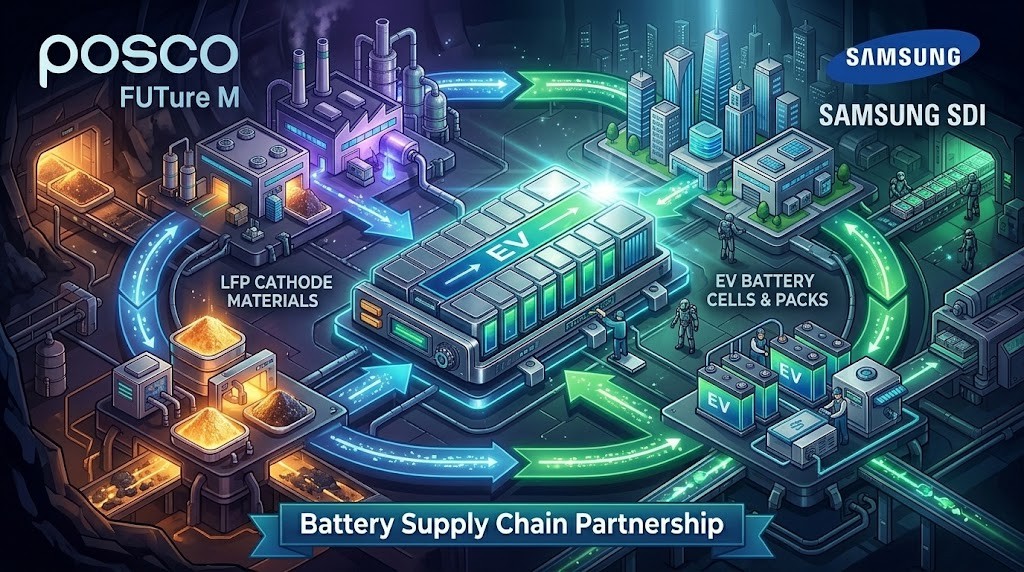
韓国の電池材料大手であるPOSCO Future M(ポスコ・フューチャーM)は2026年10月6日、Samsung SDI(サムスンSDI)との間で、総額約6兆ウォン規模に上るリン酸鉄リチウム(LFP)正極材をはじめとした二次電池材料の長期包括供給契約を締結しました。従来の三元系(NCA)単一の供給関係から、LFPやLMO(リチウムマンガン酸化物)、合成黒鉛負極材へと供給範囲を拡大し、材料の「ワンストップ供給体制」を構築することで、両社のグローバル競争力強化と地政学的リスクへの対応を進めます。
1. 契約の概要と供給規模の大幅拡大
- 契約金額・規模: 総額約6兆ウォン規模の包括契約。2026年8月に両社間で事前合意していた供給量(2027年~2032年で19万トン)の2倍以上に取引量が大幅拡大。
- 供給製品ポートフォリオの多角化:
- 既存の供給対象: 三元系(NCA)正極材
- 新たに追加・拡大する対象: LFP正極材、LMO正極材、合成黒鉛負極材
- 事業インパクト: 供給ラインナップの拡充により、POSCO Future Mの対Samsung SDI供給量は従来想定より約45パーセント増加し、主要サプライヤーとしての地位を確立します。
2. 両社の戦略的メリットと目的
- Samsung SDI(サプライチェーンの安定化): 米国のFEOC(懸念外国団体)規制等を見据え、非PFE(非禁止外国企業)であるPOSCO Future Mから正極材・負極材を一元的に調達することで、北米・欧州市場における規制リスクを回避し、材料調達網を安定化させます。
- POSCO Future M(稼働率と事業予測可能性の向上): 大規模な確定受注量を確保することで、工場の稼働率を高め、将来の設備投資や原材料調達の計画精度と効率を大幅に向上させます。
- ポスコグループのバリューチェーン統合: ポスコグループが掲げる「戦略資源」の垂直統合(リチウム塩湖、黒鉛鉱山、正極・負極材製造)を活用し、韓国国内で唯一となる正極材・負極材の同時供給プレイヤーとしての優位性を固めます。
3. 【関連情報・背景の追加】LFP市場の急速拡大と非中国系サプライチェーンの意義
- EV・ESS市場におけるLFP需要の急増: 従来の高性能EV向け三元系(NCM/NCA)電池に加え、コスト面・安全性・サイクル寿命に優れたLFP電池の需要が電気自動車(EV)の廉価モデルや産業用・電力網用エネルギー貯蔵システム(ESS)向けに急拡大しています。
- 韓国バッテリー産業(K-Battery)の「LFPシフト」: これまで韓国の電池・材料メーカーは三元系に強みを持っていましたが、中国企業が独占的シェアを持つLFP市場に対抗するため、自社でのLFP材料開発およびセル量産体制の構築を急速に進めています。
- 負極材(ハードカーボン・合成黒鉛)とワンストップ体制: 負極材市場も中国依存度が高い分野ですが、POSCO Future Mは人造(合成)黒鉛および天然黒鉛の自社生産化を進めています。正極材(LFP/LMO/NCA)と負極材(合成黒鉛)を単一のメーカーからパッケージ調達(ワンストップ供給)できる体制は、バッテリーセルメーカーにとって品質管理および規制適合の両面で極めて大きなアドバンテージとなります。
出典:https://www.poscofuturem.com/en/pr/view.do?num=1051
[K-Battery] POSCO Future M and Samsung SDI Form Strategic Partnership! Moving Toward One-Stop Supply of Battery Materials Including LFP and Synthetic Graphite
On October 6, 2026, POSCO Future M, a major South Korean battery materials manufacturer, announced that it has signed a long-term comprehensive supply agreement with Samsung SDI for secondary battery materials, centered on lithium iron phosphate (LFP) cathode materials, valued at approximately 6 trillion won in total. By expanding the supply scope from the conventional single ternary (NCA) relationship to LFP, lithium manganese oxide (LMO), and synthetic graphite anode materials, and building a “one-stop supply system” for materials, both companies aim to strengthen their global competitiveness and address geopolitical risks.
1. Overview of the Agreement and Massive Expansion in Supply Scale
- Contract Value and Scale: A comprehensive agreement valued at approximately 6 trillion won in total. The transaction volume has expanded significantly to more than double the supply volume initially agreed upon between the two companies in August 2026 (190,000 tons from 2027 to 2032).
- Diversification of the Supply Product Portfolio:
- Existing supply target: Ternary (NCA) cathode materials
- Newly added and expanded targets: LFP cathode materials, LMO cathode materials, and synthetic graphite anode materials
- Business Impact: Through the expansion of the supply lineup, POSCO Future M’s supply volume to Samsung SDI will increase by approximately 45 percent compared to initial projections, cementing its position as a primary supplier.
2. Strategic Benefits and Objectives for Both Companies
- Samsung SDI (Stabilization of Supply Chain): Anticipating U.S. FEOC (Foreign Entity of Concern) regulations and other factors, Samsung SDI can procure cathode and anode materials centrally from POSCO Future M, a non-FEEC (non-prohibited foreign entity) supplier, to mitigate regulatory risks in the North American and European markets and stabilize its material procurement network.
- POSCO Future M (Improvement of Operating Rates and Business Predictability): By securing large-scale confirmed orders, POSCO Future M can raise factory operating rates and drastically improve the planning accuracy and efficiency of future capital investments and raw material procurement.
- Integration of the POSCO Group Value Chain: By leveraging the vertical integration of “strategic resources” promoted by the POSCO Group (such as lithium salt lakes, graphite mines, and cathode/anode material manufacturing), POSCO Future M will solidify its competitive edge as South Korea’s sole simultaneous supplier of both cathode and anode materials.
3. Significance of Rapid LFP Market Expansion and Non-Chinese Supply Chains
- Surging LFP Demand in EV and ESS Markets: In addition to conventional high-performance ternary (NCM/NCA) batteries for EVs, demand for LFP batteries—which excel in cost-effectiveness, safety, and cycle life—is expanding rapidly for affordable EV models as well as industrial and grid-scale energy storage systems (ESS).
- The “LFP Shift” of the South Korean Battery Industry (K-Battery): While South Korean battery and material makers have traditionally specialized in ternary batteries, they are now rapidly advancing in-house LFP material development and cell mass-production systems to compete in the LFP market monopolized by Chinese companies.
- Anode Materials (Hard Carbon / Synthetic Graphite) and One-Stop System: The anode material market is also heavily dependent on China, but POSCO Future M is advancing in-house production of artificial (synthetic) and natural graphite. The ability to procure cathode materials (LFP/LMO/NCA) and anode materials (synthetic graphite) as a package from a single manufacturer (one-stop supply) provides battery cell makers with an extremely significant advantage in both quality control and regulatory compliance.
コメント