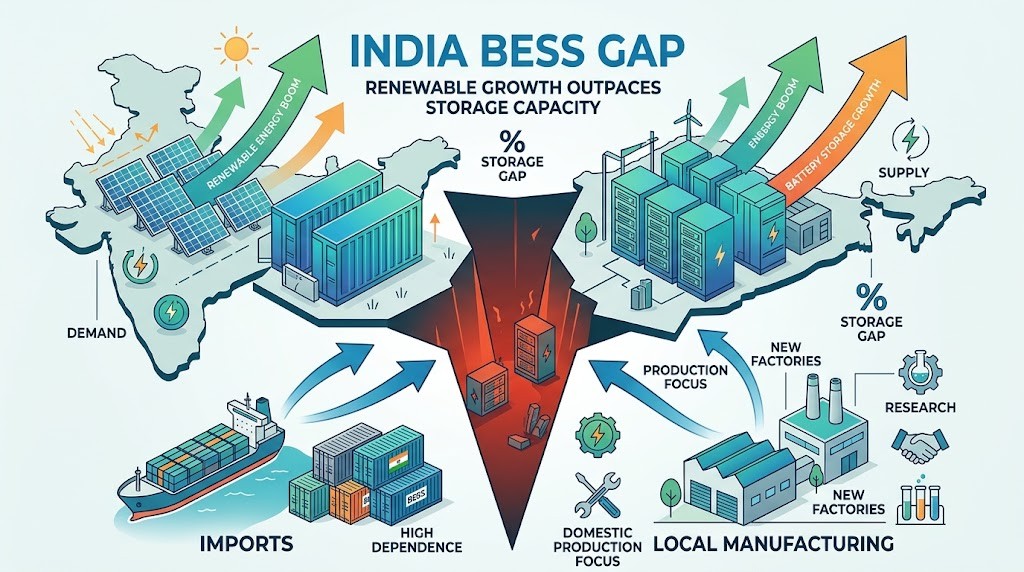
再生可能エネルギーへの転換を急速に進めるインドにおいて、電力の安定供給を支える蓄電システム(BESS)の需要が爆発的に高まっています。しかし、市場需要が急増する一方で、バッテリーセルをはじめとする主要部品の国内生産体制の構築は大幅に遅れており、需要と供給(現地化)の間に深刻なギャップが生じています。インド政府が掲げる「自立したインド」の実現に向け、どのような政策と課題が存在するのか、現状と今後の展望をまとめました。
要約:インドのエネルギー貯蔵ブームと現地化の懸念
1. 市場の急成長と野心的な政策目標
- 需要の急伸: 2026年のインドにおける年間エネルギー貯蔵容量の増加量は10 GWhを超え、入札総額も100 GWhを超える見込みです。
- 背景にある出力制御問題: 2026年4月〜6月の期間中、送電網が吸収できず抑制された太陽光発電量は8,133 GWhに達し、昼間の余剰電力と夕方の電力不足という構造的ミスマッチが深刻化しています。
- 義務化の動き: 中央電力庁(CEA)の規則案により、2027年7月以降に稼働する地上設置型太陽光および陸上風力発電所に対し、設置容量の10パーセント以上(最低2時間)の蓄電設備併設を義務付ける方針が示されています(2029年7月以降は最低4時間に延長予定)。
2. 国内生産能力(現地化)とのギャップ
- 生産目標の遅れ: 政府は2021年に50 GWhの先進化学電池(ACC)生産を目指すインセンティブ制度(PLI)を開始しましたが、2026年半ば時点で稼働している生産能力はわずか3 GWh(目標の10分の1未満)にとどまります。
- 主要部品の海外依存: 導入が進むコンテナ型の蓄電システム内部のバッテリーセルなど、主要部品のほぼすべてを国外からの輸入に頼っているのが現状です。
3. ギャップ解消へ向けた3つの取り組み(柱)
- 第1の柱:PLI制度の再調整と定置型へのシフト
- 遅延に対する罰則規定を設けつつも、計画の延期やインセンティブ適格期間の延長(2031年まで)を承認。
- 未割り当ての10 GWh分について、EV用ではなく「定置型エネルギー貯蔵向け」に特化した国際入札を実施(2026年11月入札期限)。
- 第2の柱:上流サプライチェーン(材料)の強化
- 正極材、負極材、電解質、セパレータ、銅箔などの主要5材料に対し、約1300億インドルピー(約13億7000万米ドル)規模の奨励制度を策定中。
- 太陽光分野で導入されている認証制度(ALMM)に類似した、バッテリー部品の認証枠組みを検討。
- 第3の柱:需要面からの現地調達(DVA)の推進
- 補助金対象事業(VGF制度など)において、事業費の最低20パーセントを現地調達とすることを要件化。
- 現在は「輸入セル+国内パック組み立て」で基準を満たせるものの、将来的には太陽光パネルと同様に調達要件が厳格化される見通し。
4. 課題と今後の展望
- タイムラグの問題: 2027年7月からの蓄電義務化により数十 GWh規模のセル需要が発生するのに対し、大規模な国内工場が稼働するのは早くても2028年以降となる見込みです。
- ジレンマ: ギャップを埋めるために輸入に依存すれば「自立したインド」政策に反し、かといって厳格な現地調達を強制すれば蓄電コストが上昇し、市場成長を阻害するリスクがあります。
関連情報・補足解説
- GEC-III(グリーンエネルギー回廊 第3フェーズ)
- 再生可能エネルギーで発電した電力を送電網へ統合・輸送するためのインフラ整備計画です。BESS導入に5,000億インドルピー(約52億米ドル)が割り当てられており、2032〜2033会計年度まで継続されます。
- PLI(Production Linked Incentive:生産連動型インセンティブ)制度
- インド国内での製造業振興と雇用創出を目的とした補助金政策です。対象企業が国内で生産・販売した増加分に応じてインセンティブ(補助金)が支給されます。
- VGF(Viability Gap Funding:事業性ギャップ資金)
- 経済的には重要であるものの、初期投資が大きく単体では収益化が難しいインフラプロジェクトに対し、政府が資金の一部を補助して事業性を確保させる仕組みです。
- ALMM(Approved List of Models and Manufacturers)
- インド政府が定めた「承認済みモデルおよび製造業者リスト」。政府関連の太陽光プロジェクトではこのリストに掲載された国産モジュールの使用が義務付けられており、海外製(特に中国製)製品の排除と国内産業保護に大きな役割を果たしてきました。バッテリー分野でも同様の仕組みの導入が議論されています。
- 世界のバッテリー市場におけるインドの立場
- 現在、世界のリチウムイオン電池サプライチェーンは中国が圧倒的なシェアを握っています。インドが政策のみで独自かつ競争力のあるサプライチェーンを立ち上げられるかどうかは、世界のエネルギー転換における重要なケーススタディとなっています。
Behind the 2026 India Energy Storage Boom: Surging Demand Highlights Delays in Domestic Production
In India, where the transition to renewable energy is accelerating rapidly, demand for Battery Energy Storage Systems (BESS) to support a stable power supply is skyrocketing. However, while market demand surges, the establishment of domestic manufacturing capacity for key components—particularly battery cells—is severely delayed, creating a critical gap between demand and local supply (localization). Below is a summary of the current landscape, key policies, and future outlook surrounding India’s pursuit of its “Self-Reliant India” (Atmanirbhar Bharat) initiative.
Summary: India’s Energy Storage Boom and Localization Concerns
- Rapid Market Growth and Ambitious Policy Goals
- Surge in Demand: In 2026, India’s annual addition of energy storage capacity is expected to exceed 10 GWh, with total tender volumes projected to surpass 100 GWh.
- Background Power Curtailment Issue: Between April and June 2026, 8,133 GWh of solar power generation was curtailed because the grid could not absorb it, highlighting a severe structural mismatch between daytime power surplus and evening deficits.
- Storage Mandate Push: Draft regulations from the Central Electricity Authority (CEA) propose requiring ground-mounted solar and onshore wind projects commissioning after July 2027 to co-locate storage capacity equal to at least 10 percent of installed plant capacity (for a minimum duration of 2 hours, expanding to 4 hours after July 2029).
- The Gap with Domestic Manufacturing Capacity (Localization)
- Delayed Production Targets: Although the government launched the Production Linked Incentive (PLI) scheme in 2021 targeting 50 GWh of Advanced Chemistry Cell (ACC) capacity, operational capacity reached only 3 GWh as of mid-2026—less than one-tenth of the target.
- Heavy Reliance on Imports: Almost all key components inside deployed containerized BESS units, especially battery cells, are currently imported from outside India.
- Three Key Pillars to Bridge the Gap
- First Pillar: Realigning the PLI Scheme and Shifting Focus to Stationary Storage While daily penalties are stipulated for delays, the government has acknowledged practical constraints by approving revised implementation schedules and extending incentive eligibility periods up to 2031. The unallocated 10 GWh capacity was re-tendered globally specifically for grid-scale stationary energy storage rather than electric vehicles (EVs), with a bid deadline in November 2026.
- Second Pillar: Strengthening the Upstream Supply Chain (Materials) An incentive scheme worth approximately 130 billion Indian Rupees (around 1.37 billion USD) is being formulated for five critical battery cell inputs: cathode materials, anode materials, electrolytes, separators, and copper foil. The government is also evaluating a battery component certification framework similar to the Approved List of Models and Manufacturers (ALMM) used in the solar sector.
- Third Pillar: Driving Localization Through Demand-Side Requirements Under subsidy programs like the Viability Gap Funding (VGF) scheme under the Power System Development Fund (PSDF), projects are required to source a minimum of 20 percent of total project costs locally. While this threshold can currently be met via imported cells combined with local pack assembly, procurement rules are expected to tighten progressively, following the precedent set in the solar sector.
- Key Challenges and Future Outlook
- Timeline Mismatch: The 2027 storage mandate will generate tens of GWh in cell demand, whereas large-scale domestic manufacturing capacity is not expected to come online until 2028 at the earliest.
- The Strategic Dilemma: Relying on imports to bridge the gap contradicts the “Self-Reliant India” vision. Conversely, strictly enforcing local content rules risks inflating storage costs and slowing down growth in a market that is just beginning to scale.
Related Information and Supplementary Notes
- GEC-III (Green Energy Corridor Phase III) An infrastructure program designed to integrate and transmit renewable power into the grid. It allocates 500 billion Indian Rupees (around 5.2 billion USD) for BESS deployment, running through Fiscal Year 2032-2033.
- PLI (Production Linked Incentive) Scheme A financial subsidy program aimed at boosting domestic manufacturing and job creation in India. Incentives are awarded based on incremental sales from products manufactured in domestic units.
- VGF (Viability Gap Funding) A financial mechanism through which the government provides one-time capital grants to infrastructure projects that are economically essential but lack commercial viability on their own.
- ALMM (Approved List of Models and Manufacturers) An approved list of solar models and manufacturers established by the Indian government. Mandating the use of ALMM-listed domestic modules in government-backed solar projects has played a key role in shielding local industry from foreign imports. A similar mechanism is under consideration for battery components.
- India’s Position in the Global Battery Market With China currently holding a dominant share of the global lithium-ion battery supply chain, whether India can build an independent, competitive supply chain purely through policy intervention serves as a vital case study for the global energy transition.


コメント