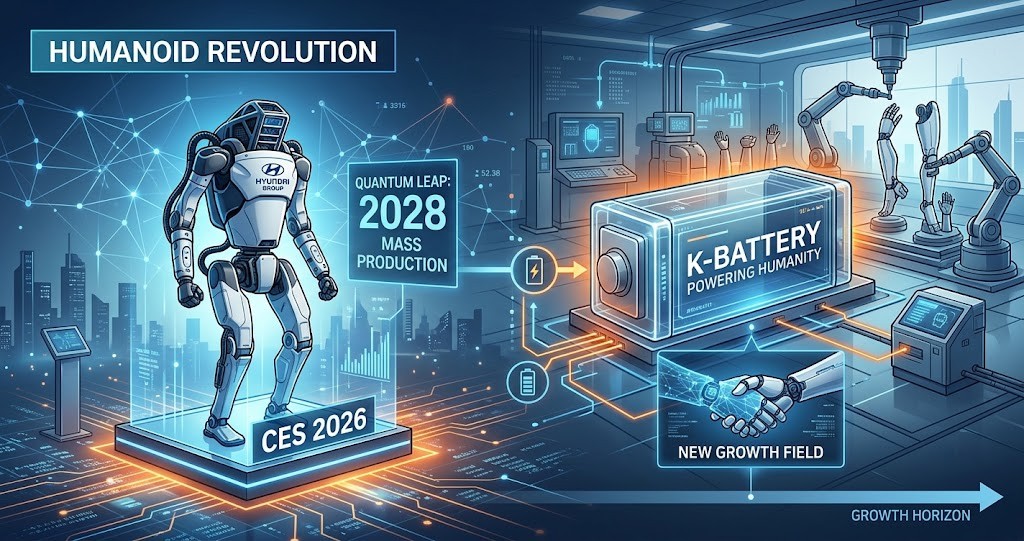
現代自動車グループは、傘下のボストン・ダイナミクスが開発した次世代電動人型ロボット「アトラス」をCES 2026で公開し、2028年からの量産構想を発表しました。これを機に、電気自動車(EV)向けに続く「Kバッテリー(韓国バッテリー業界)」の新たな成長分野としてヒューマノイド市場への期待が広がっています。
- アトラスの量産計画とスペック 現代自動車は2028年までに年間3万台規模のロボット生産体制を整え、米国の製造拠点を皮切りにアトラス(開発用モデル)を投入します。最長4時間のバッテリー駆動が可能で、残量が少なくなると3分で自動バッテリー交換を行う機能を備えます。2030年からは自動車の部品組み立て工程への投入も計画されています。
- 激化するグローバル競合 テスラは人型ロボット「オプティマス」の第3世代を2026年上半期に公開し量産化、2027年からの他社販売を目指しています。中国勢(ユニツリーやXPengなど)も低価格と高い量産能力を武器に開発を加速させています。
- 高エネルギー密度なNCM(三元系)電池に好機 ヒューマノイドロボットはEVに比べてバッテリー設置スペースが非常に狭いため、小型・大容量・高出力が要求されます。そのため、安価だが体積エネルギー密度の低いLFP(リン酸鉄リチウムイオン)電池よりも、韓国メーカーが優位性を持つNCM(ニッケル・マンガン・コバルト)などの三元系リチウムイオン電池が適しているとされています(例: テスラ「オプティマス」にはLGエナジーソリューション製の円筒形電池が搭載)。
- 今後の課題と全固体電池への期待 ロボット用途では重作業時に駆動時間が大幅に低下するほか、高放電率による発熱や寿命低下、火災リスクが課題となります。さらにロボットごとの規格が乱立しており大量生産によるコスト低減が難しい側面もあります。高出力と高い安全性を両立するため、将来的な全固体電池の採用も視野に入っていますが、初期コストの高さが普及のハードルとなる懸念も指摘されています。
【関連情報・技術的背景解説】
1. ヒューマノイド向けバッテリーに求められる仕様 電気自動車(EV)の車体底面全体に電池パックを敷き詰める手法とは異なり、ヒューマノイドロボットは胴体や背中などの限られた容積にバッテリーを収める必要があります。
- 体積エネルギー密度の重要性: 単位容積あたりに蓄えられるエネルギーが大きくないと、ロボットの自重が増え、自身の可動を阻害します。
- 高いCレート(放電特性): モーターを高トルクで駆動させる(重い荷物を持ち上げる、体勢を急激に整えるなど)際、短時間で大きな電流を流す必要があります。
2. 自動バッテリー交換機構(Swapping)の標準化とビジネスモデル アトラスが採用する「3分での自動バッテリー交換」は、充電時間を待たずに24時間連続稼働を可能にする産業用ソリューションです。
- 交換用バッテリーの予備需要: 1台のロボットに対し複数のバッテリーパックを用意する必要が生じるため、バッテリーメーカーにとってはEV向け単体出荷よりも台数あたりのパック出荷数が増加するメリットがあります。
- セルのモジュール化・標準化の課題: 現在は各ロボットメーカーが独自設計のバッテリーパックを採用しているため、セルメーカー側の量産効果が出にくい状況です。EVにおける4680などの標準規格規格化と同様の動きがロボット業界でも求められます。
3. 全固体電池(SSB)の実用化とロボティクスへの波及 安全性と高出力密度の両立を目指し、EV向けに開発が進む全固体電池ですが、ヒューマノイド分野への導入も強く期待されています。
- 可燃性の液体電解質を使用しないため、高出力放電時や衝突時の発熱・火災リスクを大幅に低減できます。
- 初期導入コストが課題となりますが、生産ラインの停止が大きな損害につながる産業用工場向けロボットであれば、安全コストとして許容されやすい側面を持ちます。
出典:https://news.yahoo.co.jp/articles/260de678f357533f2822cdfe7bdb29144996e880
Hyundai “Atlas” to Enter Mass Production by 2028! Humanoid Robots Open Up a New High-Value Battery Market
Hyundai Motor Group unveiled “Atlas,” its next-generation electric humanoid robot developed by subsidiary Boston Dynamics, at CES 2026 and announced plans for mass production starting in 2028. This news has raised expectations across the “K-Battery” (South Korean battery) industry, which views the humanoid market as a major new growth segment following electric vehicles (EVs).
- Mass Production Plans and Specifications of Atlas: Hyundai aims to establish a production capacity of 30,000 robots annually by 2028, deploying the development model of Atlas starting in US manufacturing facilities. It offers up to 4 hours of battery runtime and features an automatic battery swapping system that completes in 3 minutes when power is low. Deployment in automotive component assembly lines is planned starting in 2030.
- Intensifying Global Competition: Tesla aims to unveil its 3rd-generation “Optimus” humanoid robot in the first half of 2026 for mass production, targeting sales to third parties by 2027. Chinese competitors (such as Unitree and XPeng) are also accelerating development, leveraging low costs and high volume production capabilities.
- Opportunities for High-Energy-Density NCM (Ternary) Batteries: Because humanoid robots have significantly smaller battery installation spaces compared to EVs, they require compact, high-capacity, and high-output performance. Consequently, ternary lithium-ion batteries like NCM (nickel manganese cobalt)—where South Korean manufacturers hold a competitive edge—are considered more suitable than cheaper LFP (lithium iron phosphate) batteries, which have lower volumetric energy density (e.g., Tesla’s Optimus is reportedly equipped with cylindrical batteries from LG Energy Solution).
- Future Challenges and Expectations for Solid-State Batteries: Challenges in robotic applications include a sharp reduction in runtime during heavy-duty tasks, elevated temperatures, reduced cycle life, and fire risks caused by high discharge rates. Furthermore, fragmented specifications across different robots make it difficult for battery makers to achieve cost reductions through mass production. To balance high output with safety, future adoption of solid-state batteries is under consideration, though high initial costs remain a hurdle for widespread adoption.
[Related Information & Technical Background]
- Specifications Required for Humanoid Batteries Unlike EVs, which can spread battery packs across the entire chassis floor, humanoid robots must fit batteries within limited volumes inside the torso or back.
- Importance of Volumetric Energy Density: Without high energy stored per unit volume, the robot’s weight increases, impeding its mobility.
- High C-rate (Discharge Characteristics): Delivering large currents over short durations is necessary when driving motors at high torque (e.g., lifting heavy loads or making swift posture adjustments).
- Standardization and Business Models for Automatic Battery Swapping The 3-minute automatic battery swapping used in Atlas serves as an industrial solution enabling 24-hour continuous operation without waiting for recharge cycles.
- Spare Demand for Swappable Batteries: Preparing multiple battery packs per robot increases the number of pack shipments per unit for battery manufacturers compared to single EV shipments.
- Challenges in Cell Modularization and Standardization: Currently, robot makers use proprietary battery pack designs, limiting mass-production scale for cell manufacturers. Industry-wide standardization—similar to 4680 cells in the EV sector—is needed.
- Commercialization of Solid-State Batteries (SSBs) and Impact on Robotics Solid-state batteries developed for EVs to balance safety and high power density are strongly anticipated in the humanoid sector.
- Eliminating Flammable Liquid Electrolytes: Eliminating liquid electrolytes significantly reduces heat generation and fire risk during high-discharge operations or collisions.
- Initial Cost vs. Safety Trade-off: While initial deployment costs are a hurdle, industrial factory environments where production line downtime causes massive financial losses are more likely to absorb safety costs.


コメント