1. はじめに
再生可能エネルギーの普及や電気自動車(EV)の急速な拡大に伴い、高エネルギー密度で安全かつ安価な次世代蓄電池の開発が世界中で求められています。現在広く用いられているリチウムイオン電池は、リチウム資源の偏在や価格高騰、安全性などの課題を抱えています。
これに対し、マグネシウムやカルシウム、アルミニウムなどの多価イオンを利用する「多価イオン電池」は、リチウムの代替となる豊富な資源を活用でき、エネルギー密度の向上とコスト削減を同時に達成できる次世代電池として注目されています。本レポートでは、生成型人工知能(AI)を活用して未知の多価イオン電池用電極材料をスクリーニングし、さらにその合成プロトコルまで提案した最新の研究成果および関連背景を取りまとめて解説します。
2. 記事の要約・主要トピックス
- 掲載誌・著者情報:
- 著者:Brian Publicover(ブライアン・パブリコバー)
- 公開日:2026年8月3日
- 論文タイトル:Generative AI for discovering porous oxide materials for next-generation energy storage(『Cell Reports Physical Science』誌に掲載)
- 研究チーム:米国ニュージャージー工科大学(NJIT)のJoi Datta氏(指導教官)およびレンセラー工科大学(RPI)のNikhil Koratkar氏ら。
- AI技術を用いたスクリーニングプロセスの流れ:
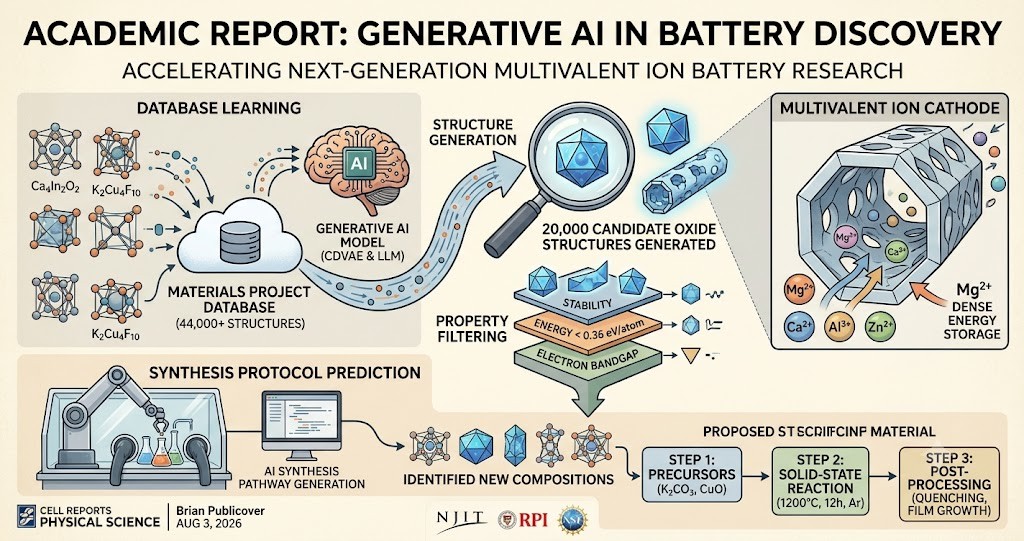
- モデルの学習:Materials Projectデータベース内の4万4000個以上の既知の無機結晶構造データを学習。
- 構造生成:結晶拡散変分オートエンコーダー(CDVAE)と高度に調整された大規模言語モデル(LLM)を組み合わせ、約2万個の遷移金属酸化物候補構造を生成。
- フィルタリング:生成エネルギー、熱力学的安定性、電子バンドギャップなどの評価基準により55種類の組成に絞り込み。
- 新規構造の特定:最終的に5種類のオープン・トンネル構造を持つ新組成を特定。これらはマグネシウムイオン、カルシウムイオン、アルミニウムイオン、亜鉛イオンを収容するように設計されている。
- 候補物質の物性(Ca4In2O2の例):
- 凸包(Convex Hull)より上のエネルギーが 0.36 eV/atom を示し、熱力学的には準安定状態(Metastable State)と定義。
- ブリルアンゾーン全体のフォノン分散解析において不安定な振動モードが見られないため、非平衡条件下(急冷や特殊膜成長等)での実験的合成が可能であることが示唆された。
- 合成経路提案AIシステムの構築:
- 科学文献を探索し、前例のない新規化合物に対して反応温度、雰囲気、安全手順などの合成条件を提示する検索拡張型生成システムを構築。
- 関連化合物 K2Cu4F10 への適用例では、固相反応経路の提示に加え、実現可能な9つの元素置換を特定。
- 研究の位置づけと資金援助:
- 本研究成果は実証済みの電池材料そのものではなく、AIによる計算フレームワークの提示として位置づけられている。
- 関連研究への資金は、NJITでのニオブタングステン酸化物アノード研究を支援する米国国立科学財団(NSF)の助成金から提供された。
3. 技術仕様・表記一覧(プレーンテキスト形式)
- 特定された化学組成例:
- Ca4In2O2
- K2Cu4F10
- エネルギー値(単位):
- 0.36 eV/atom
- 生成モデル:
- CDVAE (Crystal Diffusion Variational Autoencoder)
- 大規模言語モデル (LLM)
- 学習データ規模:
- 4万4000個以上の結晶構造(Materials Project)
4. 関連情報および解説(バックグラウンド知識)
- 多価イオン電池(Multivalent Ion Batteries)のメリット
- 複数電荷による高密度化:リチウムイオン(1価:Li+)に対し、マグネシウム(2価:Mg2+)やアルミニウム(3価:Al3+)などは、1つのイオン移動で複数の電子を転送できるため、体積あたりの理論容量・エネルギー密度が高くなります。
- 地殻クラーク数(豊富さ)と低コスト:マグネシウムやカルシウム、アルミニウム、亜鉛は地球上に極めて豊富に存在するため、原料調達リスクを低減しコストを抑えられます。
- CDVAE(結晶拡散変分オートエンコーダー)とは
- 3次元空間における原子の位置や格子の周期性を考慮して新しい結晶構造を連続的に生成する深層学習モデルです。従来のランダム探索や手動計算に比べ、現実的に安定して存在しうる結晶構造を大幅なハイスルーピットで探索できます。
- 準安定状態とフォノン分散解析
- 最もエネルギーが低い完全安定状態(基底状態)でなくても、フォノン分散解析で「虚振動(構造の崩壊を示す振動)」が存在しなければ、機械的・動的に安定して形を維持できます。このような「準安定材料」は、固相反応や熱処理などの非平衡合成手法を用いることで実際に作製可能です。
Toward Low-Cost Batteries Replacing Lithium! Generative AI Identifies Electrode Materials and Synthesis Routes for Multivalent-Ion Batteries
1. Introduction With the widespread adoption of renewable energy and the rapid expansion of electric vehicles (EVs), there is a global demand for the development of safe, low-cost, next-generation storage batteries with high energy density. Lithium-ion batteries, which are currently widely used, face challenges such as the uneven geographical distribution of lithium resources, price volatility, and safety concerns.
In contrast, “multivalent-ion batteries”—which utilize multivalent ions such as magnesium, calcium, and aluminum—are attracting attention as next-generation batteries. They leverage abundant alternative resources to lithium, making it possible to achieve both improved energy density and cost reduction simultaneously. This report summarizes the latest research findings and relevant background in which generative artificial intelligence (AI) was used to screen unknown electrode materials for multivalent-ion batteries and propose their synthesis protocols.
2. Article Summary & Key Topics
- Publication & Author Information:
- Author: Brian Publicover
- Publication Date: August 3, 2026
- Paper Title: Generative AI for discovering porous oxide materials for next-generation energy storage (Published in Cell Reports Physical Science)
- Research Team: Led by Joi Datta (Advisor) at New Jersey Institute of Technology (NJIT) in collaboration with Nikhil Koratkar at Rensselaer Polytechnic Institute (RPI) and others in the US.
- Flow of the AI-Driven Screening Process:
- Model Training: Trained on over 44,000 known inorganic crystal structure datasets from the Materials Project database.
- Structure Generation: Combined a Crystal Diffusion Variational Autoencoder (CDVAE) with a highly tuned Large Language Model (LLM) to generate approximately 20,000 candidate transition metal oxide structures.
- Filtering: Narrowed down candidates to 55 compositions based on evaluation criteria such as formation energy, thermodynamic stability, and electronic bandgap.
- Identification of New Structures: Ultimately identified 5 new compositions featuring open-tunnel structures designed to accommodate magnesium, calcium, aluminum, and zinc ions.
- Material Properties of Candidate (Example: Ca4In2O2):
- Showed an energy above the convex hull of 0.36 eV/atom, defined thermodynamically as a metastable state.
- Phonon dispersion analysis across the entire Brillouin zone showed no unstable vibrational modes, suggesting that experimental synthesis under non-equilibrium conditions (such as rapid quenching or specialized film growth) may be possible.
- Development of Synthesis Route Proposal AI System:
- Built a retrieval-augmented generative system that searches scientific literature to present synthesis conditions, such as reaction temperature, atmosphere, and safety procedures, for novel unverified compounds.
- When applied to the related compound K2Cu4F10, the system proposed solid-state reaction pathways and identified 9 feasible elemental substitutions.
- Positioning of Research & Funding:
- The research findings represent a computational AI framework rather than fully validated battery materials.
- Funding for related research was provided by a National Science Foundation (NSF) grant supporting research on niobium tungsten oxide anodes at NJIT.
3. Technical Specifications & Summary (Plain Text Format)
- Identified Chemical Composition Examples:
- Ca4In2O2
- K2Cu4F10
- Energy Value (Unit):
- 0.36 eV/atom
- Generative Models:
- CDVAE (Crystal Diffusion Variational Autoencoder)
- Large Language Model (LLM)
- Training Data Scale:
- Over 44,000 crystal structures (Materials Project)
4. Related Information & Commentary (Background Knowledge)
- Benefits of Multivalent Ion Batteries:
- High Density via Multiple Charges: Compared to lithium ions (monovalent: Li+), ions like magnesium (divalent: Mg2+) and aluminum (trivalent: Al3+) can transfer multiple electrons per ion movement, resulting in higher volumetric theoretical capacity and energy density.
- Abundance (Clarke Number) & Low Cost: Elements such as magnesium, calcium, aluminum, and zinc are extremely abundant on Earth, reducing raw material procurement risks and lowering costs.
- What is CDVAE (Crystal Diffusion Variational Autoencoder)?:
- It is a deep learning model that continuously generates new crystal structures while considering atomic positions in 3D space and lattice periodicity. Compared to conventional random searches or manual calculations, it enables high-throughput screening for crystal structures that can realistically exist stably.
- Metastable States and Phonon Dispersion Analysis:
- Even if a material is not in its lowest-energy fully stable state (ground state), it can maintain its shape mechanically and dynamically as long as phonon dispersion analysis reveals no “imaginary vibrations” (vibrations that indicate structural collapse). Such “metastable materials” can actually be fabricated using non-equilibrium synthesis techniques like solid-state reactions and thermal processing.

コメント