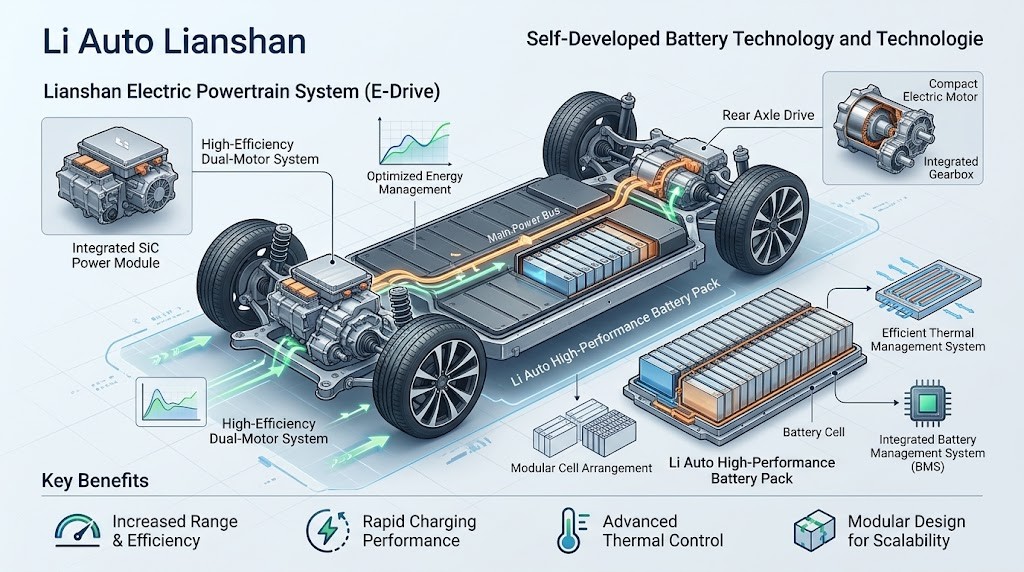
中国の主要電気自動車(EV)メーカーであるLi Auto(理想汽車)は、開催した技術イベント「パワーデー」にて、自社開発の総合電動パワートレイン技術システム「連山(Lianshan)」を発表しました。
本まとめでは、同社が推進する「CATL依存からの脱却」および「自社開発バッテリーへの切り替え」という背景情報を加え、発表内容を分かりやすく再構成して整理します。
主な発表内容と技術仕様のまとめ
1. 生涯安全保証プログラムの導入
自社製バッテリーに対する消費者の懸念を軽減するため、2つの手厚い保証を打ち出しました。
- 自然発火に対する保証: 純正バッテリーの品質問題で自然発火し廃車となった場合、同等仕様の新車と交換補償。
- 衝突・擦傷火災に対する保証: 事故等の損傷で発火し廃車となった場合、車両損害保険の補償額と実際の支払い額との差額を補填(適用条件あり)。
2. 連山(Lianshan)システムの技術的特徴
- バッテリー性能:
- 高安定性の正極、低リチウム消費の負極、長寿命を実現するデュアルフォーミュラ電解液を採用。
- 全モデルで8年走行(または16万キロメートル)後も75%以上のバッテリー健全性(SOH)を維持。
- CLTC規格で、新型Li L8は430キロメートル、2026年型Li i6は780キロメートルの純電気航続距離を実現(旧モデル比8%以上向上)。
- 安全耐性試験:
- パック底面は500ジュールの衝撃に耐え、水深1メートルで48時間の防水性を維持。
- 単一セルが摂氏50度で熱暴走を起こしても、パック全体としては24時間発火しない設計。
- 急速充電および制御アルゴリズム:
- 新世代の5C三元系リチウムイオン電池は、従来の2C型に比べて急速充電時の温度が12度低い。
- リン酸鉄リチウム電池は、独自の適応型アルゴリズムにより充電状態(SOC)の推定誤差を3%以内に抑え、冬季低充電時の最大出力を40%以上向上。
- 電動駆動(e-Drive)ユニット:
- CAR119鋳造アルミニウム製ローター素材を採用し、市街地で15キロメートル以上、高速道路で8キロメートル以上の航続距離延長を実現。
- 電源モジュールの配線再設計により、さらに30キロメートルの航続距離と24ミリメートルのスペース余裕を確保。
- 自社開発の炭化ケイ素(SiC)パワー chip は過去1年で400万個を量産搭載し、故障率ゼロを達成。
- 充電インフラ:
- 全国4200カ所以上の急速充電ステーションを展開中。
- 高速道路沿いの充電器はすべて5C超急速充電に対応し、機器稼働率は99.9%を達成。
関連情報・背景解説
なぜLi Autoは自社開発に踏み切るのか?
- サプライチェーンの多角化と内製化: これまでLi Autoは世界最大のバッテリーメーカーであるCATLに大きく依存していましたが、調達コスト削減や安定供給の観点から内製化を進めています。
- Sunwodaとの合弁設立: 2025年にSunwodaと50対50の合弁会社を設立したほか、Sunwoda EVBに26億5000万円(3億9400万ドル)を出資して株式8.79%を取得(第2位株主)し、内製化の生産基盤を固めています。
自社開発へ切り替える際の課題と信頼性回復の狙い
- ブランドイメージのギャップ: 中国市場において「CATL製=高品質・安全」という認知が定着しているのに対し、Sunwoda製バッテリーへの信頼感の醸成は課題となっています。
- 過去の品質問題と訴訟の影響: 過去にLi i6の一部納車が延期されSunwoda製への変更を余儀なくされた経緯や、Geely傘下企業からSunwoda EVBに対する品質問題の訴訟が起きた経緯が存在します。
- 手厚い保証の狙い: 今回発表された「生涯保証」や過酷な安全試験結果の公表は、こうした消費者の不安や懸念を払拭し、自社開発バッテリー搭載モデルを円滑に市場へ普及させるための戦略的な狙いがあります。
販売状況と今後の展開
- 自社開発の5Cバッテリーを搭載した「2026年モデル Li i6」は10月28日に発売され、11月上旬から納車が順次開始される予定です。
- 販売面では、直近の9月納入台数が31817台(前年同月比6.29%減)、年初9カ月累計で293436台(前年同期比1.25%減)となっており、新技術の投入を通じて販売回復を図る考えです。
出典:https://cnevpost.com/2026/10/20/li-auto-launches-lianshan-in-house-ev-tech-system/
Li Auto Unveils In-House EV Tech System “Lianshan” — Offers Lifetime Safety Guarantee on In-House Batteries
Li Auto, a leading Chinese electric vehicle (EV) manufacturer, announced its in-house developed comprehensive electric powertrain technology system, “Lianshan,” at its “Power Day” technology event.
This summary reorganizes and presents the key points of the announcement, along with background context regarding the company’s shift toward ending its reliance on CATL and transitioning to in-house developed batteries.
Summary of Key Announcements and Technical Specifications
1. Introduction of Lifetime Safety Guarantee Program
To alleviate consumer concerns regarding in-house batteries, Li Auto introduced two comprehensive guarantees:
- Spontaneous Combustion Guarantee: If a vehicle spontaneously catches fire due to quality issues with the original battery and meets total loss criteria, Li Auto will provide a replacement vehicle of equivalent specifications.
- Collision and Scrape Fire Guarantee: If a battery catches fire due to an accident or scrape damage resulting in total loss, Li Auto will cover the difference between the vehicle loss insurance coverage and the actual insurance payout (subject to terms and conditions).
2. Technical Features of the Lianshan System
- Battery Performance:
- Uses high-stability cathodes, low-lithium-consumption anodes, and a dual-formula electrolyte for extended lifespan.
- Maintains at least 75 percent battery State of Health (SOH) after 8 years or 160,000 kilometers of driving across all models.
- Under CLTC standards, the new Li L8 achieves a pure electric range of 430 kilometers, and the 2026 Li i6 achieves 780 kilometers (an overall improvement of over 8 percent compared to older models).
- Safety and Endurance Testing:
- The bottom of the battery pack withstands impacts of 500 Joules and maintains waterproof integrity at a water depth of 1 meter for 48 hours.
- Designed so that even if a single cell undergoes thermal runaway at 50 degrees Celsius, the overall battery pack will not catch fire for 24 hours.
- Fast Charging and Control Algorithms:
- The new-generation 5C ternary lithium-ion battery operates at temperatures 12 degrees Celsius lower during fast charging compared to conventional 2C batteries.
- For lithium iron phosphate batteries, a proprietary adaptive algorithm keeps State of Charge (SOC) estimation error within 3 percent and boosts maximum power output during low charge in winter by over 40 percent.
- Electric Drive (e-Drive) Unit:
- Utilizes patented CAR119 cast aluminum rotor material, extending pure electric range by over 15 kilometers in urban driving and over 8 kilometers on highways.
- Redesigned power module wiring adds an extra 30 kilometers of range and creates 24 millimeters of extra space.
- In-house developed silicon carbide (SiC) power chips have been deployed in 4 million mass-production vehicles over the past year with zero failures.
- Charging Network:
- Currently operates over 4,200 fast-charging stations nationwide.
- All highway fast chargers support 5C supercharging, achieving an equipment uptime rate of 99.9 percent.
Related Information and Background Context
Why is Li Auto Moving Toward In-House Development?
- Supply Chain Diversification and In-House Production: Li Auto previously relied heavily on CATL, the world’s largest battery manufacturer. It is pushing for in-house production to lower procurement costs and secure a stable supply.
- Joint Venture with Sunwoda: In 2025, Li Auto established a 50-50 joint venture with Sunwoda and invested 2.65 billion yuan (394 million USD) into Sunwoda EVB to acquire an 8.79 percent stake (becoming the second-largest shareholder), strengthening its in-house manufacturing foundation.
Challenges in Transitioning to In-House Production and Restoring Trust
- Brand Image Gap: While CATL is widely recognized in the Chinese market for high quality and safety, building consumer trust for Sunwoda-produced batteries remains a challenge.
- Past Quality Issues and Lawsuits: Li Auto previously faced delivery delays for the Li i6, forcing a switch to Sunwoda batteries. Additionally, Sunwoda EVB faced a lawsuit from a Geely subsidiary over alleged cell quality issues.
- Strategic Intent Behind the Guarantees: The lifetime guarantee and the rigorous safety test results are strategically designed to dispel consumer anxiety and facilitate the smooth market adoption of models equipped with in-house batteries.
Sales Status and Future Outlook
- The 2026 Li i6, equipped with the in-house 5C battery, is scheduled for launch on October 28, with deliveries beginning sequentially in early November.
- On the sales front, Li Auto delivered 31,817 vehicles in September (down 6.29 percent year-on-year) and 293,436 vehicles in the first nine months of the year (down 1.25 percent year-on-year). The company aims to recover sales momentum through the rollout of these new technologies.

コメント