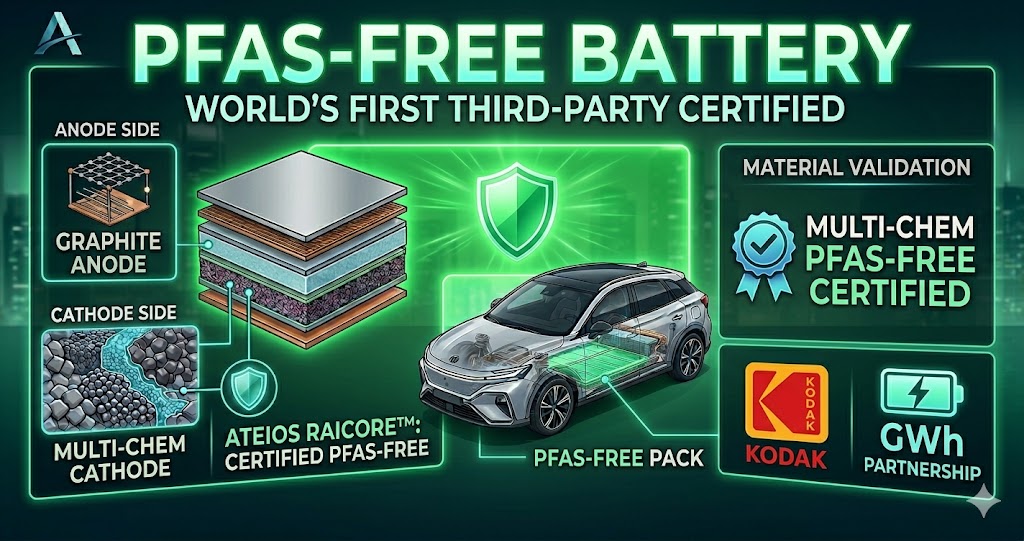
世界のバッテリー産業では、環境規制の強化に伴い、製造工程からPFAS(ペルフルオロアルキル化合物およびポリフルオロアルキル化合物、いわゆる「永久化学物質」)を排除する動きが加速しています。従来の電極製造では、バインダー(結着剤)としてPVDF(ポリフッ化ビニリデン)などのフッ素系ポリマーが広く使われてきましたが、これらは環境負荷やリサイクルの難しさが課題でした。
2026年3月、Ateios Systemsとコダックは、主要な3つの正極材料においてPFASフリーを達成し、かつ業界標準を上回る製造効率を実現したと発表しました。
- 1. 発表の核心:RaiCoreプラットフォームの拡張とPFASフリー認証
- 2. 第4世代RaiCore電極の技術進化
- 3. 背景とパートナーシップ:コダックの知見と公的支援
- World’s First Third-Party Verified PFAS-Free Electrodes: Ateios and Kodak Achieve Success Across Three Major Chemistries
- Introduction
- 1. Core Announcement: Expansion of RaiCore Platform and PFAS-Free Certification
- 2. Technical Evolution of 4th Generation RaiCore Electrodes
- 3. Background and Partnership: Kodak’s Expertise and Public Support
1. 発表の核心:RaiCoreプラットフォームの拡張とPFASフリー認証
Ateiosの「RaiCore」電極プラットフォームが、世界で最も普及している3種類の正極材および負極材に拡張され、第三者機関によるPFASフリー認証を取得しました。
- 対応する化学組成:
- LCO: リチウムコバルト酸化物(スマホ、PC等)
- LFP: リン酸鉄リチウム(EV、ESS等)
- NMC: ニッケルマンガンコバルト(EV等)
- Graphite: グラファイト(負極材)
- PFASフリーの検証結果:
- 第三者機関の試験により、全有機フッ素(TOF)濃度が20ppm未満(分析限界値以下)であることが確認されました。これは規制値である100ppmを大幅に下回る数値です。
- 現時点で、第三者検証を受けた世界唯一のPFASフリー電極としての地位を確立しています。
2. 第4世代RaiCore電極の技術進化
認証と同時に、性能を大幅に向上させた最新の「第4世代」配合が発表されました。
- 高密度化: 活性物質の充填率を98%以上に向上。
- 製造の高速化: コダックの精密コーティング技術を活用し、従来のフッ素系バインダーを用いた手法(約30m/min)に比べ、約3倍の80m/minから100m/minという超高速塗工を実現。
- 既存ラインとの互換性: 独自の「RaiCure」電子線硬化プロセス(溶剤不要)を用いながら、既存のギガファクトリーへの導入がスムーズな「ドロップイン」ソリューションとして提供されます。
3. 背景とパートナーシップ:コダックの知見と公的支援
このプロジェクトは、米国の国内サプライチェーン強化を目的とした公的支援を受けています。
- コダック(Kodak)の役割: 130年以上にわたり培ってきた写真フィルムの精密・高速・多層コーティング技術をバッテリー電極製造に転用。ニューヨーク州の拠点でGWh規模の量産を支援しています。
- 公的資金: 米国国立科学財団(NSF)のエネルギー貯蔵エンジンによる助成金を受け、LFP正極の検証と量産化を加速させました。
- 脱・懸念外国団体(FEOC): 中国などの「懸念される外国の事業体(FEOC)」に依存しない、北米主導のサプライチェーン構築を目的としています。
World’s First Third-Party Verified PFAS-Free Electrodes: Ateios and Kodak Achieve Success Across Three Major Chemistries
Introduction
In the global battery industry, there is an accelerating movement to eliminate PFAS (per- and polyfluoroalkyl substances, known as “forever chemicals”) from manufacturing processes due to tightening environmental regulations. Traditionally, fluorine-based polymers such as PVDF (polyvinylidene fluoride) have been widely used as binders in electrode production. However, these materials present challenges regarding environmental impact and recycling difficulty.
In March 2026, Ateios Systems and Kodak announced that they have achieved PFAS-free status across three major cathode materials while delivering manufacturing efficiency that exceeds industry standards.
1. Core Announcement: Expansion of RaiCore Platform and PFAS-Free Certification
The Ateios “RaiCore” electrode platform has been expanded to support the three most common cathode materials and anode materials, earning PFAS-free certification from a third-party organization.
- Supported Chemical Compositions:
- LCO: Lithium Cobalt Oxide (Smartphones, PCs, etc.)
- LFP: Lithium Iron Phosphate (EVs, ESS, etc.)
- NMC: Nickel Manganese Cobalt (EVs, etc.)
- Graphite: Graphite (Anode material)
- PFAS-Free Verification Results:
- Third-party testing confirmed that the Total Organic Fluorine (TOF) concentration is below 20ppm (below the analytical reporting limit). This is significantly lower than the regulatory threshold of 100ppm.
- Currently, it has established its position as the world’s only PFAS-free battery electrode verified by an independent third party.
2. Technical Evolution of 4th Generation RaiCore Electrodes
Alongside the certification, the latest “4th Generation” formulation with significantly improved performance was announced.
- Higher Density: Increased the active material loading rate to over 98%.
- High-Speed Manufacturing: Leveraging Kodak’s precision coating technology, they achieved ultra-high-speed coating of 80m/min to 100m/min. This is approximately three times faster than conventional methods using fluorine-based binders (approx. 30m/min).
- Compatibility with Existing Lines: Utilizing the proprietary “RaiCure” electron-beam curing process (solvent-free), it is offered as a “drop-in” solution that allows for smooth integration into existing gigafactories.
3. Background and Partnership: Kodak’s Expertise and Public Support
This project receives public support aimed at strengthening the domestic supply chain in the United States.
- Role of Kodak: Kodak is repurposing its precision, high-speed, multi-layer coating technology—developed over 130 years for photographic film—for battery electrode manufacturing. They are supporting GWh-scale mass production at their facility in New York State.
- Public Funding: Supported by grants from the National Science Foundation (NSF) Energy Storage Engine, which accelerated the verification and mass production of LFP cathodes.
- Non-FEOC (Foreign Entity of Concern): The goal is to build a North American-led supply chain that does not rely on “Foreign Entities of Concern” (FEOC) such as China.
コメント