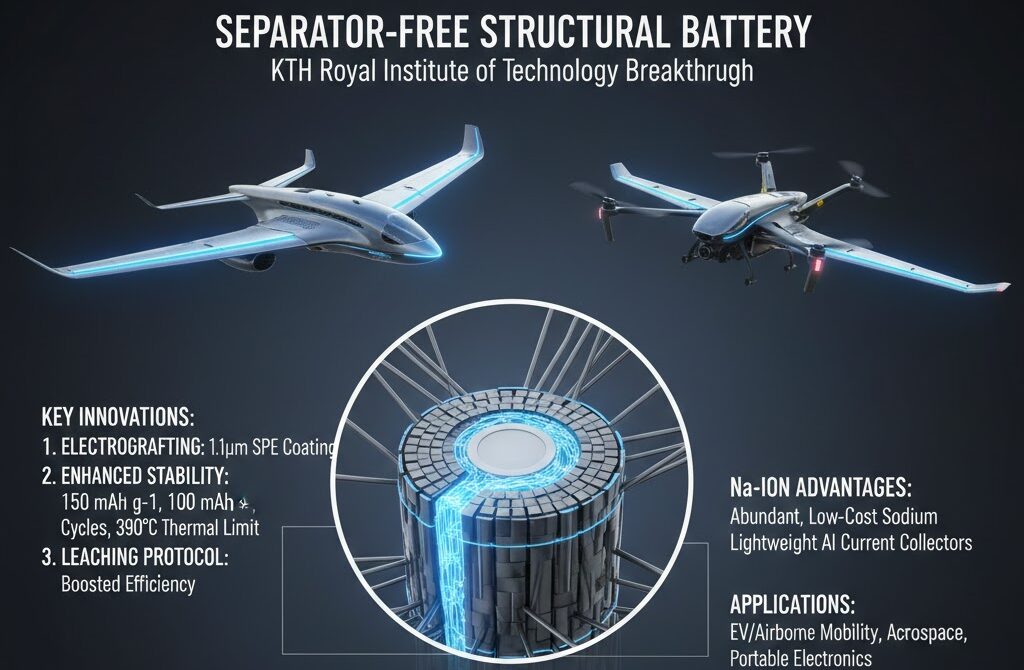
スウェーデンの王立工科大学(KTH)を中心とする研究チームは、炭素繊維(カーボンファイバー)に超薄膜の固体電解質を直接コーティングする新しい手法を開発しました。
1. ニュースの核心:セパレータレス構造電池への道
研究チームは、「電気グラフト法(Electrografting)」という手法を用い、炭素繊維の表面に厚さわずか1.1μm(1mmの約1000分の1)の固体高分子電解質(SPE)を均一にコーティングすることに成功しました。
- 革新点: 従来の電池に不可欠な「セパレーター(絶縁材)」を不要にし、電解質自体にその役割を持たせています。
- 構造電池への応用: 荷重を支える「炭素繊維」と、エネルギーを貯蔵する「電池」を一体化。システム全体の軽量化と高エネルギー密度化を同時に実現します。
2. 技術的な3つのブレークスルー
この研究が構造用ナトリウム電池のベンチマークとされる理由は、以下の3点に集約されます。
- 超薄型・高密着コーティング: 電気グラフト法は、複雑な形状の炭素繊維1本1本に対して、化学的に結合した均一な膜を形成します。これにより、固体電池の課題である「界面の接触不良」を解決しました。
- 優れた安定性と性能: * 耐熱性: 390°Cまで分解しない高い熱安定性を持ちます。
- 比容量: 150 mAh g-1の高い比容量と、99%を超える高い充放電効率(クーロン効率)を100サイクル以上維持しました。
- 浸出(Leaching)工程の重要性: 未反応のモノマー(原料)を48時間かけて除去することで、電池内部の抵抗を下げ、初回サイクルの容量損失を最小限に抑えるプロトコルを確立しました。
3. 関連情報と今後の展望
ナトリウムイオン電池は、リチウムに比べて資源が豊富で安価ですが、重くなりがちという欠点がありました。今回の「セパレータレス構造」はその欠点を補う決定打となります。
市場と技術の背景
- 資源の持続可能性: ナトリウムは海塩などから入手可能で、リチウムやコバルトのような供給リスクが低いため、低コストな次世代電池として期待されています。
- アルミニウム集電体の使用: ナトリウムはリチウムと異なりアルミニウムと合金化しないため、安価で軽いアルミ箔を集電体(負極側も含む)に使用できるメリットがあります。
今後のロードマップ
- 導電率の向上: 現在のイオン伝導率は 25°C で 6 x 10⁻⁵ S cm-1 ですが、塩濃度を調整することでさらなる高速充電・高出力化が期待されています。
- 多機能材料としての展開: 電気輸送機器(電気飛行機やドローン)、宇宙航空、ポータブル電子機器など、重量削減が至上命題である分野への適用が進むと見られています。
まとめ:軽量化のパラダイムシフト
今回の研究は、電池を「デバイス」として載せるのではなく、製品の「構造体」そのものにする技術を大きく前進させました。セパレーターという「重り」を排除したナトリウム電池は、将来のクリーンエネルギー社会において、持続可能で強力な選択肢となるでしょう。
出典:https://pubs.rsc.org/en/content/articlelanding/2026/eb/d5eb00212e
1.1 um Solid Electrolyte Coating on Carbon Fibers via Electrografting: Realizing Separator-less SIBs
A research team, primarily from the KTH Royal Institute of Technology in Sweden, has developed a new method for directly coating carbon fibers with an ultra-thin solid electrolyte.
1. The Core News: A Path Toward Separator-less Structural Batteries
Using a technique called “Electrografting,” the team successfully coated individual carbon fibers with a uniform layer of Solid Polymer Electrolyte (SPE) only 1.1 um thick (approximately 1/1000th of a millimeter).
- Key Innovation: This eliminates the need for the conventional “separator” (insulating material) essential in standard batteries, allowing the electrolyte itself to perform that role.
- Structural Battery Application: By integrating load-bearing carbon fibers with energy-storing battery functions, the system achieves simultaneous weight reduction and high energy density.
2. Three Technical Breakthroughs
This study is considered a benchmark for structural sodium-ion batteries (SIBs) due to the following three points:
- Ultra-thin, High-Adhesion Coating: Electrografting forms a chemically bonded, uniform film on every single carbon fiber within complex shapes. This solves the “interfacial contact” issues common in solid-state batteries.
- Superior Stability and Performance:
- Thermal Stability: The material remains stable without decomposing up to 390°C.
- Specific Capacity: It maintained a high specific capacity of 150 mAh g-1 and a coulombic efficiency exceeding 99% over 100 cycles.
- Importance of the Leaching Process: By removing unreacted monomers over 48 hours, the team established a protocol that lowers internal resistance and minimizes capacity loss during the first cycle.
3. Context and Future Outlook
Sodium-ion batteries are cheaper and more abundant than lithium-based ones but traditionally suffer from higher weight. This “separator-less structure” is a game-changer for overcoming that disadvantage.
Market and Technical Background
- Resource Sustainability: Sodium is accessible from sea salt, and because it avoids the supply risks associated with lithium or cobalt, it is a promising low-cost, next-generation technology.
- Use of Aluminum Current Collectors: Unlike lithium, sodium does not alloy with aluminum. This allows for the use of inexpensive and lightweight aluminum foil as a current collector for both electrodes.
Future Roadmap
- Improving Conductivity: While current ionic conductivity is 6 x 10⁻⁵ S cm-1 at 25°C, further optimization of salt concentrations is expected to enable faster charging and higher power output.
- Expansion as Multifunctional Materials: Applications are anticipated in sectors where weight reduction is critical, such as electric transport (electric planes and drones), aerospace, and portable electronics.
Conclusion: A Paradigm Shift in Lightweighting
This research significantly advances the technology for making the battery the “structure” of the product itself rather than just a “device” carried within it. By removing the “dead weight” of the separator, these sodium batteries represent a sustainable and powerful solution for the future of clean energy.
コメント