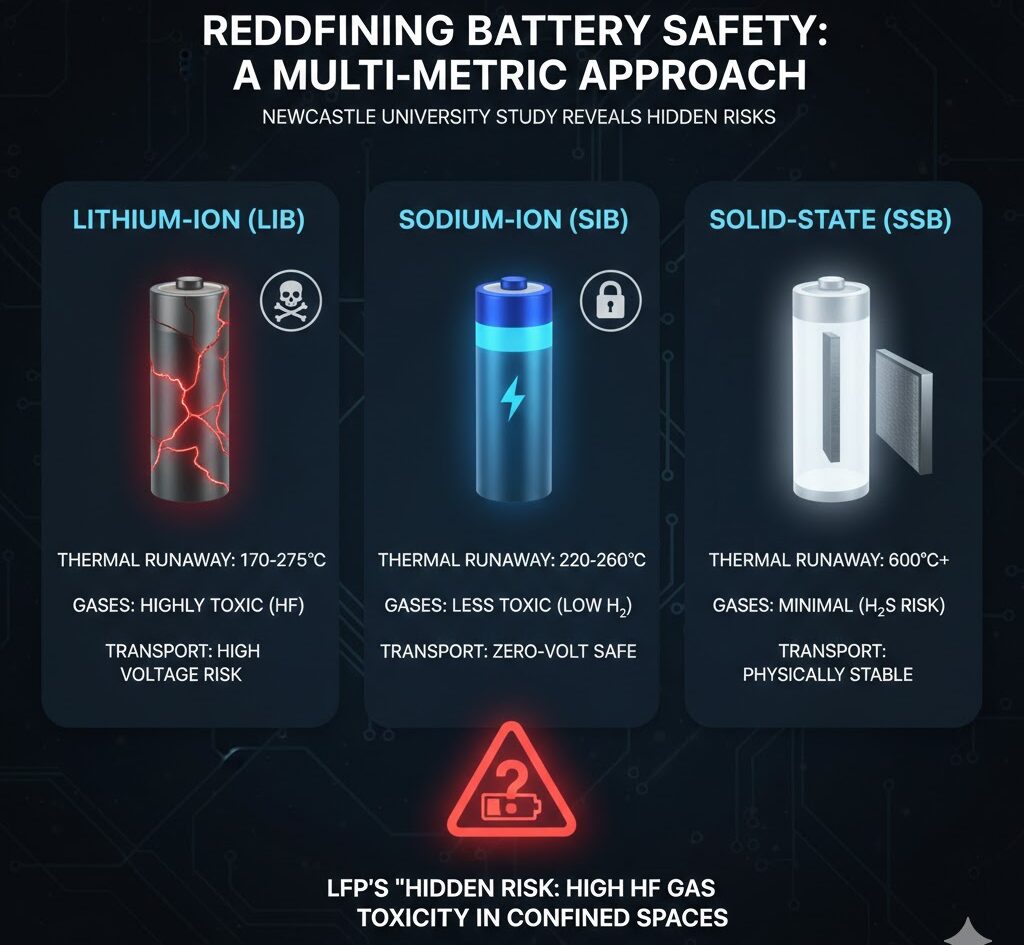
エネルギー移行の要となるバッテリー技術において、これまで「最も安全」と目されてきたLFP(リン酸鉄リチウム)電池の評価が、新たな研究によって揺らぎ始めています。英国ニューカッスル大学などの研究チームは、熱暴走の温度だけでなく、放出されるガスの毒性や輸送時のリスク、さらには設置環境(海上輸送やグリッド貯蔵)といった「アプリケーション固有の制約」を考慮した多属性の安全性評価の必要性を強調しています。
以下に、リチウムイオン、ナトリウムイオン、全固体電池の主要3技術の安全性プロファイルを整理・比較しました。
バッテリー技術別 安全性プロファイル比較表
| 特徴 / 技術 | リチウムイオン (LIB) | ナトリウムイオン (SIB) | 全固体電池 (SSB) |
| 熱暴走の開始温度 | 低~中(170~275℃) | 中(220~260℃) | 高(600℃以上 ※酸化物系) |
| 主な故障リスク | 液体電解質の可燃性、酸素放出による発熱 | LIBより発熱率が低く安定 | 電解質が固体のため発熱・発火リスクを根本的に低減 |
| ガスの危険性 | 可燃性ガス、高濃度のフッ化水素(HF) | 水素含有量が比較的少ない | 発生量は最小限(硫化物系は硫化水素のリスクあり) |
| 輸送時の安全性 | 常に一定の電圧保持が必要 | ゼロボルト(0V)での輸送が可能 | 固体のため物理的安定性が高い |
| 伝播速度 | 速い(9~11℃/分) | 中程度 | 極めて遅い(0.3~0.9℃/分) |
各技術の詳細分析と関連情報
1. リチウムイオン電池(LIB):既存のスタンダード
- 正極材による性質の差:
- NMC系: 高エネルギー密度だが、ニッケル含有量が増えるほど不安定になり、約215℃で分解が始まる。
- LFP系: 300℃超まで酸素放出を抑制する強固な構造を持つ。
- 【注目すべき知見】LFPの「隠れたリスク」:熱安定性は高いものの、故障時に放出されるフッ化水素(HF)の濃度(3000~8000ppm)は他よりも高く、密閉空間や海上輸送においては、火災以上の毒性リスクをもたらす可能性が指摘されています。
2. ナトリウムイオン電池(SIB):実用的な改善策
- 熱的優位性: LIBに比べて熱暴走の開始温度が高く、放出されるガス中の水素含有量も少ないため、爆発のリスクが低減されます。
- 物流の革命: 最大の特徴は「0V(ゼロボルト)輸送」が可能である点です。リチウムイオン電池が抱える輸送中の自然発火リスクを、物理的に回避できる大きな利点があります。
3. 全固体電池(SSB):究極の安全性への道
- 圧倒的な安定性: 可燃性液体電解質を排除することで、600℃を超える高温まで耐えうる設計が可能です。
- 伝播の抑制: セルが故障しても隣接するセルへ熱が伝わる速度が極めて遅く、システム全体の大規模火災を防ぎやすいのが特徴です。
- 【関連情報】: ただし、硫化物系電解質は水分に触れると硫化水素(H₂S)を発生させるため、材料選定や封止技術といった「化学的な安全性」の確保が普及の鍵となります。
結論:用途に応じた「安全」の再定義
今回の研究は、どのバッテリーが「一律に安全か」ではなく、「その用途においてどのリスクを優先的に排除すべきか」という視点への転換を促しています。
- 電気自動車: 高エネルギーと軽量化のため、全固体電池による本質的な安全向上が期待される。
- グリッド貯蔵・ESS: 大量設置されるため、毒性ガス放出が少なく、コスト面でも有利なナトリウムイオン電池が有力な選択肢となる。
Beyond Fire Risk: The “Toxic Gas” Blind Spot Redefining Battery Safety
In the field of battery technology—the cornerstone of the energy transition—the reputation of Lithium Iron Phosphate (LFP) batteries as the “safest” option is being challenged by new research. A team from Newcastle University (UK) and partners has emphasized the need for a multi-attribute safety framework. This approach moves beyond just thermal runaway temperatures to consider “application-specific constraints,” such as the toxicity of released gases, transport risks, and specific environments like maritime shipping and grid-scale storage.
Below is a comparative analysis of the safety profiles for the three major technologies: Lithium-ion, Sodium-ion, and Solid-state batteries.
Battery Technology Safety Profile Comparison
| Feature / Technology | Lithium-ion (LIB) | Sodium-ion (SIB) | Solid-State (SSB) |
| Thermal Runaway Onset | Low–Mid (170–275°C) | Mid (220–260°C) | *High (>600°C Oxide-based) |
| Primary Failure Risk | Flammable liquid electrolyte; heat from oxygen release | Lower heat release rate; more stable than LIB | Minimal risk; solid electrolyte eliminates flammability |
| Gas Hazards | Flammable gases; High-concentration Hydrogen Fluoride (HF) | Relatively low hydrogen content | Minimal (Sulfide-based may release Hydrogen Sulfide) |
| Transport Safety | Requires constant voltage maintenance | Capable of 0V (Zero-Volt) transport | High physical stability due to solid structure |
| Propagation Speed | Fast (9–11°C/min) | Moderate | Extremely Slow (0.3–0.9°C/min) |
Detailed Analysis and Insights
1. Lithium-ion Battery (LIB): The Current Standard
- Cathode Variations:
- NMC-based: Offers high energy density, but stability decreases as nickel content increases; decomposition can start around 215°C.
- LFP-based: Features a robust olivine structure that suppresses oxygen release even above 300°C.
- Key Insight: The “Hidden Risk” of LFP: While thermally stable, LFP cells can release significantly higher concentrations of Hydrogen Fluoride (HF) (3,000–8,000 ppm) during failure. In confined spaces or maritime transport, this poses a toxicity risk that may be more dangerous than the fire itself.
2. Sodium-ion Battery (SIB): The Practical Alternative
- Thermal Advantage: SIBs have a higher thermal runaway onset temperature and lower hydrogen content in their off-gas compared to LIBs, reducing explosion risks.
- Logistical Revolution: Their standout feature is the ability to be shipped at 0V (zero volts). This physically eliminates the risk of spontaneous combustion during transit, a major pain point for lithium-based systems.
3. All-Solid-State Battery (SSB): The Path to Ultimate Safety
- Superior Stability: By replacing flammable liquid electrolytes with solids, these batteries can be designed to withstand temperatures exceeding 600°C.
- Propagation Suppression: If a cell fails, the rate of heat transfer to adjacent cells is extremely low, making it easier to prevent large-scale system fires.
- Note: Sulfide-based electrolytes can release Hydrogen Sulfide ($H_2S$) when exposed to moisture. Ensuring “chemical safety” through material selection and hermetic sealing remains a hurdle for widespread adoption.
Conclusion: Redefining “Safety” Based on Use Case
This research prompts a shift in perspective: the question is no longer which battery is “universally safe,” but rather “which risks must be prioritized for exclusion in a specific application?”
- Electric Vehicles (EVs): Solid-state batteries are expected to provide intrinsic safety improvements alongside high energy density and lightweighting.
- Grid Storage / ESS: Sodium-ion batteries emerge as a strong candidate due to lower toxic gas emissions and cost advantages in large-scale installations.


コメント