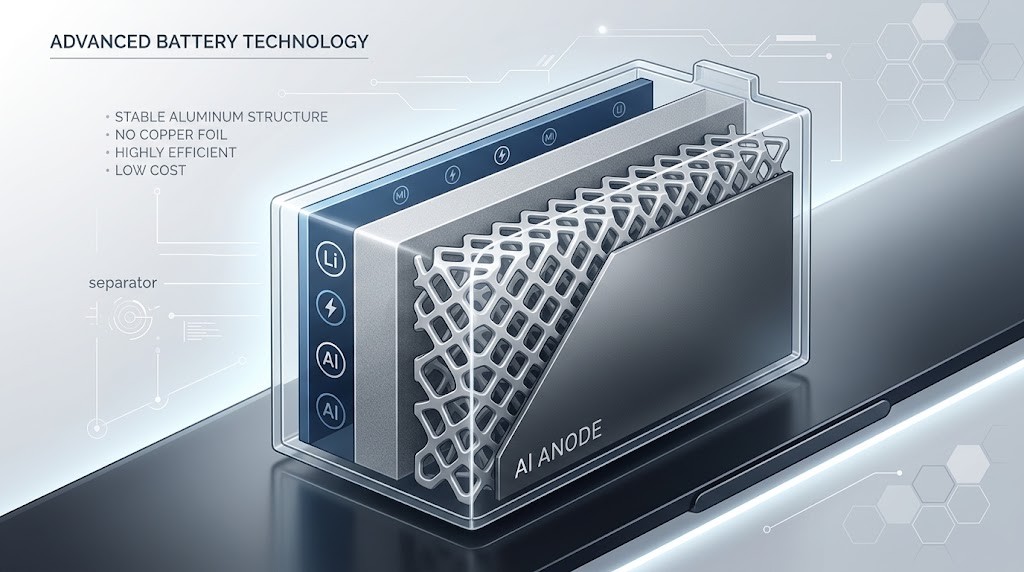
アルミニウムは高容量かつ低コストで豊富な金属資源として、リチウムイオン電池の理想的な負極候補とされてきましたが、充放電に伴う急激な体積変化と粉砕現象が実用化の大きな壁となっていました。フラウンホーファーIPAは、動作中の材料構造を安定化させる特許技術を開発し、この劣化プロセスを克服。銅箔や複雑なコーティング工程を必要としない革新的なアルミニウム負極セル技術を発表しました。
【ニュースの概要と主要ポイント】
- 発表機関: フラウンホーファー製造工学・自動化研究所(Fraunhofer IPA)およびシュトゥットガルト大学太陽光発電研究所。
- 主要な成果: 充放電時の微細構造劣化や電極粉砕を抑え、電気的接触を多数サイクルにわたり維持する特許取得済みのアルミニウム負極安定化技術を開発。
- 製造コストとプロセスの大幅削減:
- 安価な市販のアルミニウム合金箔を集電体兼活物質として使用。
- 重い銅箔(集電体)やグラファイト/シリコンの塗布(コーティング工程)が不要になり、製造工程のコストと消費エネルギーを大幅に削減。
- 既存インフラへの適合: 新たな製造設備を建設することなく、既存のリチウムイオン電池(LIB)生産ラインにそのまま統合可能。現在、デジタル電池セル生産センター(ZDB)にて試作品の評価試験が進行中。
【技術的特長と安全性の進化】
- PFASフリー・フッ素フリー構成の実現:
- 正極にリチウムマンガン酸化物(LMO)を採用。
- 高引火点かつフッ素フリーの代替電解液と組み合わせることで、万一の漏洩時にも有害なフッ化水素(HF)が発生しない、完全PFASフリーの安全設計を実現。
- グラファイトおよびリン酸塩からの脱却:
- 欧州で供給リスクが高いとされるグラファイトを使用せず、リチウム鉄リン酸(LFP)正極の代替としてリン酸塩不使用のLMOを提示。
- 想定される用途: 小型・高信頼性・高安全性が重視される航空貨物追跡用コンテナや、特殊医療機器、過酷な温度環境でのエネルギー貯蔵など。
【関連情報の補足】
- アルミニウム負極の動作メカニズムと技術的突破口:
- アルミニウムはリチウムと合金化(LiAl合金を形成)することで、理論上高い容量(約993 mAh/g)を発揮しますが、リチウムの挿入・脱離時に約100%近い体積膨張が起き、電極が微粉化することが最大の課題でした。今回の技術は、市販アルミニウム合金の組成や機械的構造を最適化・安定化することで、集電体としての強度と負極活物質としての合金化反応を両立させた点が画期的です。
- 欧州におけるPFAS規制とサプライチェーン自立への寄与:
- 欧州連合(EU)では現在、環境残留性の高いPFAS(有機フッ素化合物)に対する規制強化が進んでおり、電池材料におけるフッ素フリー化(バインダーや電解質塩の脱フッ素)は極めて重要な開発テーマとなっています。また、中国依存度の高いグラファイトや銅の消費量を削減できる本技術は、欧州のバッテリーサプライチェーンの地政学的リスク軽減に大きく貢献すると期待されます。
Fraunhofer IPA Develops Technology for Practical High-Capacity, Low-Cost Aluminum Anode Batteries
Aluminum has long been considered an ideal anode candidate for lithium-ion batteries due to its high capacity, low cost, and natural abundance. However, severe volume changes and pulverization during charge and discharge cycles have posed major hurdles to commercialization. Fraunhofer IPA has developed a patented technology to stabilize the material structure during operation, overcoming this degradation process and introducing an innovative aluminum anode cell technology that requires neither copper foil nor complex coating steps.
News Overview and Key Highlights
- Publishing Organizations: Fraunhofer Institute for Manufacturing Engineering and Automation (Fraunhofer IPA) and the Institute for Photovoltaics at the University of Stuttgart.
- Key Achievement: Developed a patented stabilization technology for aluminum anodes that suppresses microstructural degradation and electrode pulverization during cycling, maintaining electrical contact across numerous cycles.
- Significant Reduction in Manufacturing Costs and Processes:
- Utilizes low-cost, commercially available aluminum alloy foil as both current collector and active material.
- Eliminates the need for heavy copper foil (current collectors) and graphite or silicon coating steps, significantly reducing manufacturing costs and energy consumption.
- Compatibility with Existing Infrastructure: Can be integrated directly into existing lithium-ion battery (LIB) production lines without constructing new manufacturing facilities. Prototype evaluation testing is currently underway at the Center for Digitalized Battery Cell Production (ZDB).
Technical Features and Safety Innovations
- Implementation of PFAS-Free and Fluorine-Free Design:
- Employs lithium manganese oxide (LMO) for the cathode.
- Combined with a high-flashpoint, fluorine-free alternative electrolyte, achieving a completely PFAS-free safety architecture that eliminates the risk of toxic hydrogen fluoride (HF) generation even in the event of a leak.
- Departure from Graphite and Phosphates: Eliminates graphite—viewed as a high supply-risk material in Europe—and offers phosphate-free LMO as a cost-effective alternative to lithium iron phosphate (LFP) cathodes.
- Anticipated Applications: Small-scale applications where high reliability and safety are critical, such as tracking containers for air freight, specialized medical devices, and energy storage in demanding temperature environments.
Supplementary Context
- Operating Mechanism and Technical Breakthrough of Aluminum Anodes:
- Aluminum offers a high theoretical capacity of approximately 993 mAh/g by alloying with lithium to form LiAl. However, nearly 100 percent volume expansion during lithium insertion and extraction leads to severe electrode pulverization, which has historically been the primary challenge. This technology represents a major breakthrough by optimizing and stabilizing the composition and mechanical structure of commercial aluminum alloys, successfully balancing structural strength as a current collector with alloy reaction activity as an anode material.
- Contribution to PFAS Regulations and Supply Chain Independence in Europe:
- As the European Union (EU) tightens regulations on persistent per- and polyfluoroalkyl substances (PFAS), developing fluorine-free battery materials (eliminating fluorine from binders and electrolyte salts) has become a crucial goal. Additionally, by reducing reliance on graphite and copper—which carry high dependence on Chinese supply chains—this technology is expected to contribute significantly to mitigating geopolitical risks in the European battery supply chain.


コメント