ナトリウムイオン電池(SIB)は、リチウム資源の枯渇や価格高騰を背景に、次世代の安価で安全な蓄電池として世界中で実用化研究が進んでいます。
その鍵を握るのが、電池の性能や寿命を直接左右する「正極材料」の改善です。特に「層状酸化物」と呼ばれる正極材料は高いエネルギーを持てる反面、充電・放電を繰り返すと結晶構造が壊れやすいという弱点がありました。
この問題を解決する切り札として注目されているのが、アルカリ・アルカリ土類金属(AAEM: Li, Mg, K, Caなど)を微量に混ぜ込む「ドープ技術」です。
各元素の役割と最新技術のポイントを分かりやすく整理しました。
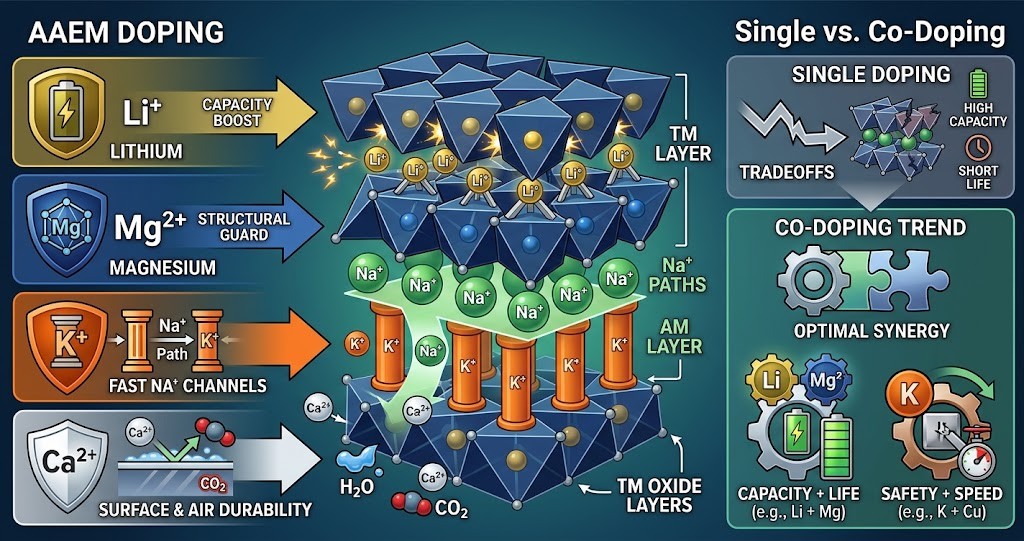
1. 代表的な4つの金属イオン(AAEM)の役割
元素ごとに「入る場所」と「得意な仕事」が異なり、弱点を補い合います。
- リチウム(Li⁺):「容量アップ」が得意
- 金属層(TM層)に入り込み、酸素の力を引き出して充電できる電気の量(容量)を大きく増やします。
- マグネシウム(Mg²⁺):「歪み(ひずみ)ガード」が得意
- 金属層(TM層)に入り、充放電時に起こる結晶の変形や崩壊を防いで、電池の骨格をしっかり支えます。
- カリウム(K⁺):「なめらかな抜け道づくり」が得意
- ナトリウム層(AM層)に入り込みます。サイズが大きい原子なので「柱(ピラー)」として隙間を押し広げ、ナトリウムイオンの移動をスムーズにして急速充電を可能にします。
- カルシウム(Ca²⁺):「空気・水分への耐久性向上」が得意
- ナトリウム層(AM層)に入り、完全放電に近い状態でも構造を守るほか、空気中の水分や二酸化炭素による表面の劣化を防ぎます。
2. 2つ以上を組み合わせる「共ドープ」でさらに進化
単一の元素だけでは「容量は増えるが寿命が縮む」といった貿易オフ(二律背反)が起こりやすいため、最近では複数の元素を同時に混ぜる「共ドープ」がトレンドです。
- AAEM同士の組み合わせ(例:Li + Mg)
- Liで「大容量」にしながら、Mgで「高寿命」にする、いいとこ取りが可能です。
- AAEM + ほかの金属(例:Li + Cu)
- 高電圧で充電した際に発生しやすい有害な酸素ガスの放出を抑え、安全に高速充放電ができるようになります。
- AAEM + フッ素やホウ素(例:K + F)
- 強固な化学結合を作り出し、劣化に強いタフな正極を作ることができます。
このように、元素の性質をパズルのように組み合わせて正極を補強することで、長持ちで安全、かつ急速充電ができる次世代ナトリウムイオン電池の開発が進んでいます。
Frontiers of Alkali and Alkaline-Earth Metal Doping in Layered Oxide Cathodes for Sodium-Ion Batteries
Against the backdrop of lithium resource depletion and skyrocketing costs, research on practical applications for sodium-ion batteries (SIBs) is advancing worldwide as a low-cost, safe, next-generation energy storage solution.
The key to this effort lies in improving cathode materials, which directly dictate battery performance and lifespan. In particular, layered oxide cathodes offer high energy density, but they suffer from a structural vulnerability: their crystal lattice degrades easily under repeated charge-discharge cycles.
To address this issue, doping technology—incorporating trace amounts of alkali and alkaline-earth metals (AAEMs: Li+, Mg2+, K+, Ca2+, etc.)—has drawn significant attention as a game-changing strategy.
1. Roles of Four Representative Metal Ions (AAEMs)
Each element occupies a distinct lattice site and performs a specific function, mutually compensating for structural weaknesses:
- Lithium (Li+) – Enhancing CapacityIntegrates into the transition metal (TM) layer to activate oxygen redox chemistry, significantly boosting the rechargeable capacity.
- Magnesium (Mg2+) – Mitigating Structural DistortionEnters the transition metal (TM) layer to suppress lattice deformation and structural collapse during cycling, firmly stabilizing the battery framework.
- Potassium (K+) – Facilitating Fast DiffusionOccupies the alkali metal (AM/Na) layer. Due to its large ionic radius, it acts as a “pillar” that widens the interlayer spacing, enabling smooth Na+ transport and rapid charging.
- Calcium (Ca2+) – Improving Environmental & Interfacial StabilityEnters the alkali metal (AM/Na) layer to safeguard the structure even at deep desodiation states, while suppressing surface degradation caused by ambient moisture and CO2.
2. Evolution via Synergistic “Co-Doping”
Relying on a single element often leads to trade-offs (e.g., increasing capacity at the expense of lifespan). Consequently, co-doping multiple elements simultaneously has become a major research trend:
- AAEM + AAEM Combinations (e.g., Li+Mg)Combines the strengths of both elements—leveraging Li for high capacity and Mg for extended lifespan.
- AAEM + Transition Metal Combinations (e.g., Li+Cu)Suppresses harmful oxygen gas release during high-voltage charging, enabling safe, high-rate charge-discharge performance.
- AAEM + Anion/Light Element Combinations (e.g., K+F)Establishes robust chemical bonds to create highly durable, degradation-resistant cathodes.
By strategically combining elemental properties like puzzle pieces to reinforce cathode structures, researchers are accelerating the development of long-lasting, safe, and fast-charging next-generation sodium-ion batteries.

コメント