電気自動車(EV)やエネルギー貯蔵システム(ESS)の進化に伴い、次世代バッテリーである「固体電池」や「乾式電極(ドライ電極)」への注目が世界中で高まっています。しかし、これらの新しい電池は従来の液体電池とは構造が大きく異なるため、「いかに高品質で大量生産するか」という製造技術の確立が世界的な課題となっています。
2026年6月4日、産業用スチールベルトおよび加工システムの世界的リーダーであるIPCOグループのCTO、ペトリック・ジーベイル博士が、次世代バッテリーの量産化を可能にする同社のモジュール式ダブルベルトプレス技術について解説しました。その要点と背景を整理します。
- 1. 発表の要点:IPCO社が解決する「量産の課題」
- 2. 【関連情報】技術の背景:なぜ今「乾式電極」と「スチールベルト」なのか?
- 3. 市場の動向:成長を牽引する地域と産業
- まとめ:今後の展望
- 1. Key Takeaways: The “Mass Production Challenges” IPCO Resolves
- 2. [Context] Technical Background: Why “Dry Electrodes” and “Steel Belts” Now?
- 3. Market Trends: Regions and Industries Driving Growth
- Summary: Future Outlook
1. 発表の要点:IPCO社が解決する「量産の課題」
次世代バッテリーの製造において、IPCO社の「ロールツーロール加工」と「ダブルベルトプレス」の組み合わせが注目されている理由は以下の通りです。
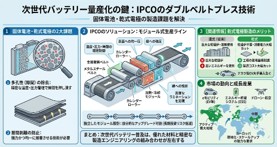
① 固体電池・乾式電極における製造の2大課題
- 多孔性(隙間)の除去: 液体電解質を使わない固体電池や乾式電極では、材料の中にわずかでも隙間(多孔性)があると電気がうまく流れません。厳密な温度・圧力管理で隙間を完全に押し潰す必要があります。
- 層間剥離の防止: 電池の材料(層)が剥がれてしまうことは故障の最大原因です。強力かつ均一に接着させる技術が不可欠です。
② IPCOのソリューション:連続プレスとモジュール化
- 温度・圧力・時間の精密制御: スチールベルトプレスと複数のカレンダーローラーを組み合わせることで、単一のライン内で「表面への均一な圧力」と「線への強い圧力」を同時にコントロールし、高度なラミネーション(積層)を実現。
- モジュール式(分割型)生産ライン: バッテリーの化学組成や技術は日々進化します。IPCOのラインは各セグメントが独立したモジュール設計になっており、将来の技術刷新時にもライン全体を買い替えることなく、部分的なアップグレード(改造)が可能です。長期的な投資リスクを大幅に低減します。
- 並行開発が可能なテストセンター: ドイツ・フェルバッハなどのテストセンターを提供することで、顧客は実生産ラインを止めることなく、新製品の検証やプロセス開発を並行して行えます。
2. 【関連情報】技術の背景:なぜ今「乾式電極」と「スチールベルト」なのか?
記事の理解を深めるために、製造現場で起きているパラダイムシフトを補足します。
① 「乾式電極(ドライ電極)」製造のメリット
従来の電極製造は、材料を溶剤に混ぜてドロドロの「スラリー(液体)」にし、それを金属箔に塗ってから、巨大なオーブンで長時間かけて乾燥させる「湿式」が主流でした。 これに対し、乾式電極技術は溶剤を一切使わず、粉末状の材料をそのままプレスしてシート化します。
- メリット: 巨大な乾燥炉が不要になるため、工場の敷地面積を劇的に削減でき、消費電力(CO2排出量)と製造コストを大幅にカットできます。テスラをはじめとする世界のEV・電池大手が導入を急いでいます。
- 課題: 液体を介さないため、粉末同士を均一に結合・成形するために、IPCO社が提供するような超高精度のプレス技術が必要不可欠となります。
② IPCO社(イプコ)とはどんな企業か?
元々はスウェーデンの世界的エンジニアリング企業「サンドビック(Sandvik)」のプロセスシステム部門であり、スチールベルトを用いた加熱・冷却・成形技術において100年以上の歴史を持っています。化学、食品、複合材料など、超高精度な連続シート加工が求められるあらゆる産業を支えてきたノウハウが、現在の最先端バッテリー製造に活かされています。
3. 市場の動向:成長を牽引する地域と産業
ジーベイル博士は、次世代バッテリーの需要と成長について以下のように分析しています。
- 牽引する産業:
- eモビリティ(EV・電動輸送機器): 最大の推進力。
- エネルギー貯蔵システム(ESS): 電力網やデータセンター向け。
- ドローン・航空用途: 特にエネルギー密度の高いバッテリーが要求される分野。
- 活発な地域: 中国が市場を主導していますが、北米や欧州でも次世代バッテリーの開発が並行して活発化しています。欧州ではモロー(Morrow)社の破産申請など逆風のニュースもありますが、クリーンエネルギーへの移行に伴う製造の現地化・規模拡大(スケールアップ)の要求は依然として強力です。
まとめ:今後の展望
次世代バッテリーの普及を左右するのは、「優れた化学(材料)」だけでなく、「それを安く、安定して大量に作れる製造技術(エンジニアリング)」との組み合わせです。
IPCO社のように、長年他の産業で培われた精密な金属ベルト加工や熱管理のノウハウが、これからのバッテリー量産工場(ギガファクトリー)の標準仕様になっていくかどうかが、実用化のスピードを握る鍵となります。
Overcoming the Mass Production Barrier for Next-Generation Batteries (Solid-State & Dry Electrode): IPCO’s Innovative Press Manufacturing Technology
With the evolution of electric vehicles (EVs) and energy storage systems (ESS), global attention is increasingly focusing on next-generation batteries, such as solid-state batteries and dry electrodes. However, because the structures of these new batteries differ fundamentally from conventional liquid-electrolyte batteries, establishing manufacturing technologies that allow for high-quality mass production has become a critical global challenge.
On June 4, 2026, Dr. Petric de Vaal, CTO of the IPCO Group—a global leader in industrial steel belts and processing systems—explained how the company’s modular double belt press technology enables the mass production of next-generation batteries. Below is a summary of the key takeaways and technical background.
1. Key Takeaways: The “Mass Production Challenges” IPCO Resolves
In next-generation battery manufacturing, the combination of IPCO’s “roll-to-roll processing” and “double belt press” solutions is drawing significant attention due to the following factors:
(1) Two Major Manufacturing Challenges in Solid-State & Dry Electrode Batteries
- Elimination of Porosity (Gaps): In solid-state batteries and dry electrodes that do not use liquid electrolytes, even the slightest gap (porosity) within the materials disrupts the efficient flow of electricity. It is crucial to completely flatten and eliminate these gaps under strictly controlled temperature and pressure conditions.
- Prevention of Delamination: Delamination (peeling between material layers) is a leading cause of battery failure. Technology capable of creating a strong, uniform bond between layers is indispensable.
(2) IPCO’s Solution: Continuous Pressing and Modularization
- Precision Control of Temperature, Pressure, and Time: By combining a steel belt press with various calender rollers, the system simultaneously controls both “uniform surface pressure” and “high line pressure” within a single production line, achieving advanced lamination.
- Modular Production Lines: Battery chemistries and technologies are evolving rapidly. IPCO’s lines are designed with independent modular segments, allowing specific modules to be individually upgraded without replacing the entire line when future innovations occur. This drastically reduces long-term investment risks.
- Test Centers for Parallel Development: By offering test centers, such as the one in Fellbach, Germany, IPCO enables customers to validate new products and develop processes in parallel without halting their actual commercial production lines.
2. [Context] Technical Background: Why “Dry Electrodes” and “Steel Belts” Now?
To deepen your understanding of the article, here is some additional context regarding the paradigm shift occurring on the factory floor.
(1) Advantages of “Dry Electrode” Manufacturing
Conventional electrode manufacturing predominantly relies on a “wet process,” where raw materials are mixed with solvents into a thick “slurry,” coated onto metal foils, and then dried over a long period in massive ovens. In contrast, dry electrode technology uses no solvents at all, directly pressing powdered materials into sheets.
- Advantages: Eliminating the need for massive drying ovens drastically reduces the factory footprint, cutting power consumption (CO2 emissions) and manufacturing costs significantly. Global EV and battery giants, including Tesla, are rushing to implement this technology.
- Challenges: Because no liquids are used, an ultra-high-precision pressing technology—such as the one provided by IPCO—is absolutely vital to uniformly bind and shape the powder particles.
(2) What Kind of Company is IPCO?
Originally the process systems division of Sandvik, the world-renowned Swedish engineering company, IPCO boasts over 100 years of history in heating, cooling, and forming technologies utilizing steel belts. Its long-standing expertise in supporting industries that require ultra-high-precision continuous sheet processing—such as chemicals, food, and composite materials—is now being applied to cutting-edge battery manufacturing.
3. Market Trends: Regions and Industries Driving Growth
Dr. de Vaal analyzes the demand and growth of next-generation batteries as follows:
- Driving Industries:
- e-Mobility (EVs and Electric Transportation): The primary driving force.
- Energy Storage Systems (ESS): Tailored for power grids and data centers.
- Drones and Aerospace Applications: Sectors specifically demanding ultra-high energy density.
- Active Regions: While China leads the market, development of next-generation batteries is simultaneously accelerating in North America and Europe. Despite headwinds in Europe, such as Morrow’s bankruptcy filing, the demand for localized manufacturing and scaling up driven by the clean energy transition remains incredibly strong.
Summary: Future Outlook
The widespread adoption of next-generation batteries depends not only on “excellent chemistry (materials)” but also on its combination with “manufacturing technology (engineering) that can produce them cheaply, stably, and in large quantities.”
Whether the precision metal belt processing and thermal management expertise developed over decades in other industries by companies like IPCO will become the standard specification for tomorrow’s battery mass-production factories (gigafactories) remains the ultimate key to accelerating commercialization.

コメント