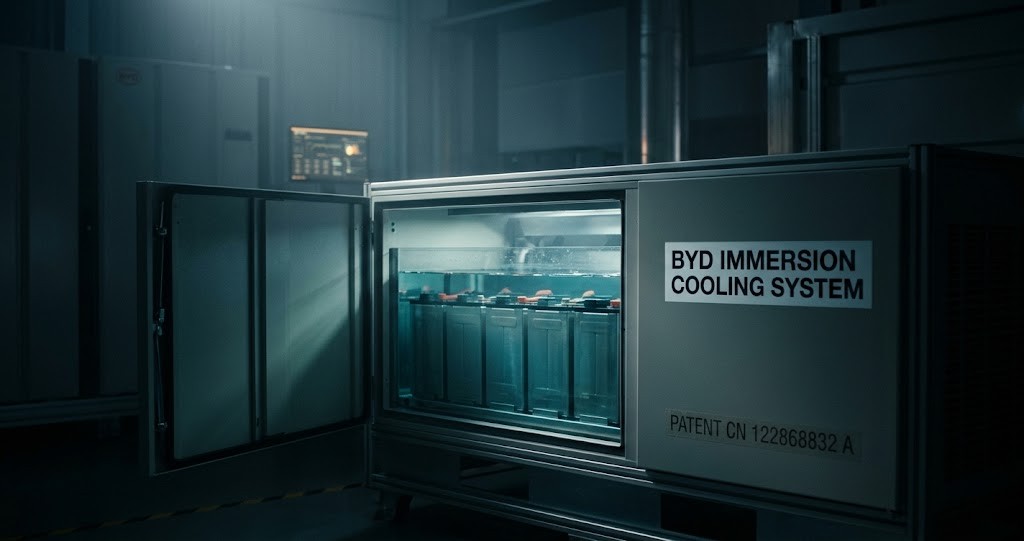
中国のEV・蓄電池大手であるBYDが、バッテリーセルを誘電性液体(絶縁冷却液)に直接浸す「浸漬冷却(イマーション・クーリング)」に関する新たな特許を出願しました。
2026年10月5日に中国国家知識産権局(CNIPA)より公開された特許出願(CN 122868832 A、2025年3月出願)は、大型の据え置き型蓄電システム(エネルギー貯蔵装置)向けバッテリーキャビネットに関する技術です。浸漬冷却の実用化において最大の課題となる「液密性と電気接続の両立」に対して、独自の筐体構造でアプローチしています。
- 1. 特許出願(CN 122868832 A)の技術的ポイント
- 2. 従来の「間接冷却」と「浸漬冷却」の比較
- 3. 据え置き型蓄電池で浸漬冷却が注目される背景
- 4. 今後の課題と展望
- 1. Key Technical Features of Patent Application CN 122868832 A
- 2. Comparison Between Conventional Indirect Cooling and Immersion Cooling
- 3. Why Immersion Cooling Is Gaining Attention in Stationary Storage
- 4. Challenges and Outlook
1. 特許出願(CN 122868832 A)の技術的ポイント
本特許の核心は、キャビネット内部を物理的に2つのエリアに完全分離し、配線のルートを最適化した点にあります。
- 2室分離構造(ドライ/ウェットの完全分離)
- 上部チャンバー(乾燥区画): 制御機器や電気機器などの部品を配置。
- 下部チャンバー(液体区画): 炭化水素系やエステル系などの非導電性誘電流体を満たし、セルモジュールを直接浸漬。
- 配線を上部から通す高耐久密閉設計
- 液体チャンバーの底面や側面に配線貫通口を設けず、配線を一度上部に引き上げてから上部チャンバーへ接続。
- 深さに比例して高くなる静水圧(液圧)の影響を最小限に抑え、液漏れリスクを大幅に低減。
2. 従来の「間接冷却」と「浸漬冷却」の比較
バッテリーの熱管理(サーマルマネジメント)において、従来の方式と今回の浸漬冷却方式では構造や伝熱効率に明確な違いが存在します。
| 項目 | 従来方式(間接液冷) | BYDの新規技術(直接浸漬冷却) |
| 冷却方法 | アルミ製の冷却プレート(コールドプレート)に冷却液を循環 | 絶縁性の不導電性流体にバッテリーセルを丸ごと直接浸漬 |
| 熱伝導経路 | セル -> ケース -> タイム(熱伝達シート等) -> プレート -> 冷却液 | セル表面 -> 冷却液(ダイレクト伝熱) |
| 熱伝達効率 | 界面抵抗が多く、高速充放電時の局所発熱に対応しにくい | 伝熱経路が短く、セル全体の温度均一性が非常に高い |
| 主な用途例 | CATL (EnerOne, EnerC, 麒麟バッテリー), BYD (MC Cube-T) | 次世代データセンターバックアップ、超急速充電ステーション、定置用BESS |
3. 据え置き型蓄電池で浸漬冷却が注目される背景
AIデータセンターの拡大(高電力ラック導入)や、出力密度の高い再エネ連系用蓄電システム(BESS)の普及に伴い、バッテリーの充放電時に発生する熱量は著しく増加しています。
- 熱暴走(サーマルランナウェイ)の連鎖防止万が一、一部のセルが内部ショート等で異常発熱を起こした場合でも、不導電性の液体が周囲を囲んでいるため、隣接セルへの熱伝播を物理的・物理化学的に遮断しやすくなります。
- 高出力充放電(Cレート向上)の実現直接冷却によってセル内部の温度差を極小化できるため、セルへの負荷を抑えつつ超高速充放電を行うことが可能になります。
- 長期寿命化セルの作動温度を最適かつ均一に保てるため、セルの劣化速度を緩和できます。
4. 今後の課題と展望
- 商業化へのステップ本出願は現在実体審査中(出願段階)であり、BYDが直ちに商業量産に入ることを示すものではありません。
- 自動車用(EV)への展開本出願は「据え置き型(キャビネット型)」に特化した内容です。EVなどの車載用途では、液体の重量増加や振れ動き(スロッシング)、車両事故時の液体漏洩リスクなどの課題が存在するため、まずは産業用・電力用蓄電池(BESS)領域からの社会実装が進むと考えられます。
出典:https://carnewschina.com/2026/10/06/byd-puts-battery-cells-directly-in-cooling-liquid-in-new-patent/
BYD Files New Patent Application: How Direct Immersion Cooling Is Transforming Battery Thermal Management
BYD, a major Chinese EV and battery manufacturer, has filed a new patent related to immersion cooling, a technology in which battery cells are directly submerged in a dielectric (electrically insulating) fluid.
Published by the National Intellectual Property Administration of China (CNIPA) on October 5, 2026, the patent application (CN 122868832 A, filed in March 2025) covers a battery cabinet designed for large-scale stationary energy storage systems (BESS). It addresses the primary challenge in commercializing immersion cooling—achieving both fluid tightness and reliable electrical connections—through an innovative enclosure architecture.
1. Key Technical Features of Patent Application CN 122868832 A
The core innovation lies in physically separating the cabinet interior into two distinct compartments while optimizing the wiring layout.
- Two-Chamber Separation Structure (Complete Dry/Wet Separation)
- Upper Chamber (Dry Zone): Houses control systems, electrical components, and associated equipment.
- Lower Chamber (Wet Zone): Filled with non-conductive dielectric fluid (such as hydrocarbon- or ester-based fluids) in which cell modules are directly submerged.
- High-Durability Sealed Design with Top-Routed Wiring
- Wiring penetrations are avoided on the bottom and sidewalls of the fluid chamber. Instead, cables are routed upward before crossing over into the upper dry chamber.
- This structure minimizes exposure to hydrostatic pressure, which increases with depth, thereby substantially reducing the risk of fluid leakage.
2. Comparison Between Conventional Indirect Cooling and Immersion Cooling
Significant structural and thermal transfer differences exist between conventional battery thermal management systems and this direct immersion cooling approach.
| Item | Conventional Method (Indirect Liquid Cooling) | BYD’s New Technology (Direct Immersion Cooling) |
|---|---|---|
| Cooling Method | Circulation of liquid coolant through aluminum cooling plates (cold plates) | Direct submersion of entire battery cells in non-conductive dielectric fluid |
| Heat Transfer Path | Cell -> Case -> TIM (Thermal Interface Material) -> Plate -> Coolant | Cell Surface -> Coolant (Direct heat transfer) |
| Thermal Transfer Efficiency | High interfacial thermal resistance; struggles with localized heating during high-rate charging/discharging | Short heat transfer path with extremely uniform temperature distribution across cells |
| Primary Applications | CATL (EnerOne, EnerC, Qilin Battery), BYD (MC Cube-T) | Next-generation data center backup power, ultra-fast charging stations, stationary BESS |
3. Why Immersion Cooling Is Gaining Attention in Stationary Storage
With the expansion of AI data centers (and the deployment of high-power server racks) alongside the growth of high-power-density renewable energy storage systems (BESS), heat generation during battery charge and discharge cycles has increased significantly.
- Mitigation of Cascading Thermal Runaway If an individual cell experiences an internal short circuit or severe overheating, the surrounding non-conductive dielectric fluid acts as a physical and thermochemical barrier to prevent thermal propagation to adjacent cells.
- Enabling High-Rate Charging and Discharging (Higher C-Rates) Direct liquid contact minimizes internal cell temperature gradients, allowing ultra-fast charging and discharging while reducing mechanical and thermal stress on the cells.
- Extended Service Life Maintaining cells at an optimal and highly uniform operating temperature suppresses degradation and extends overall battery lifespan.
4. Challenges and Outlook
- Steps Toward Commercialization This patent application is currently undergoing substantive examination, meaning it does not indicate immediate commercial mass production by BYD.
- Potential for Electric Vehicle (EV) Applications This specific application focuses on stationary, cabinet-type systems. For automotive applications, challenges such as added fluid weight, sloshing behavior, and leakage risks during vehicle accidents must be addressed. Consequently, commercial deployment is expected to begin in the industrial and utility-scale energy storage (BESS) sectors.
コメント