急速に進化を続けるモバイル・IT機器の心臓部であるバッテリー分野において、今、大きな世代交代の波が押し寄せています。これまでスマートフォンの長時間駆動を支えてきた「シリコンカーボン電池」ですが、その登場から間もなく、それを遥かに凌駕する「全固体電池」という真の革命的技術が現実のものとなりつつあります。
日常の充電ストレスから人類を解放するかもしれない、この次世代バッテリー技術の最新動向と、未来のロードマップについて詳しくまとめました。
- 1. シリコンカーボン電池:現行技術の限界と進化
- 2. 全固体電池:ゲームチェンジャーとなる革新技術
- 3. メーカーの動向と実用化ロードマップ
- 4. 追加情報:全固体電池が抱える現在の壁
- 5. まとめ
1. シリコンカーボン電池:現行技術の限界と進化
シリコンカーボン電池は、従来のリチウムイオン電池の負極にシリコンを添加した改良型技術です。
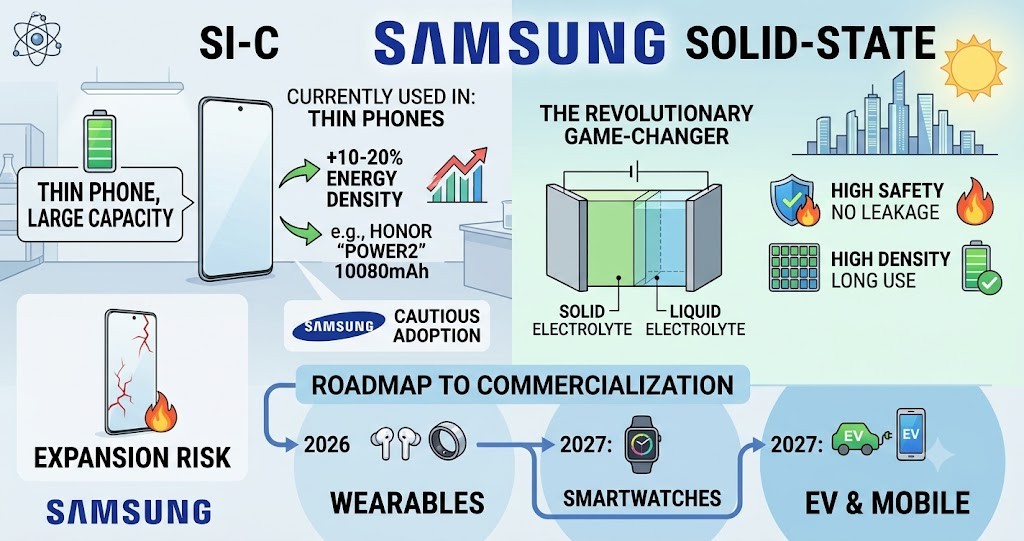
- メリット: エネルギー密度が10%から20%向上します。デバイスの厚みを増やさずに、6000mAhから7000mAh、あるいは中国Honor社の「Power2」のように10080mAhといった超大容量バッテリーを薄型スマホに搭載できます。
- デメリットと課題: シリコンは充放電時に最大300%も膨張する特性があり、電極が破損するリスクがあります。この安全上の理由から、サムスンなどは採用に慎重な姿勢を崩していません。現行の延長線上の技術であり、劇的なブレイクスルーとは言えない側面があります。
2. 全固体電池:ゲームチェンジャーとなる革新技術
シリコンカーボン電池が「既存ルールの改良」であるのに対し、全固体電池は「バッテリーの常識を覆す革命(ゲームチェンジャー)」と期待されています。
- 構造の変化: 従来の可燃性液体電解質をすべて「固体基板」に置き換えます。
- 主なメリット: * 高い安全性: 液漏れがなく、衝撃や高温に対しても非常に安全です。
- 高密度化: 安全対策のための余分なスペースが不要になり、より多くのセルを詰め込めるため、機器を数週間連続稼働させることも不可能ではありません。
- ワイヤレスな未来: 充電ケーブルに縛られない生活が現実味を帯びてきます。
3. メーカーの動向と実用化ロードマップ
全固体電池の登場により、今後の市場は以下のように動くと予想されています。
サムスン電機のロードマップ(ウェアラブルから開始)
部品スペースが極めて限られているスマートウェアラブルデバイスが、全固体電池の最初の出発点となります。
- 2026年後半: 超小型全固体電池を開発し、「Galaxy Ring」を皮切りにワイヤレスヘッドホンへ搭載。
- 2027年: スマートウォッチへ搭載。
サムスンSDIのロードマップ
- 2027年まで: 電気自動車(EV)およびモバイルデバイス向けに全固体電池を商用化することを目指しています。
4. 追加情報:全固体電池が抱える現在の壁
非常に有望な全固体電池ですが、世界的な普及までにはまだ超えなければならないハードルが存在します。
- 界面抵抗の課題: 固体同士(電極と固体電解質)を密着させる必要があるため、原子レベルでの接触(界面)の制御が難しく、電気の流れが滞りやすいという技術的難題があります。
- 製造コストの高さ: 特殊な素材や精密な製造環境が必要となるため、現時点では低コストでの量産が極めて困難です。そのため、まずは高価格帯のウェアラブルや高級EVから段階的に導入される見込みです。
5. まとめ
毎日15%のバッテリー残量警告に怯える時代は、終わりを迎えつつあります。スマートフォンを薄く大容量にするシリコンカーボン電池は過渡期の技術となり、2026年から2027年にかけて登場する「全固体電池」こそが、私たちのデジタルライフやEVの未来を根本から変える真の主役となるでしょう。
出典:https://www.vietnam.vn/ja/cong-nghe-pin-moi-sap-khien-pin-silicon-carbon-loi-thoi
Samsung Joins the Move: The Generational Shift to Solid-State Batteries Beginning in 2026-2027
A massive wave of generational change is currently sweeping through the battery sector, the vital heart of rapidly evolving mobile and IT devices. While silicon-carbon batteries have recently supported longer runtimes for smartphones, a true technological revolution is already becoming a reality: solid-state batteries, which far outperform their predecessor.
This report provides an in-depth look at the latest trends and future roadmaps for this next-generation battery technology, which could soon free humanity from the daily stress of charging.
1. Silicon-Carbon Batteries: Limits and Evolution of Current Technology
Silicon-carbon batteries are an improved version of conventional lithium-ion batteries, created by adding silicon to the negative electrode (anode).
- Pros: Energy density increases by 10% to 20%. This allows manufacturers to pack ultra-high-capacity batteries—ranging from 6000mAh to 7000mAh, or even 10080mAh as seen in Chinese manufacturer Honor’s “Power2″—into slim smartphones without increasing device thickness.
- Cons and Challenges: Silicon has a property that causes it to expand by up to 300% during charging and discharging, posing a risk of electrode damage. Due to these safety concerns, companies like Samsung maintain a cautious stance regarding its adoption. Ultimately, it remains an extension of existing technology rather than a dramatic breakthrough.
2. Solid-State Batteries: A Game-Changing Innovation
While silicon-carbon batteries are merely an improvement on existing rules, solid-state batteries are expected to be a true game-changer that completely rewrites battery conventions.
- Structural Change: They completely replace conventional, flammable liquid electrolytes with a solid substrate.
- Key Benefits:
- High Safety: With no risk of liquid leakage, they are exceptionally safe from impacts and high temperatures.
- Higher Density: Eliminating the need for extra space for safety measures allows more cells to be packed in, potentially enabling devices to run continuously for several weeks.
- A Wireless Future: A life free from the constraints of charging cables is becoming a realistic prospect.
3. Manufacturer Trends and Commercialization Roadmaps
With the arrival of solid-state batteries, the market is expected to shift along the following timelines:
Samsung Electro-Mechanics Roadmap (Starting with Wearables)
Smart wearable devices, where component space is extremely limited, will serve as the initial launching pad for solid-state technology.
- Late 2026: Developing ultra-small solid-state batteries to be integrated into wireless headphones, starting with the Galaxy Ring.
- 2027: Integration into smartwatches.
Samsung SDI Roadmap
- By 2027: Aiming to commercialize solid-state batteries for both electric vehicles (EVs) and mobile devices.
4. Additional Information: Current Hurdles for Solid-State Batteries
Despite their immense promise, solid-state batteries still face significant hurdles before they can achieve global adoption.
- Interfacial Resistance Challenges: Because solid components (the electrodes and the solid electrolyte) must be tightly bonded, controlling the contact area at an atomic level (the interface) is highly difficult, often hindering the smooth flow of electricity.
- High Manufacturing Costs: The need for specialized materials and highly precise manufacturing environments makes low-cost mass production extremely difficult at present. Consequently, the technology is expected to be phased in starting with premium wearables and luxury EVs.
5. Conclusion
The era of living in fear of the daily 15% low-battery warning is drawing to a close. Silicon-carbon batteries, which made smartphones thin yet high-capacity, are turning out to be a transitional technology. The solid-state batteries emerging between 2026 and 2027 will be the true main character, fundamentally transforming our digital lives and the future of EVs.

コメント