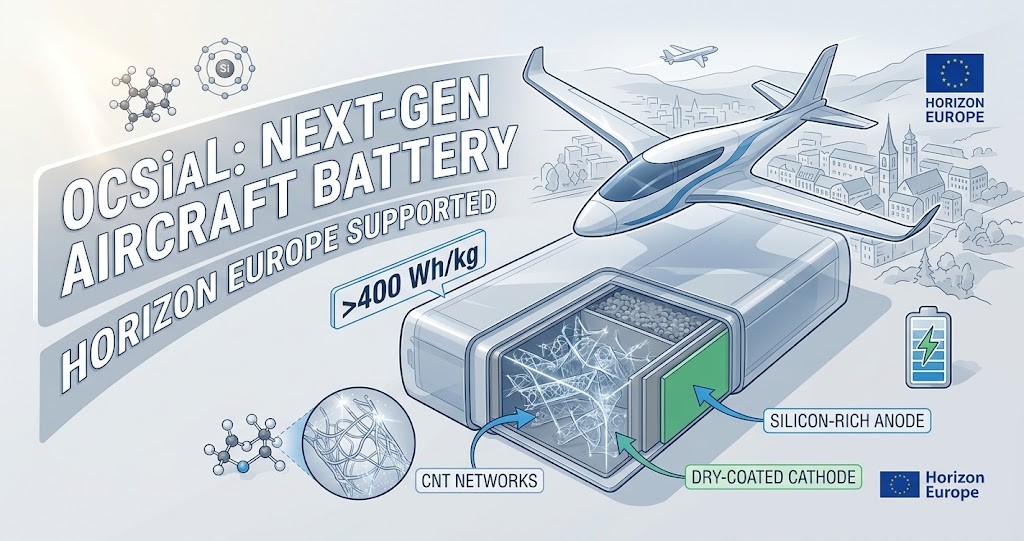
カーボンナノチューブ大手のOCSiAlは2026年10月5日、EU(欧州連合)の「ホライズン・ヨーロッパ」プログラムから支援を受けるコンソーシアムに参加し、エネルギー密度400Wh/kg以上を目指す航空機グレードの次世代バッテリー開発を進めていると発表しました。
このプロジェクトは電動航空機への適用を主眼に置きつつ、欧州のバッテリー産業全体で活用可能な基盤技術の確立を目指しています。高容量なシリコンリッチ負極、ドライコーティング(乾式塗工)正極、およびOCSiAlの単層カーボンナノチューブ(商品名:TUBALL)を組み合わせることで、次世代電池特有の導電性・安定性・製造技術上の課題を解決するアプローチをとっています。
プロジェクトと技術の主なポイント
- 400Wh/kgというエネルギー密度の意義 400Wh/kg超のエネルギー密度は、実用的な電動リージョナル航空機(地域間輸送機)を実現するための必須条件とされています。また本プロジェクトでは、高エネルギー密度化だけでなく、高い安全性と、溶媒を使用しない環境配慮型の乾式電極製造プロセスの確立も追求しています。
- 単層カーボンナノチューブ(SWCNT)の役割 従来の導電助剤とは異なり、SWCNTは少量添加で電極内に広範な導電ネットワークを形成します。これにより活物質間の導電性と電極の機械的強度を高め、充放電に伴うシリコン負極の体積膨張抑制、電極の柔軟性向上、プレス(カレンダー加工)後のスプリングバック軽減を実現します。
- 市場の動向と展望 OCSiAlのエネルギープロジェクト責任者であるアンドレイ・セニウト氏は、SWCNTがシリコンリッチ負極、高ニッケル/単結晶NCM正極、LFP正極、全固体電池、乾式電極などで採用が進んでいると指摘しています。また、SWCNTを適用した電池を搭載するEVの数は2025年だけで3倍に増え、世界で100万台を超えたとして、業界が検証段階から大規模量産フェーズに移行したことを示しています。
- コンソーシアムの体制 電池試作・量産技術を持つUniverCell、電動航空機開発のVaeridionをはじめ、材料・製造・研究領域からダイキンケミカルヨーロッパ、ブラウンシュバイク工科大学、EURA、ウプサラ大学、CIDETEC、Addionics、IKA、LEONHARD KURZ Stiftungなどが参画し、材料開発から航空機への実装までを統合的に推進しています。
関連情報(背景と補足)
- OCSiAlとTUBALLについて OCSiAl(オクシアル)は、ルクセンブルクに本社を置く単層カーボンナノチューブの世界最大手メーカーです。同社の「TUBALL」は、非常に僅かな添加量(0.01-0.1wt%程度)で電極全体の導電性を大幅に引き上げられるため、エネルギー密度を維持したまま急速充電性能やサイクル寿命を向上させる材料として急速に採用が広がっています。
- 乾式電極(ドライコーティング)技術のトレンド 従来の湿式電極製造プロセスでは、NMPなどの有害な溶媒の使用と乾燥工程に莫大な電力と設備が必要でした。有機溶媒を使わない乾式電極技術は、製造コスト削減と工場占有面積の縮小、環境負荷の低減をもたらす次世代プロセスとして、自動車や航空業界から強く注目されています。
- 航空機の電動化に向けた課題 航空機は自動車と比べて要求される出力と安全基準が極めて高く、特に重量あたりのエネルギー密度が航続距離を左右する決定的な要因となります。400Wh/kg級のセルの実現は、化石燃料に依存しないクリーンな短距離空路の開設に向けた非常に重要なマイルストーンです。
出典:https://www.bestmag.co.uk/ocsiai-targets-400-wh-kg-aviation-batteries/
Unlocking the Future of Electric Aviation Beyond 400 Wh/kg: How OCSiAl’s Single-Wall Carbon Nanotubes Address Next-Generation Battery Challenges
On October 5, 2026, carbon nanotube leader OCSiAl announced its participation in a consortium supported by the European Union’s Horizon Europe program to develop next-generation aircraft-grade batteries targeting an energy density of over 400 Wh/kg.
While focusing primarily on applications for electric aircraft, the project aims to establish foundational technologies applicable across the broader European battery industry. The consortium is taking an approach that resolves challenges in conductivity, stability, and manufacturing inherent to next-generation battery architectures by combining silicon-rich anodes, dry-coated cathodes, and OCSiAl’s TUBALL single-wall carbon nanotubes.
Key Highlights of the Project and Technology
- Significance of 400 Wh/kg Energy Density: An energy density exceeding 400 Wh/kg is widely considered a prerequisite for realizing commercially viable electric regional aircraft. Beyond high energy density, the project also pursues enhanced safety and scalable, environmentally friendly dry electrode manufacturing processes that eliminate the use of solvents.
- Role of Single-Wall Carbon Nanotubes (SWCNTs): Unlike conventional conductive additives, SWCNTs form a long-range conductive network throughout the electrode even at low addition rates. This enhances conductivity between active material particles and increases mechanical stability, mitigating volume expansion of silicon anodes during charge-discharge cycles, improving electrode flexibility, and limiting springback after calendering.
- Market Trends and Outlook: Andrey Senyut, Head of Energy Projects at OCSiAl, noted that SWCNTs are being increasingly adopted across next-generation technologies, including silicon-rich anodes, high-nickel and single-crystal NCM cathodes, LFP cathodes, solid-state batteries, and dry electrode structures. He highlighted that the industry has transitioned from validation to large-scale deployment, with the number of electric vehicles using batteries containing SWCNTs tripling in 2025 alone to exceed 1 million units worldwide.
- Consortium Structure: The consortium brings together industry and research leaders across the European battery and aviation value chains, including UniverCell for advanced cell development and pilot manufacturing expertise, and Vaeridion for integrating research into future electric aircraft. Additional members providing expertise in materials, battery technology, and manufacturing include Daikin Chemical Europe, Technische Universitat Braunschweig, EURA, Uppsala University, CIDETEC, Addionics, IKA, and LEONHARD KURZ Stiftung.
Related Information (Background and Context)
- About OCSiAl and TUBALL: Headquartered in Luxembourg, OCSiAl is the world’s largest manufacturer of single-wall carbon nanotubes. Its product, TUBALL, significantly boosts overall electrode conductivity at ultra-low addition levels (around 0.01-0.1 wt%), making it a rapidly adopted material to improve fast-charging performance and cycle life without sacrificing energy density.
- Dry Electrode (Dry Coating) Technology Trends: Traditional wet coating processes require hazardous solvents such as NMP and consume vast amounts of energy and facility footprint during the drying stage. Solvent-free dry electrode processing is drawing intense interest from the automotive and aerospace sectors as a next-generation technology that lowers manufacturing costs, reduces plant footprint, and minimizes environmental impact.
- Challenges in Aircraft Electrification: Aircraft demand far higher power output and safety margins than automobiles, with weight-based energy density being the decisive factor determining flight range. Achieving 400 Wh/kg class cells represents a crucial milestone toward establishing clean, fossil-fuel-free regional air routes.


コメント