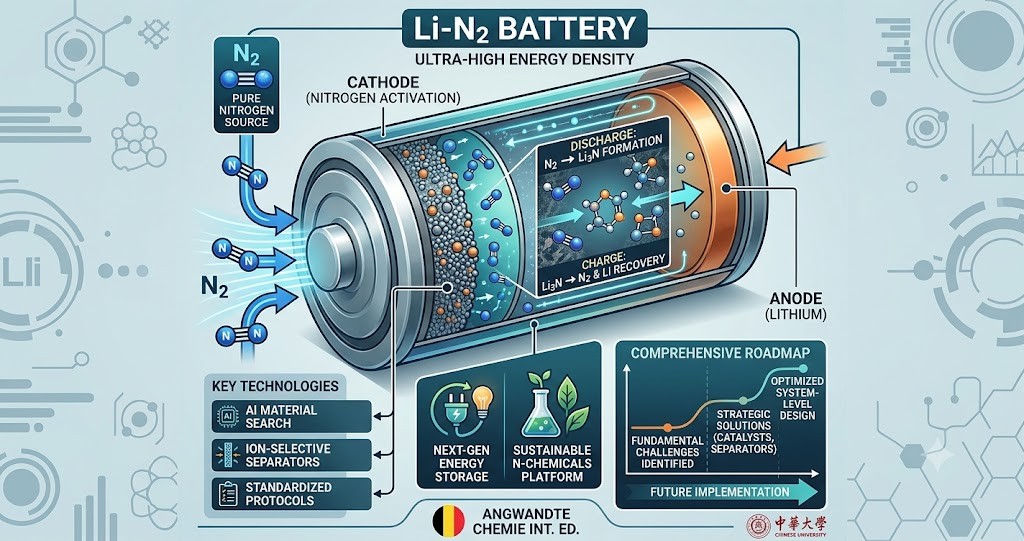
現在のエネルギー貯蔵技術を塗り替える可能性を秘めた「リチウム窒素(Li-N2)電池」は、超高エネルギー密度を達成し得る次世代の革新的な技術として期待されています。さらに、この技術は単なる蓄電デバイスに留まらず、従来のエネルギー多消費型プロセスに代わる、持続可能な窒素系化学物質の製造プラットフォームとしての側面も併せ持っています。本報告書では、ベルギーのナミュール大学と中国の武漢理工大学の研究グループが国際学術誌「Angewandte Chemie International Edition」に発表した最新の包括的ロードマップを基に、実用化に向けた根本的課題、技術提案、および関連する学術的背景を整理・解説します。
1. 最新研究成果の要約
ベルギーと中国の国際研究チームは、Li-N2電池の実用化を拒む主な障壁を特定し、その可逆性と長期安定性を向上させるための初の包括的な開発ロードマップを提示しました。
- 作動原理と進捗: 放電時にリチウムが窒素ガス(N2)と電気化学的に反応して窒化リチウム(Li3N)を形成し、充電時にリチウムと窒素に再生される仕組みです。約10年前に初の可逆型セルが実証されましたが、実用化は限定的でした。
- 特定された根本的課題: 可逆性の低さ、サイクル安定性の限界、窒素活性化速度の遅さ、電解質・電極の劣化、水分や酸素の混入による副反応、不適切なセパレータ設計、および実際のN2からLi3Nへの変換を検証する厳格な評価手法の欠如が挙げられています。
- 提案された解決戦略: 単一の材料開発に依存せず、高安定性電解質、窒素活性化用触媒(鉄系ナノ触媒など)、イオン選択性ガス遮断セパレータ、窒素輸送を促進するフローフィールドアシスト型フローセル構造の導入を推奨しています。また、人工知能(AI)を活用した材料探索や、同位体標識実験を含む標準化された試験プロトコルの確立を求めています。
2. 関連技術情報の補足(背景と重要性)
Li-N2電池の理解を深めるため、以下の化学的・技術的背景が極めて重要となります。
- 窒素分子(N2)の強固な結合と触媒の重要性 窒素ガス(N2)は、窒素原子同士が非常に強力な「三重結合」で結ばれており、化学的に極めて安定(不活性)な気体です。この三重結合を電気化学的に切断してリチウムと反応させるには莫大なエネルギー(高い過電圧)が必要となるため、反応をスムーズに進める「窒素活性化触媒」の設計が技術の成否を握っています。
- グリーン化学および「脱ハーバー・ボッシュ法」への期待 現在、世界のアンモニアなどの窒素化合物の大半は、高温・高圧を必要とする伝統的な「ハーバー・ボッシュ法」で製造されており、多大なエネルギー消費と二酸化炭素(CO2)排出が課題となっています。Li-N2電池技術は、再生可能エネルギー由来の電力を用いて、常温・常圧に近い環境下で窒素を固定(Li3Nの合成)し、そこから各種化学物質へと誘導できるため、クリーンな「グリーン化学」のプラットフォームとして機能します。
3. 結論と今後の展望
本研究グループのYu Li氏が指摘するように、Li-N2電池の課題解決には触媒設計のみならず、セル構成、ガスの純度管理、セパレータの特性、検証プロトコルといったシステム全体の最適化が不可欠です。現在、研究チームは鉄系ナノ触媒の開発やin situ(その場)特性評価技術の実装を進めており、予備実験では慎重に制御された条件下での可逆的な反応を示す有望な兆候が得られています。この技術が概念から実用へと進化すれば、未来のエネルギー貯蔵と持続可能な窒素変換を同時に実現する、単一の統合技術として定着する可能性を秘めています。
Lithium-Nitrogen Batteries: Potential and Development Roadmap
Lithium-nitrogen (Li-N2) batteries, which have the potential to revolutionize current energy storage technologies, are highly anticipated as a next-generation innovative technology capable of achieving ultra-high energy density. Furthermore, this technology is not limited to being a mere energy storage device; it also serves as a sustainable manufacturing platform for nitrogen-based chemicals, replacing traditional energy-intensive processes. Based on the latest comprehensive roadmap published in the international academic journal “Angewandte Chemie International Edition” by a research group from the University of Namur in Belgium and Wuhan University of Technology in China, this report outlines and explains the fundamental challenges, technical proposals, and relevant academic background for its practical application.
1. Summary of the Latest Research Findings
An international research team from Belgium and China has identified the primary barriers hindering the practical application of Li-N2 batteries and presented the first comprehensive development roadmap to improve their reversibility and long-term stability.
- Operating Principle and Progress: The system operates on a mechanism where lithium electrochemically reacts with nitrogen gas (N2) during discharge to form lithium nitride (Li3N), and ideally, lithium and nitrogen are regenerated during charging. Although the first reversible cell was demonstrated nearly a decade ago, the practical application of this technology has remained limited.
- Identified Fundamental Challenges: The challenges include low reversibility, limited cycle stability, slow nitrogen activation kinetics, degradation of electrolytes and electrodes, side reactions caused by moisture and oxygen crossover, inadequate separator design, and the lack of rigorous evaluation methods to verify the true conversion of N2 to Li3N.
- Proposed Solution Strategies: Rather than relying solely on single material development, the roadmap recommends the introduction of highly stable electrolytes, dedicated nitrogen activation catalysts (such as iron-based nanocatalysts), ion-selective gas-blocking separators, and flow-field-assisted flow cell structures that facilitate nitrogen transport. It also calls for the utilization of artificial intelligence (AI) to accelerate material discovery and the establishment of standardized testing protocols, including isotope-labeling experiments.
2. Supplementary Technical Information (Background and Importance)
To deepen the understanding of Li-N2 batteries, the following chemical and technical backgrounds are extremely critical:
- The Strong Bond of Nitrogen Molecules (N2) and the Importance of Catalysts: Nitrogen gas (N2) is an extremely stable (inert) gas chemically, as nitrogen atoms are bound together by an exceptionally strong “triple bond.” Breaking this triple bond electrochemically to react with lithium requires a massive amount of energy (high overpotential). Therefore, the design of a “nitrogen activation catalyst” that facilitates a smooth reaction holds the key to the success of this technology.
- Expectations for Green Chemistry and a “Post-Haber-Bosch” Process: Currently, the majority of the world’s nitrogen compounds, such as ammonia, are manufactured using the traditional “Haber-Bosch process,” which requires high temperatures and high pressures, presenting significant challenges in terms of high energy consumption and carbon dioxide (CO2) emissions. Li-N2 battery technology can fix nitrogen (synthesizing Li3N) under conditions close to ambient temperature and pressure using electricity derived from renewable energy, and then derive various chemical substances from it. Thus, it functions as a clean platform for “green chemistry.”
3. Conclusion and Future Outlook
As pointed out by Dr. Yu Li of the research group, solving the challenges of Li-N2 batteries requires the optimization of the entire system—including cell configuration, gas purity management, separator properties, and verification protocols—rather than focusing on catalyst design alone. Currently, the research team is advancing the development of iron-based nanocatalysts and the implementation of advanced in situ characterization techniques. Preliminary results have shown promising signs that a reversible lithium-nitrogen electrochemical reaction is feasible under carefully controlled conditions. If this technology evolves from a concept to practical application, it holds the potential to establish itself as a single, integrated technology that simultaneously achieves future energy storage and sustainable nitrogen conversion.
コメント