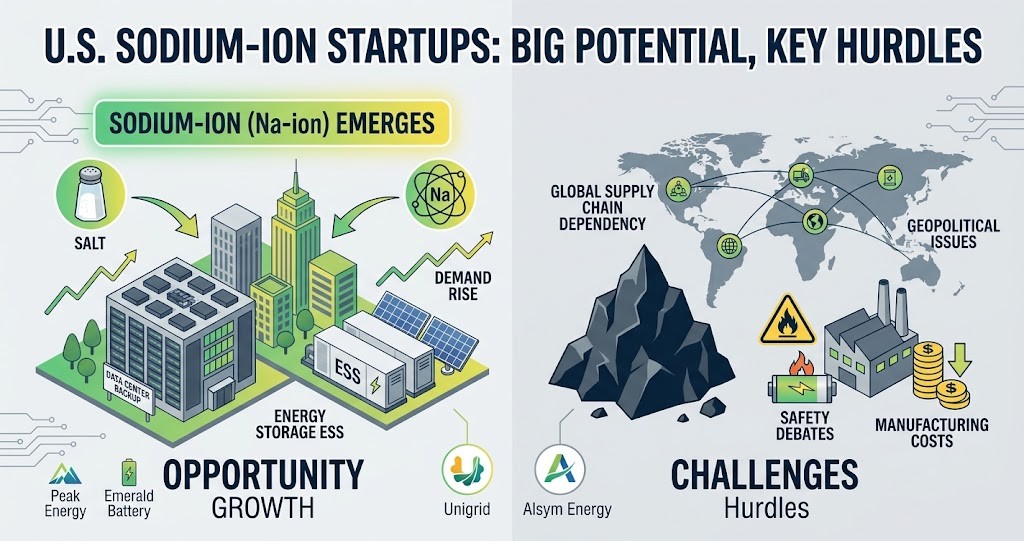
米国では、エネルギー貯蔵システム(ESS)やデータセンター向けバックアップ電源としての需要急増を背景に、リチウムイオン電池に代わる選択肢としてナトリウムイオン電池(Na-ion)を手がけるスタートアップ企業(Unigrid、Emerald Battery Lab、Peak Energy、Alsym Energyなど)が頭角を現しています。しかし、材料の地政学的依存、正極材の安全性を巡る議論、製造コストの優位性確立といった多くの課題に直面しています。
ナトリウムイオン電池のメリットと現状の課題
- ナトリウムイオン電池の強み 主要原料であるナトリウムは資源が豊富かつ安価であり、リチウムやコバルトなどの希少金属に依存しません。熱暴走(発火)のリスクが低く、マイナス40℃から高温域まで幅広い温度範囲で安定して動作するため、冷却・加熱のための追加コストを削減できます。
- エネルギー密度と用途 リチウムイオン電池(特にNMC系や高容量LFP)と比較してエネルギー密度が低いため、スマートフォンや長距離走行が求められる乗用EVには不向きです。一方で、設置スペースや重量の制約が比較的緩やかな「定置型蓄電池(ESS)」、「住宅用蓄電池」、「データセンター向けバックアップ電源」、「12V車両用補助バッテリー」などの用途で主力を担うと期待されています。
各社の動向と米国のサプライチェーンの矛盾
- Unigrid(サンディエゴ) ヨーロッパの熱波に伴う家庭用蓄電池(9 kWh)需要を取り込み、出荷を拡大中。正極材に3価クロムを採用しており、特定の過充電条件下における6価クロム(有毒・発がん性物質)の発生懸念が指摘されているものの、同社は電圧制御と第三者機関の安全試験により安全性を証明済みと主張しています。
- Emerald Battery Lab(シアトル) 12V商用フリート向け補助バッテリーを開発中。将来的に市場の80%がナトリウムイオン電池になると予測し、米国産負極材(ハードカーボン等)の開発を目指しています。
- Peak Energy(カリフォルニア / コロラド) ゼネラル・モーターズ(GM)と提携し、電力網向けESS用のサプライチェーン構築を推進。2028年末までにミシガン州でのセル生産体制立ち上げを目指しています。
- Alsym Energy / ESS Tech(オレゴン) データセンター向けの再生可能エネルギー供給およびバックアップ用途を見込み、2027年までに数百 MWh 規模の米国製セル出荷を計画しています。
【サプライチェーンの現状】 米国内での「材料・製造100%内製化」を掲げる企業が多いものの、現時点では製造コストや供給規模の観点から、初期製品のセル調達を中国メーカーに依存せざるを得ないのが実情です。
補足・関連情報:技術・市場的背景
- 正極材(カソード)アプローチの多様化 ナトリウムイオン電池の正極材には、主に3つの系統が存在します。
- 層状酸化物(Layered Oxides): クロムやマンガン、鉄などを主成分とし、エネルギー密度が高い(Unigridなどが活用)。
- プルシアンブルー類(Prussian Blue Analogues): 鉄やフェロシアン化物を使用。低コストだが水分管理やサイクル寿命に課題。
- ポリアニオン系(NFPPなど): リン酸鉄ナトリウムピロリン酸などを用い、熱安定性と寿命に優れる(Peak Energyなどが採用)。
- LFP(リン酸鉄リチウム電池)との価格競争 ナトリウムイオン電池の最大の競合は、既存の安価なLFP電池です。LFPのセル価格が 1 kWh あたり約80ドル前後まで下落しているのに対し、初期段階のナトリウムイオン電池は約100ドル/kWh前後と依然高価です。将来的に 30ドル/kWh 台まで低下するポテンシャルを秘めているものの、ギガファクトリー規模の大量生産体制が整うまでには数年の歳月を要します。
- AIデータセンター需要の急増 AI(人工知能)インフラの急速な拡大に伴い、米国や欧州ではデータセンターの消費電力が急増しています。無停電電源装置(UPS)や再生可能エネルギーの平滑化用途として、安全性が高く動作温度範囲の広いナトリウムイオン電池への投資が加速しています。
Next-Generation Stationary Storage: Sodium-Ion Batteries Gain Traction in US Stationary and Data Center Markets
In the United States, startups specializing in sodium-ion (Na-ion) batteries—such as Unigrid, Emerald Battery Lab, Peak Energy, and Alsym Energy—are coming to the fore as alternatives to lithium-ion batteries, driven by surging demand for energy storage systems (ESS) and backup power for data centers. However, these companies face numerous hurdles, including geopolitical dependencies on materials, debates over cathode safety, and the need to establish manufacturing cost advantages.
Advantages and Current Challenges of Sodium-Ion Batteries
- Key Strengths of Sodium-Ion Batteries Sodium, the primary raw material, is abundant and inexpensive, eliminating reliance on critical metals like lithium and cobalt. It features a lower risk of thermal runaway (fire) and operates stably across a broad temperature range—from minus 40°C to high ambient temperatures—thereby reducing additional costs associated with heating and cooling.
- Energy Density and Application Scope Due to lower energy density compared to lithium-ion batteries (particularly NMC chemistries and high-capacity LFP), sodium-ion is unsuitable for smartphones or long-range passenger EVs. However, it is expected to play a major role in applications with relatively flexible space and weight constraints, such as stationary energy storage systems (ESS), residential energy storage, data center backup power, and 12V auxiliary vehicle batteries.
Corporate Developments and US Supply Chain Contradictions
- Unigrid (San Diego) Expanding shipments by capturing demand for residential storage systems (9 kWh) driven by heatwaves in Europe. While concerns have been raised regarding its use of trivalent chromium in cathode materials—specifically the potential formation of hexavalent chromium (a toxic carcinogen) under specific overcharge conditions—the company asserts safety has been proven through voltage control mechanisms and third-party safety testing.
- Emerald Battery Lab (Seattle) Developing auxiliary batteries for 12V commercial fleets. Projecting that sodium-ion will eventually capture 80% of the market, the company aims to develop US-produced anode materials (such as hard carbon).
- Peak Energy (California / Colorado) Partnering with General Motors (GM) to build a supply chain for grid-scale ESS. Target dates set to establish cell manufacturing in Michigan by late 2028.
- Alsym Energy / ESS Tech (Oregon) Targeting renewable energy integration and backup applications for data centers, with plans to ship hundreds of MWh of US-manufactured cells by 2027.
[Current Supply Chain Reality] While many firms champion “100% domestic sourcing and manufacturing” within the US, current cost constraints and scale limitations force reliance on Chinese manufacturers for initial cell procurement.
Technical and Market Context
- Diversification of Cathode Approaches Cathode chemistries for sodium-ion batteries generally fall into three main categories:
- Layered Oxides: Composed primarily of chromium, manganese, or iron, offering higher energy density (utilized by Unigrid and others).
- Prussian Blue Analogues: Based on iron and ferrocyanides, providing low cost but facing challenges in moisture management and cycle life.
- Polyanionic Compounds (e.g., NFPP): Incorporating sodium iron pyrophosphate, offering superior thermal stability and lifespan (adopted by Peak Energy and others).
- Cost Competition with LFP (Lithium Iron Phosphate) The primary competitor for sodium-ion batteries is existing low-cost LFP chemistry. While LFP cell prices have dropped to around 80 USD per kWh, early-stage sodium-ion batteries remain higher at approximately 100 USD per kWh. Although sodium-ion holds long-term potential to drop to the 30 USD per kWh range, reaching gigafactory-scale mass production will require several years.
- Surging Demand from AI Data Centers Rapid expansion of AI infrastructure is driving exponential electricity consumption in data centers across the US and Europe. Consequently, investment is accelerating into sodium-ion batteries for uninterruptible power supply (UPS) systems and renewable energy smoothing due to their enhanced safety and wide operating temperature window.

コメント