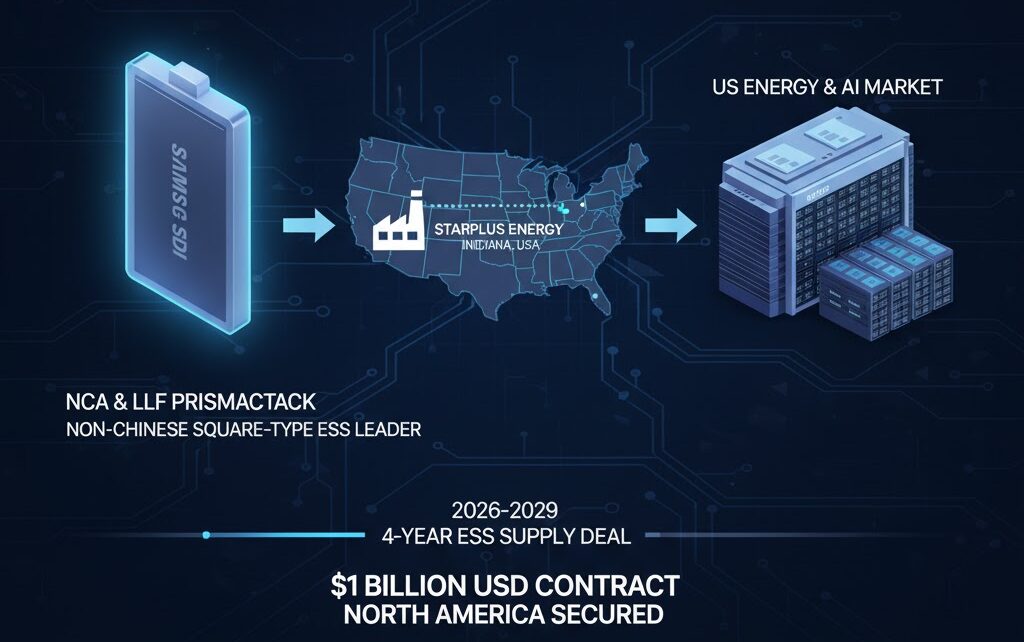
サムスンSDIは2026年3月16日、米国のエネルギー企業との間で、2029年までの4年間にわたる大型のエネルギー貯蔵システム(ESS)用バッテリー供給契約を発表しました。契約総額は約1兆5000億ウォン(約10億ドル)にのぼります。
1. 供給の概要と生産拠点
今回の契約は、サムスンSDIの米国子会社(Samsung SDI America)を通じて締結されました。
- 生産拠点: 米国インディアナ州にある「StarPlus Energy(サムスンSDIとステランティスの合弁会社)」の工場で生産されます。
- 供給スケジュール: 2026年から2029年までの4年間、段階的に供給されます。
- 採用技術: 初期は高エネルギー密度のNCA(ニッケル・コバルト・アルミニウム)電池を供給し、その後、コスト競争力に優れたLFP(リン酸鉄リチウム)電池へとラインナップを拡大する計画です。
2. 「非中国系」唯一の角型ESSサプライヤーとしての強み
サムスンSDIは、北米市場において「中国メーカー以外で唯一、角型ESS電池を供給できる主要ベンダー」としての地位を固めています。
- PrismStack技術: 同社独自の積層プロセスにより、高いエネルギー密度と優れた耐久性を実現しています。
- 高い安全性: 角型電池はパウチ型に比べて堅牢な筐体を持ち、防火技術においても米国のエネルギー企業から高い信頼を得ています。
- 地政学的背景: 米国の「通商法(IRA:インフレ抑制法)」などの影響により、中国製バッテリーへの依存を減らしたい米国企業のニーズに合致しています。
3. 急成長する米国のESS・AI市場への対応
米国では現在、再生可能エネルギーの導入拡大に加え、AIデータセンターの急増に伴う安定した電力確保のためにESS需要が爆発的に伸びています。
- 直近の実績: 2025年12月にも、米インフラ企業と2兆ウォン規模のLFP電池供給契約を締結済みです。
- 市場の評価: 今回の連続した受注成功により、同社はNCA(ハイエンド)とLFP(普及型)の両面で技術競争力が証明された形となります。
【関連情報】知っておきたいキーワード解説
NCA電池とLFP電池の違い
- NCA (Nickel-Cobalt-Aluminum): 高エネルギー密度が特徴で、限られた設置スペースで大容量を確保したい場合に適しています。
- LFP (Lithium Iron Phosphate): 希少金属を使わないため安価で熱安定性が高く、ESS(定置型蓄電池)市場で世界的な主流になりつつあります。サムスンSDIはこれまでNCAに強みを持っていましたが、市場の要求に応えるためLFPの量産体制を急速に整えています。
ESS(Energy Storage System)の重要性
太陽光や風力などの再生可能エネルギーは発電量が天候に左右されるため、電力を一時的に貯蔵し、必要な時に放電するESSが不可欠です。また、24時間稼働するAIデータセンターにとっても、バックアップ電源としてのESSはインフラの要となっています。
まとめ:サムスンSDIの狙い
今回の契約獲得により、サムスンSDIは北米のESS市場における足場を盤石なものにしました。同社は現在、複数のグローバル顧客とさらなる供給協議を進めており、今後も「高付加価値な角型技術」と「現地生産体制」を武器に、中国勢が強いESS市場でのシェア奪還を狙います。
出典:https://www.samsungsdi.com/sdi-now/sdi-news/4802.html?pageIndex=1&pagesize=15&idx=4802
- The Sole “Non-Chinese” Prismatic Supplier: Samsung SDI Secures 1.5 Trillion Won Contract in the U.S.
The Sole “Non-Chinese” Prismatic Supplier: Samsung SDI Secures 1.5 Trillion Won Contract in the U.S.
On March 16, 2026, Samsung SDI announced a major battery supply contract for Energy Storage Systems (ESS) with a U.S. energy company. The agreement spans four years until 2029, with a total value of approximately 1.5 trillion won (roughly 1 billion USD).
1. Supply Overview and Production Base
The contract was signed through Samsung SDI America, the company’s U.S.-based subsidiary.
- Production Base: Batteries will be manufactured at the StarPlus Energy plant in Indiana, a joint venture between Samsung SDI and automaker Stellantis.
- Supply Schedule: Delivery will be carried out in phases over four years, from 2026 to 2029.
- Technology Adopted: Initial supplies will consist of high-energy-density NCA (Nickel-Cobalt-Aluminum) batteries, with plans to expand the lineup to include cost-competitive LFP (Lithium Iron Phosphate) batteries later.
2. Strength as the Only “Non-Chinese” Prismatic ESS Supplier
Samsung SDI is solidifying its position as the only major vendor in the North American market capable of supplying prismatic ESS batteries outside of Chinese manufacturers.
- PrismStack Technology: The company’s proprietary stacking process achieves high energy density and superior durability.
- High Safety: Prismatic batteries feature a robust casing compared to pouch-type batteries. Their fire protection technology has earned high trust from U.S. energy firms.
- Geopolitical Context: The company’s offerings align with the needs of U.S. companies looking to reduce dependence on Chinese-made batteries, driven by the Inflation Reduction Act (IRA) and other trade policies.
3. Addressing the Rapidly Growing U.S. ESS and AI Markets
In the U.S., ESS demand is exploding due to the expansion of renewable energy and the need for stable power for the rapidly increasing number of AI data centers.
- Recent Achievements: In December 2025, Samsung SDI also signed a 2 trillion won LFP battery supply contract with a U.S. infrastructure firm.
- Market Evaluation: These consecutive contract wins prove Samsung SDI’s technical competitiveness in both high-end (NCA) and entry-level (LFP) segments.
[Related Info] Key Terms Explained
Difference Between NCA and LFP Batteries
- NCA (Nickel-Cobalt-Aluminum): Characterized by high energy density; ideal for securing large capacity in limited installation spaces.
- LFP (Lithium Iron Phosphate): Since it does not use rare metals, it is inexpensive and has high thermal stability. It is becoming the global mainstream in the ESS (stationary storage) market. While Samsung SDI has traditionally been strong in NCA, it is rapidly setting up mass production for LFP to meet market demand.
Importance of ESS (Energy Storage System)
Because renewable energy sources like solar and wind vary with the weather, ESS is essential for temporarily storing power and discharging it when needed. Furthermore, for AI data centers that operate 24/7, ESS serves as a vital infrastructure component for backup power.
Summary: Samsung SDI’s Strategic Goal
By securing this contract, Samsung SDI has established a rock-solid foothold in the North American ESS market. The company is currently in supply discussions with multiple global customers and will continue to use its “high-value prismatic technology” and “local production system” as weapons to reclaim market share in an ESS landscape currently dominated by Chinese players.
コメント