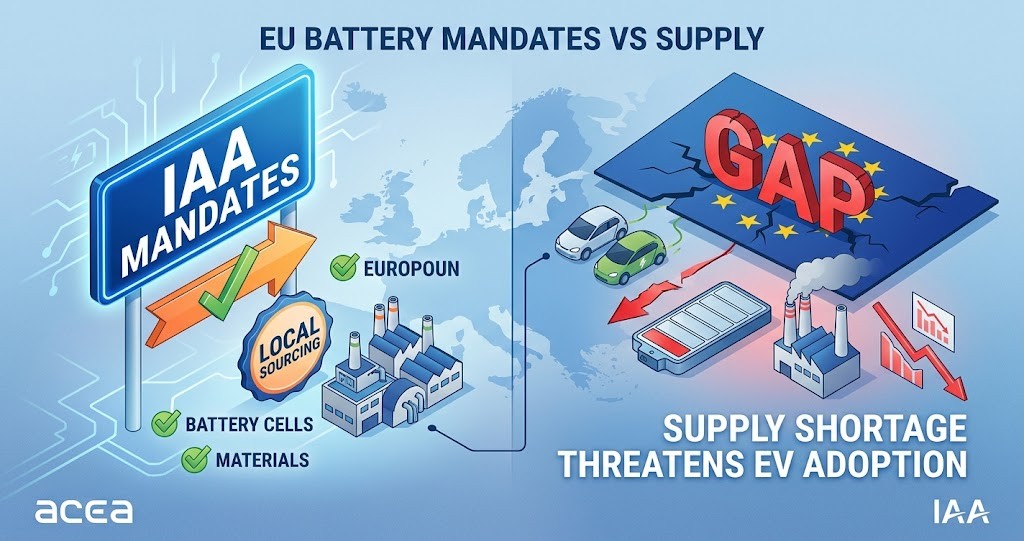
欧州で検討が進む産業加速法(IAA:Industrial Acceleration Act)が定めるバッテリー部材の欧州域内調達(現地化)要件に対し、欧州市場の生産能力が大幅に不足していることが最新調査で明らかになりました。欧州自動車工業会(ACEA)の委託調査によると、セルや材料などの供給不足は長期化する見通しであり、拙速な現地化規制が欧州の電気自動車(EV)普及や産業競争力に打撃を与える懸念が示されています。
IAAが求める段階的な現地化要件と予測シナリオ
IAAの草案では、欧州市場でインセンティブ(購入補助金や優遇措置)を受けるバッテリーに対し、2段階で欧州原産部品の使用を義務付ける計画です。
- 第1段階(施行から6か月後 / 2027-2028年頃) バッテリーセルを含む「3つのEU原産部品」の使用を義務化。
- 第2段階(採択から3年後 / 2030-2031年頃) バッテリーセル、BMS(バッテリー管理システム)、CAM(正極活物質)を含む「5つのEU原産部品」の使用を義務化。
調査では「市場全体(高需要)」「公共主導(中需要)」「公共部門(低需要)」の3つの需要シナリオで分析を行いましたが、どのシナリオにおいても欧州の供給能力は需要を満たせないという結果になりました。
- 乗用車・小型商用車への影響 2032年までに欧州のセル生産能力が 306 GWh まで拡大しても供給不足は解消されません。例えば2028年にIAAが適用された場合、セル不足により年間約300万台のEVが「EU製」としての優遇措置を受けられなくなる恐れがあります。
- 中型・大型商用車(トラック・バス等)への影響 需要と供給の乖離はさらに深刻で、2032年には約 23 GWh の供給不足(需要が欧州産供給の約4倍)に達すると予測されています。
単なる「工場建設」にとどまらない構造的課題
- バッテリー化学組成(ケミストリー)のミスマッチ 欧州で計画されているギガファクトリーの多くは高価格・高エネルギー密度のNMC(ニッケル・マンガン・コバルト)系に偏重しています。しかし、現在の市場需要は低価格なLFP(リン酸鉄リチウム)系へ急速にシフトしており、このLFP分野は中国企業が世界シェアの大部分を圧倒しています。
- コスト差と生産計画の不確実性 高いエネルギーコストや人件費により、欧州製バッテリーの製造コストは輸入製品よりも大幅に割高です。また、「発表されたギガファクトリーの生産能力」と「実際の稼働率」には大きな差があり、資金調達の難航、許認可の遅れ、建設リスクなどから計画通り稼働しないケースが多発しています。
- 上流素材(CAM・AAM)の慢性的な不足 バッテリーセルだけでなく、さらに上流のCAM(正極活物質)やAAM(負極活物質)の域内精製・製造能力が圧倒的に不足しています。需要が最も低いシナリオであっても、この上流素材の不足は2038年から2040年まで解消されない見通しです。
補足・関連情報:欧州バッテリー産業を取り巻く背景
- 米インフレ抑制法(IRA)との対比 米国はIRA(Inflation Reduction Act)を通じて巨額の税制優遇措置で自国および協定国へのサプライチェーン引き込みを進めています。EUもこれに対抗すべくIAAやクリティカル生鮮原材料法(CRMA)で対抗しようとしていますが、金融インセンティブの規模やスピード感で後手に回っているとの指摘があります。
- 中国依存からの脱却と経済的リアリズムの板挟み 欧州政策立案者は経済安保の観点から中国産電池への依存度を下げたい考えですが、過度な規制強化は欧州自動車メーカーのEV調達コストを跳ね上げ、結果として安価な中国製完成車EVの流入を許すという皮肉な事態を招くリスクを孕んでいます。
主な機関について
- ACEA(European Automobile Manufacturers’ Association / 欧州自動車工業会) BMW、ステランティス、ルノー、フォルクスワーゲン、トヨタ(欧州法)など、欧州で操業する主要自動車・トラックメーカーを代表する業界団体。現実的かつ段階的な脱炭素・規制ポリシーの策定をEU当局に働きかけている。
- Mobility Global モビリティ、交通政策、自動車技術の移行に関する市場調査や戦略コンサルティングを行う専門調査機関。
Gap Between Industrial Acceleration Act Requirements and Supply — Prolonged Shortages Highlighted in European Battery Supply Chain
A new study has revealed that production capacity in the European market falls significantly short of meeting the local content requirements for battery components proposed under the Industrial Acceleration Act (IAA). According to the study commissioned by the European Automobile Manufacturers’ Association (ACEA), supply shortages for cells and raw materials are expected to persist over the long term, raising concerns that premature local content regulations could severely impact electric vehicle (EV) adoption and industrial competitiveness in Europe.
Phased Local Content Requirements under IAA and Forecast Scenarios
Draft proposals for the IAA plan to introduce mandatory two-stage requirements for European-sourced components for batteries to qualify for incentives (such as purchase subsidies and preferential treatment) in the European market.
- Phase 1 (6 months post-entry into force / around 2027-2028) Mandates the inclusion of “3 EU-origin components,” including battery cells.
- Phase 2 (3 years post-adoption / around 2030-2031) Mandates the inclusion of “5 EU-origin components,” including battery cells, battery management systems (BMS), and cathode active materials (CAM).
The study analyzed three demand scenarios—”Overall Market (High Demand),” “Public-Led (Medium Demand),” and “Public Sector (Low Demand)”—and found that European supply capacity fails to meet demand across all scenarios.
- Impact on Passenger Cars and Light Commercial Vehicles Even with European cell production capacity projected to expand to 306 GWh by 2032, the supply deficit will remain unresolved. For instance, if the IAA takes effect in 2028, approximately 3 million EVs per year could miss out on “Made in EU” incentives due to cell shortages.
- Impact on Medium- and Heavy-Duty Commercial Vehicles (Trucks and Buses) The supply-demand gap is even more severe, with a projected deficit of around 23 GWh by 2032 (where demand is expected to be approximately four times the available European supply).
Structural Challenges Beyond Simple Factory Construction
- Mismatch in Battery Chemistry Most planned gigafactories in Europe focus heavily on high-cost, high-energy-density NMC (nickel-manganese-cobalt) chemistry. However, market demand is rapidly shifting toward lower-cost LFP (lithium iron phosphate) batteries—a sector predominantly dominated by Chinese companies.
- Cost Discrepancies and Uncertainty in Production Plans Due to elevated energy costs and higher labor expenses, manufacturing batteries in Europe remains significantly more expensive than importing them. Furthermore, a substantial gap exists between “announced gigafactory capacity” and “actual operational output,” with numerous projects stalling due to financing hurdles, permitting delays, and execution risks.
- Chronic Shortages of Upstream Materials (CAM and AAM) Beyond battery cell manufacturing, regional refining and production capacity for upstream materials like CAM (cathode active material) and AAM (anode active material) are critically lacking. Even under the lowest demand scenario, this upstream deficit is not expected to be resolved until between 2038 and 2040.
Key Context: Background Surrounding the European Battery Industry
- Contrast with the US Inflation Reduction Act (IRA) The United States is actively attracting supply chains to its domestic market and trade partners through massive tax incentives under the IRA. While the EU seeks to respond with measures like the IAA and Critical Raw Materials Act (CRMA), critics point out that Europe lags behind in the scale and speed of financial incentives.
- Caught Between Reducing Dependence on China and Economic Realism While European policymakers aim to decrease reliance on Chinese batteries for economic security, overly aggressive regulatory tightening risks driving up EV procurement costs for European automakers. Ironically, this could open the door for an influx of affordable imported complete EVs from China.
About the Key Entities
- ACEA (European Automobile Manufacturers’ Association) The major trade association representing leading automobile and truck manufacturers operating in Europe, including BMW, Stellantis, Renault, Volkswagen, and Toyota Europe. ACEA advocates for realistic, progressive decarbonization and regulatory policy frameworks with EU authorities.
- Mobility Global A specialized research firm providing market analysis and strategic consulting on mobility, transportation policy, and technological transitions in the automotive sector.
コメント