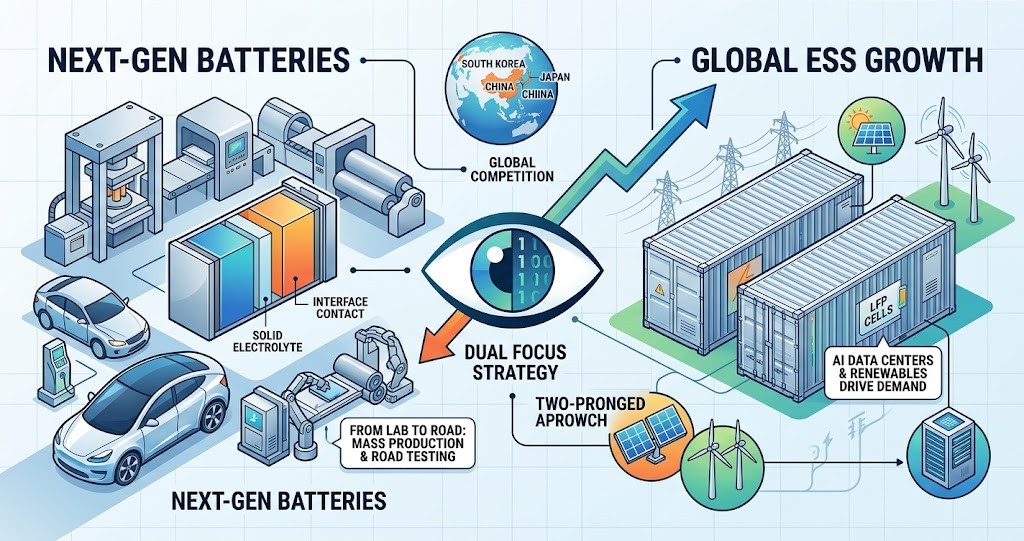
次世代バッテリーの主流とされる「全固体電池」の開発競争は、従来の「素材研究」から、実際の「量産工程の確立」および「車両適用(実車検証)」のフェーズへとシフトしています。韓国・日本・中国・ドイツの主要メーカーが実用化に向けた動きを加速させる一方、既存のリチウムイオン電池の性能向上や高コスト問題といった課題も存在します。
こうした中、韓国の主要バッテリー3社(Samsung SDI、LG Energy Solution、SK On)は、将来的な全固体電池での技術的主導権確保を狙いつつ、足元では急成長するLFP(リン酸鉄リチウム)ベースのESS市場へ注力するという「二眼構え」の戦略を提示しています。
全固体電池・ESS市場の最新動向と整理
1. 全固体電池:素材開発から「量産工程・実車検証」へ
- 技術競争のシフト: 固体界面の接触抵抗低減や電極の積層・圧着、セル製造装置など、量産に直結する技術開発と特許出願が活発化しています。
- 韓国3社の量産計画(2026年9月時点):
- Samsung SDI: 硫化物系正極および積層・圧着技術を公開。韓国3社で最速となる2027年下半期の量産準備完了を目指す。ヒューマノイド向けパウチ型も開発中。
- LG Energy Solution: ロール方式接合の製造法を特許化。2029年にEV用(黒鉛系)、2030年にロボット用(無負極系)の商用化目標を設定。
- SK On: 導電層配置による内部抵抗低減技術を公開。米Factorial Energyと提携し、2029年の硫化物系商用化を目指す。
- 日本・中国・欧州の動き:
- 日本(Toyota / 出光興産): 硫化物系サプライチェーンを構築し、2027〜2028年のEV搭載・商用化を計画。
- 中国(BYD / CATL): 2027年に小規模生産・試験生産を目標化。
- ドイツ完成車: Mercedes-Benz(Factorial製セル搭載EQS)やBMW(Solid Power製セル搭載i7)が公道での実車検証を進める。
- 課題: 固体電解質の高価格、界面抵抗、耐久性、量産歩留まりの確保。既存リチウムイオン電池の性能向上が続く中、コストと量産性で優位性を示せるかが焦点。本格的な大衆化は2030年前後との見方もあります。
2. 短期〜中期の成長エンジン:LFPベースのESS市場
- 韓国国内の動き(第3次ESS中央契約市場):
- 総規模1.18GW(陸上1.1GW、済州80MW)の入札が進行中(2026年11月事業者選定、2029年2月完工予定)。
- 価格50%・非価格50%(産業寄与度・安全性等)で評価されるため、国産素材の活用や火災対策技術が重要視されている。
- 米国市場の需要爆発:
- AIデータセンター拡大や再生可能エネルギー普及により、米国エネルギー貯蔵協会は2032年末までに設置目標225GW / 1TWhを提示。
- 韓国3社はEV用生産ラインの一部をESS用に転換、または北米でのLFP生産能力を急ピッチで増強中。
企業別・主要開発&事業計画の比較一覧
【全固体電池】開発・量産目標
| 企業名 | 主な公開技術・特徴 | 目標時期 | 備考・ターゲット |
| Samsung SDI | 積層・圧着製造技術、硫化物系正極 | 2027年下半期(量産準備) | 韓国3社最速目標。水原Sラインで検証中、フィジカルAI向けも展開 |
| LG Energy Solution | ロール方式接合、セル構造・連続供給 | 2029年(EV用) 2030年(ロボット用) | 梧倉プラントで開発。黒鉛系(EV)と無負極系(ロボット)を打ち出す |
| SK On | 導電層配置による内部抵抗低減 | 2029年(硫化物系) | 大田で検証。米Factorial Energyと製造協力 |
| Toyota | 硫化物系固体電解質サプライチェーン(出光興産提携) | 2027〜2028年(EV搭載) | 実車商用化を計画 |
| BYD / CATL | 小規模生産・試験生産推進 | 2027年(試験・小規模) | 中国での実証・試作ライン推進 |
【ESS市場(LFP電池)】対応と北米戦略
| 企業名 | 韓国国内対応(第3次ESS市場等) | 北米・海外対応 |
| Samsung SDI | 蔚山工場の一部LFP転換・角型導入・消火技術を検討中 | 米国合弁ラインの一部を転換し、2026年Q4にLFP量産開始予定 |
| LG Energy Solution | 梧倉で生産。4大核心素材を韓国国内企業から調達方針 | 北米のLFP拠点を拡大し、2026年末までに50GWh以上の能力確保を計画 |
| SK On | 瑞山工場の一部を転換。L&FおよびPOSCO Future MとLFP正極材供給契約を締結 | 米ジョージア工場の一部を転換。Neovolta Powerへ9GWh分を供給(2027〜2031年) |
まとめ・今後の展望
- 全固体電池(長期戦略): 中国中心に再編された既存サプライチェーンに対し、韓国勢にとっては主導権を取り戻すためのカード。実車走行での信頼性・長距離走行時の安定性・量産歩留まりの確立が勝敗を分ける。
- ESS / LFP電池(短期・中期収益): AI拡大に伴う電力需要を背景に、足元の収益を支える現実解。韓国企業はEV用ラインの柔軟な転換とサプライチェーンの国産化により、収益性と安全性の両立を図る方針。
出典:https://finance.biggo.jp/news/87e00aac-1159-46f7-9508-16f68b79c473
“Next-Gen All-Solid-State” and “Immediate LFP/ESS” — The Dual-Track Survival Strategy of South Korea’s Top 3 Battery Makers
The development race for all-solid-state batteries—considered the next-generation mainstream technology—is shifting from traditional “materials research” to the phase of “establishing mass production processes” and “vehicle integration (on-road validation).” While major manufacturers across South Korea, Japan, China, and Germany are accelerating efforts toward commercialization, challenges remain, such as ongoing performance improvements in conventional lithium-ion batteries and high production costs.
In this landscape, South Korea’s top three battery manufacturers (Samsung SDI, LG Energy Solution, and SK On) are presenting a “dual-track strategy”: securing long-term technological leadership in all-solid-state batteries while actively targeting the rapidly growing LFP (Lithium Iron Phosphate)-based ESS (Energy Storage System) market to generate immediate revenue.
Latest Trends & Market Summary: All-Solid-State Batteries & ESS
1. All-Solid-State Batteries: From Materials R&D to Mass Production & Vehicle Validation
- Shift in Technological Competition: Activity is intensifying around technology development and patent filings directly tied to mass production—such as reducing solid-interface contact resistance, electrode stacking and pressing, and cell manufacturing equipment.
- Mass Production Plans of South Korea’s Big 3 (As of September 2026):
- Samsung SDI: Unveiled sulfide-based cathode technology and stacking/pressing assembly processes. Targets H2 2027 for mass production readiness, the earliest among the South Korean trio. Also developing pouch-type cells for humanoid/physical AI applications.
- LG Energy Solution: Patented a continuous roll-bonding manufacturing process. Set commercialization targets for EVs by 2029 (graphite-based) and robots by 2030 (anode-free).
- SK On: Disclosed internal resistance reduction technology using conductive layers. Partnering with US-based Factorial Energy, aiming for sulfide-based commercialization in 2029.
- Global Developments (Japan, China, Europe):
- Japan (Toyota / Idemitsu Kosan): Building a sulfide-based solid electrolyte supply chain, planning EV integration and commercialization for 2027–2028.
- China (BYD / CATL): Target pilot and small-scale production in 2027.
- German OEMs: Moving to real-world road testing. Mercedes-Benz (EQS test car with Factorial cells) and BMW (i7 test car with Solid Power cells) are conducting public road validations.
- Challenges: High cost of solid electrolytes, interfacial resistance, durability, and securing mass production yields. With continuous improvements in existing lithium-ion battery performance, the key question is whether all-solid-state technology can demonstrate clear cost and scale advantages. Full-scale market adoption is anticipated around 2030.
2. Short- to Mid-Term Growth Engine: The LFP-Based ESS Market
- Domestic Developments in South Korea (3rd Central ESS Contract Market):
- Bidding is underway for a total scale of 1.18 GW (1.1 GW onshore, 80 MW Jeju), with operator selection scheduled for November 2026 and completion set for February 2029.
- Evaluated on a 50% price / 50% non-price split (industrial contribution, safety, etc.), putting high importance on domestic material sourcing and fire safety technology.
- Surging Demand in the U.S. Market:
- Driven by AI data center expansion and renewable energy adoption, the American Clean Power / Energy Storage Association outlined an installation target of 225 GW / 1 TWh by the end of 2032.
- Korean battery makers are converting parts of their EV production lines to ESS or rapidly expanding LFP capacity in North America.
Comparison of Key Development & Business Plans by Company
【All-Solid-State Batteries】 Development & Mass Production Goals
| Company | Key Technologies & Features | Target Timeline | Notes / Target Applications |
| Samsung SDI | Stacking/pressing assembly, sulfide-based cathodes | H2 2027 (Mass production ready) | Earliest goal among Korean Big 3. Validating at Suwon S-Line; expanding to physical AI. |
| LG Energy Solution | Roll-bonding process, continuous cell manufacturing | 2029 (EVs) 2030 (Robotics) | Developing at Ochang plant. Focusing on graphite-based (EVs) and anode-free (robots). |
| SK On | Internal resistance reduction via conductive layers | 2029 (Sulfide-based) | Validating at Daejeon; manufacturing partnership with US-based Factorial Energy. |
| Toyota | Sulfide-based solid electrolyte supply chain (Partnered with Idemitsu Kosan) | 2027–2028 (EV integration) | Planning commercial vehicle deployment. |
| BYD / CATL | Small-scale / pilot line production | 2027 (Pilot / Small-scale) | Advancing pilot lines and real-world trials in China. |
【ESS Market (LFP Batteries)】 Strategy & North American Expansion
| Company | South Korean Market Response (3rd ESS Market, etc.) | North America & Global Strategy |
| Samsung SDI | Considering partial LFP conversion at Ulsan plant, prismatic cell adoption, and fire extinguishing technology. | Converting part of US JV line; plans to start LFP mass production in Q4 2026. |
| LG Energy Solution | Manufacturing at Ochang plant; policy to source all 4 key materials from domestic companies. | Expanding North American LFP hubs; targeting over 50 GWh capacity by end of 2026. |
| SK On | Converting parts of Seosan plant; signed LFP cathode supply deals with L&F and POSCO Future M. | Converting part of Georgia plant; supplying 9 GWh of LFP cells to Neovolta Power (2027–2031). |
Summary & Future Outlook
- All-Solid-State Batteries (Long-Term Strategy): Represents a pivotal move for South Korean firms to reclaim leadership in a battery supply chain currently dominated by China. Success hinges on real-world reliability, high performance over long driving ranges, and stable mass production yields.
- ESS / LFP Batteries (Short- to Mid-Term Revenue): A practical solution to secure immediate profitability, powered by rising electricity demands from AI infrastructure expansion. South Korean firms aim to balance profitability and safety through flexible EV production line conversions and localized supply chain integration.
コメント