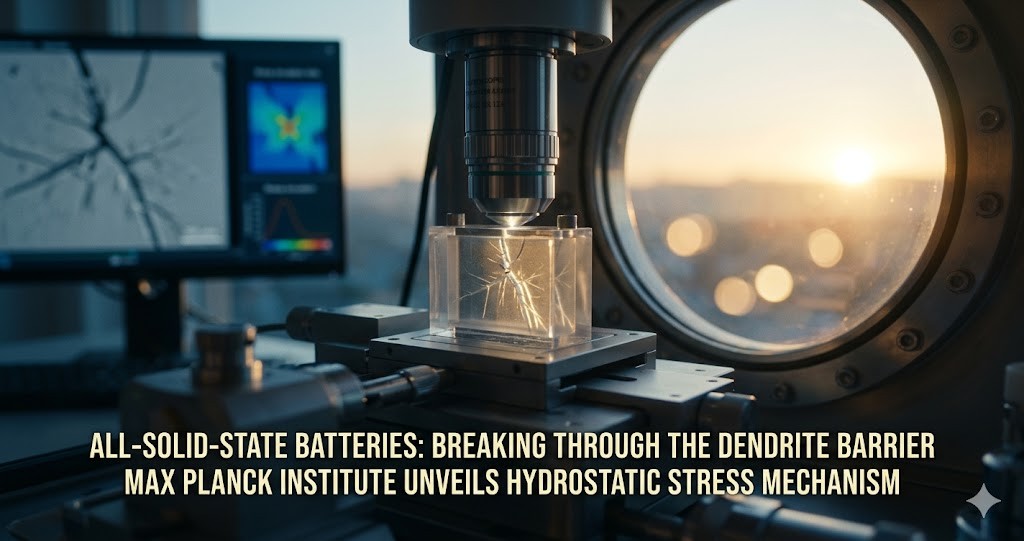
次世代のエネルギー貯蔵技術として期待される「全固体電池」ですが、実用化に向けた最大の障壁の一つが、充電中に発生する「デンドライト(樹枝状結晶)」による内部短絡です。柔らかいリチウム金属が、なぜ硬いセラミック電解質を突き破ってしまうのか。この長年の謎に対し、ドイツのマックス・プランク研究所が物理的なメカニズムを解明し、安全で長寿命な電池開発への新たな一歩を記しました。
- ニュースの概要:全固体電池における短絡現象の解明
- 関連情報:全固体電池とデンドライトの重要性
- Solving the Mystery of “Soft Metal Breaking Hard Ceramics”: A Major Step Toward Practical Solid-State Batteries
- News Summary: Clarifying Short-Circuit Phenomena in Solid-State Batteries
- Related Information: The Importance of Solid-State Batteries and Dendrites
ニュースの概要:全固体電池における短絡現象の解明
マックス・プランク持続可能材料研究所の研究チームは、科学誌「Nature」において、デンドライトが固体電解質を破壊するプロセスを明らかにしました。
- 研究の背景: 固体電池は高いエネルギー密度と安全性を持ちますが、充電時にリチウム金属が樹枝状(デンドライト)に成長し、電解質を貫通して短絡を引き起こす課題がありました。
- 解明されたメカニズム:
- 柔らかいリチウムが硬いセラミックを壊すのは、デンドライト内部で発生する「静水圧応力」が原因です。
- これは「岩を貫くウォータージェット」のような原理であり、蓄積された応力が固体電解質に引張応力を引き起こし、脆性破壊(ひび割れ)を誘発します。
- 調査手法: 外部環境(酸素や水)の影響を排除するため、極低温かつ真空条件下での試料調製と特性評価を実施。微視的力学的破壊モデリングによって計算結果の裏付けを行いました。
- 今後の展望: 固体電解質の靭性向上、微細な空隙による成長方向の誘導、電極への保護コーティングなどの対策により、亀裂の防止を目指します。
関連情報:全固体電池とデンドライトの重要性
今回の研究成果をより深く理解するための補足情報です。
1. 全固体電池がもたらすメリット
従来の液体電解質を使用するリチウムイオン電池と比較して、以下の点が優れています。
- 高エネルギー密度: スマートフォンの数日間駆動や、電気自動車(EV)の航続距離を大幅に(理論上は現在の3分の1程度向上、あるいはそれ以上)延ばす可能性があります。
- 高い安全性: 燃えやすい有機電解液を使用しないため、発火リスクが極めて低くなります。
2. デンドライト問題の難しさ
デンドライトは、充電時にリチウムイオンが電極表面で還元され、金属として析出する際に発生します。
- 直感に反する破壊: 硬いセラミックが柔らかい金属に負ける現象は、材料工学上の大きな謎でした。今回の「静水圧応力」の証明は、材料設計の指針を根本から変える発見です。
3. 次世代市場へのインパクト
- EV市場: 充電時間の短縮と航続距離の延長を両立させ、ガソリン車に近い利便性を実現します。
- ウェアラブルデバイス: 形状の自由度が高まり、より小型で長時間駆動するデバイスの開発を可能にします。
出典:https://www.mpie.de/5151287/short-circuit-solid-state-batteries
Solving the Mystery of “Soft Metal Breaking Hard Ceramics”: A Major Step Toward Practical Solid-State Batteries
While “solid-state batteries” are highly anticipated as a next-generation energy storage technology, one of the biggest barriers to their practical use is internal short-circuiting caused by “dendrites” (tree-like crystals) that form during charging. How can soft lithium metal pierce through a hard ceramic electrolyte? To solve this long-standing mystery, the Max Planck Institute in Germany has clarified the physical mechanism, marking a new milestone toward developing safe and long-lasting batteries.
News Summary: Clarifying Short-Circuit Phenomena in Solid-State Batteries
A research team at the Max Planck Institute for Sustainable Materials has revealed the process by which dendrites destroy solid electrolytes, with their findings published in the journal “Nature.”
- Research Background: Solid-state batteries offer high energy density and safety, but they face a challenge where lithium metal grows into dendrites during charging, penetrating the electrolyte and causing short circuits.
- Mechanism Clarified: The reason soft lithium breaks hard ceramics is due to “hydrostatic stress” generated inside the dendrites.
- This follows a principle similar to a “water jet piercing through rock,” where accumulated stress induces tensile stress in the solid electrolyte, leading to brittle fracture (cracking).
- Research Methodology: To eliminate influences from the external environment (such as oxygen or water), sample preparation and material characterization were conducted under cryogenic and vacuum conditions. These results were supported by microscopic mechanical fracture modeling.
- Future Outlook: The team aims to prevent cracking through methods such as improving the toughness of solid electrolytes, introducing micro-voids to guide growth direction, and applying protective coatings to electrodes.
Related Information: The Importance of Solid-State Batteries and Dendrites
The following information provides deeper context for these research results.
1. Benefits of Solid-State Batteries
Compared to conventional lithium-ion batteries that use liquid electrolytes, solid-state batteries offer several advantages:
- High Energy Density: They have the potential to power smartphones for several days and significantly extend the cruising range of electric vehicles (EVs) (theoretically by about one-third or more compared to current levels).
- High Safety: Since they do not use flammable organic liquid electrolytes, the risk of fire is extremely low.
2. The Difficulty of the Dendrite Problem
Dendrites occur when lithium ions are reduced at the electrode surface and deposit as metal during charging.
- Counter-intuitive Destruction: The phenomenon of hard ceramics being defeated by soft metal was a major mystery in materials engineering. The proof of “hydrostatic stress” is a discovery that fundamentally changes the guidelines for material design.
3. Impact on Next-Generation Markets
- EV Market: These batteries will achieve convenience close to that of gasoline vehicles by combining shorter charging times with longer cruising ranges.
- Wearable Devices: Greater flexibility in shape will enable the development of smaller, longer-lasting devices.

コメント