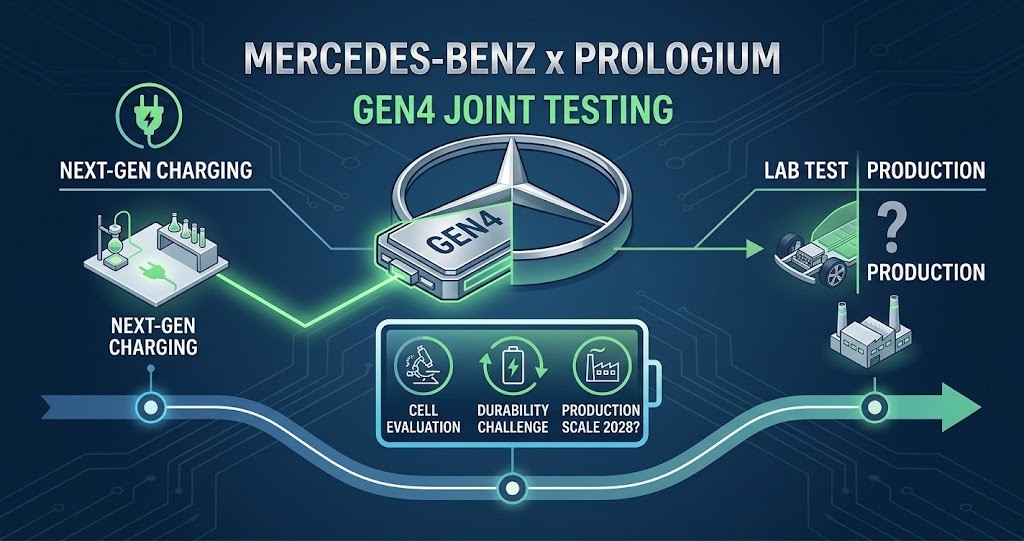
Mercedes-Benzと台湾の電池メーカーProLogiumは、次世代全固体電池「Gen4」の共同試験契約を締結しました。短時間での充電性能などが注目される一方、実用化や量産に向けては開発段階の違いや耐久性・生産性の検証といった課題が残されています。
主なポイント
- 共同検証の開始: Mercedes-BenzがProLogiumの「Gen4」セルの優先アクセス権を得て、電気・熱・安全性能を評価する段階に入った。
- 実車テストとの差: 走行試験を実施している他社製セル(Factorial製など)とは異なり、Gen4は研究室レベルから評価工程に入った段階にある。
- 今後の焦点: セルのサイクル寿命、車載時の安全性、2028年以降の量産計画の実現性が鍵となる。
記事の要約
1. Mercedes-BenzとProLogiumの契約内容
Mercedes-BenzはProLogiumの「Gen4」全固体電池セルを活用し、自社施設および外部専門機関で電気特性、熱挙動、安全性の試験を開始します。ただし、今回の契約は評価工程への移行を意味しており、現時点で実車走行試験の実施や量産車への採用、独占供給が決まったわけではありません。
2. 電池世代と他社製セルとの開発段階の違い
- Gen3.5: ProLogiumが台湾の GWh 級施設で量産を開始した世代。
- Gen4: 今回評価される次世代品。電解質を全無機系へ切り替えており、構造は共通するものの品質や寿命を改めて検証する必要がある。
- Factorial製セル: Mercedes-BenzがEQSに搭載し、すでに約 1,200 km 以上の公道走行試験を行っている別方式のセル。
3. 公表数値の整理と注意点
ProLogiumが発表しているスペック数値には測定対象や世代の異なるデータが含まれています。
- Gen3.5の実測値: 第三者機関(TUVなど)による測定で、エネルギー密度 381 Wh/kg や 903 Wh/L を記録。
- Gen4の公表値: 体積エネルギー密度 最大 860 Wh/L、イオン伝導度 57 mS/cm、残量 5 % から 60 ~ 80 % まで約 4 ~ 6 分で急速充電可能とされる性能。※これらは異なる条件下の数値を指しており、直ちに「量産済みの超急速充電セル」と判断することはできません。
関連情報・背景知識
全固体電池における課題とGen4のアプローチ
従来の固体電池は、固着面でのイオン移動の難しさや、充放電に伴う膨張・収縮による接触面の劣化が課題とされています。
Gen4では、超流動化全無機固体電解質、セラミックセパレーター、全シリコン負極を採用しています。これにより外部から過度な圧力を加えることなく界面状態を維持し、膨張による劣化や熱暴走を抑える構造を提示していますが、実際の車載環境での耐久性や安全性は今後の評価に委ねられます。
実用化・量産に向けたハードル
ProLogiumはフランス Dunkirk 工場などで2028年以降に Gen4 の量産を目指す計画を掲げています。しかし、製造ラインの構築だけでなく、大型セルでの均一な歩留まり維持、繰り返し充電における寿命維持率、低温・高温環境下の耐久性確保など、量産化と実車への採用には多くの検証プロセスが必要です。
出典:https://xenospectrum.com/mercedes-prologium-gen4-cell-test/
ProLogium’s Gen4 Solid-State Battery: Mercedes Begins Performance Evaluation — Road to Automotive Adoption and Remaining Challenges
Mercedes-Benz and Taiwanese battery manufacturer ProLogium have signed a joint testing agreement for the “Gen4” next-generation solid-state battery. While its fast-charging capabilities have drawn attention, challenges such as differences in development stages, durability verification, and mass-production feasibility remain before commercialization.
Key Points
- Start of Joint Verification: Mercedes-Benz has gained priority access to ProLogium’s “Gen4” cells, moving into the phase of evaluating electrical, thermal, and safety performance.
- Difference from On-Road Testing: Unlike cells from other manufacturers (such as Factorial) that are undergoing actual driving tests, Gen4 is at the stage of moving from laboratory-level testing into the OEM evaluation process.
- Key Focus Going Forward: Cell cycle life, in-vehicle safety, and the feasibility of mass-production plans from 2028 onward will be critical.
Article Summary
- Agreement Details Between Mercedes-Benz and ProLogium Mercedes-Benz will utilize ProLogium’s “Gen4” solid-state battery cells to begin testing electrical characteristics, thermal behavior, and safety at its own facilities and external specialized institutions. However, this agreement simply marks the transition to the evaluation phase; it does not imply that on-road vehicle testing, adoption in production vehicles, or exclusive supply agreements have been decided at this time.
- Battery Generations and Differences in Development Stages Compared to Competitors
- Gen3.5: The generation for which ProLogium announced the start of mass production at its GWh-scale facility in Taiwan.
- Gen4: The next-generation product being evaluated this time. It switches to an all-inorganic electrolyte system, and while it shares underlying structural aspects, its quality and lifespan must be verified anew.
- Factorial Cells: A different type of cell that Mercedes-Benz installed in an EQS, which has already undergone public road driving tests covering over 1,200 km.
- Organizing Published Figures and Caveats The specification values released by ProLogium include data from different measurement targets and battery generations.
- Measured Values for Gen3.5: Tests by third-party organizations (such as TUV) recorded energy densities of 381 Wh/kg and 903 Wh/L.
- Published Values for Gen4: Maximum volumetric energy density of 860 Wh/L, ionic conductivity of 57 mS/cm, and fast-charging performance capability from 5% to 60-80% in approximately 4 to 6 minutes.
- Note: Because these figures refer to data measured under different conditions, they cannot be interpreted immediately as indicating a “mass-produced, ultra-fast-charging cell.”
Related Information and Background Knowledge
Challenges in Solid-State Batteries and the Gen4 Approach Conventional solid-state batteries face challenges regarding the difficulty of ion movement across solid contact surfaces, as well as interface degradation caused by expansion and contraction during charging and discharging cycles. Gen4 adopts a superfluidized all-inorganic solid-state electrolyte, a ceramic separator, and an all-silicon anode. This structure is presented as maintaining a healthy interface without applying external pressure while suppressing expansion-related degradation and thermal runaway, though its actual durability and safety in vehicle environments remain to be evaluated.
Hurdles Toward Commercialization and Mass Production ProLogium has outlined plans to begin mass production of Gen4 at its Dunkirk plant in France and other locations starting in 2028. However, beyond establishing production lines, adopting these cells into actual vehicles and achieving true mass production will require extensive verification processes—including maintaining uniform yield rates in large-format cells, capacity retention after repeated charging, and ensuring durability under extreme cold and hot temperature conditions.

コメント