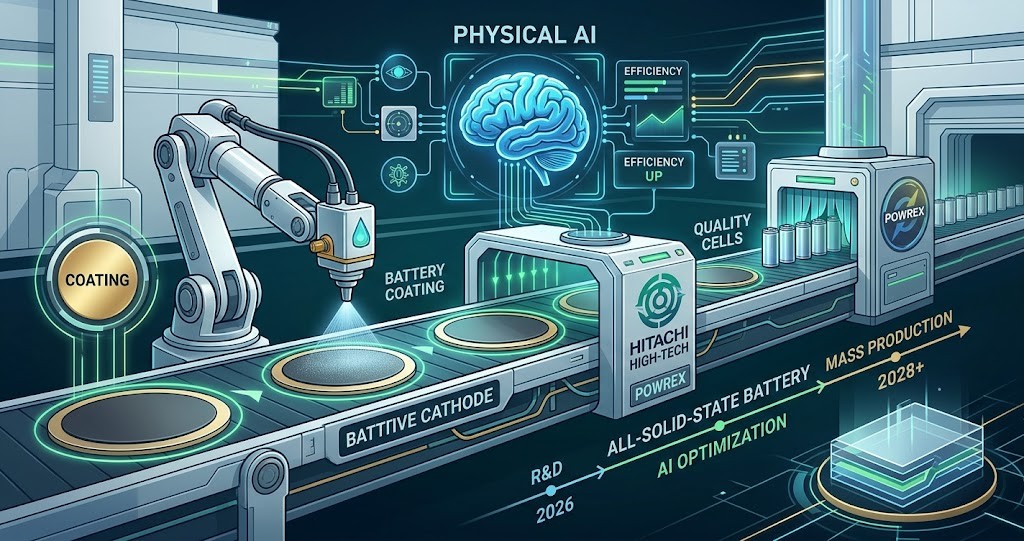
次世代電池として注目を集める全固体電池の量産化・実用化に向け、AI技術を活用した製造プロセスの効率化が急速に進んでいます。2026年8月20日、日立ハイテクとパウレックは、フィジカルAIを用いて全固体電池の正極活物質コーティングプロセスを最適化する実証完了を発表しました。
以下に本ニュースの要点と、背景となる関連情報をまとめてお届けします。
実証実験の要点
- 成果: 日立ハイテクとパウレックが共同で、全固体電池の「正極活物質表面へのコーティングプロセス」をフィジカルAIにより最適化する実証を完了。
- 背景と課題: 全固体電池は充放電を繰り返すと電極界面に抵抗が発生し出力が低下します。これを防ぐ被膜コーティングは、条件探索が複雑で高度な専門知識や熟練者の経験に依存しており、開発・スケールアップに長時間を要していました。
- 両社の役割:
- パウレック: 高精度な流動層コーティングをはじめとする粉体処理・製造プロセス技術を提供。
- 日立ハイテク: 蛍光X線分析(XRF)や走査電子顕微鏡(SEM)を用いた定量評価手法と、デジタルソリューション「PROACCELA」を融合したフィジカルAIを提供。
- 今後の展開: 本成果を日立ハイテクの製造業向けソリューション「HMAX Industry」のラインアップとして提供。研究開発から量産までをシームレスに繋ぐ「Lab to Fab」を支援し、開発期間の短縮を目指します。
関連情報・背景解説
1. 全固体電池が抱える技術的課題と被膜処理の重要性 全固体電池は、従来の液体電解質に比べて発火リスクが極めて低く、EV(電気自動車)の航続距離延長や急速充電を可能にする次世代技術です。しかし、固体の「正極活物質」と「固体電解質」が接触する面(界面)で生じる高い抵抗が実用化の大きな壁となっています。薄く均一な被膜を正極表面に形成することは、この抵抗を最小限に抑えるために必須の技術ですが、材料の組み合わせや装置条件の変数が多く、従来の「試行錯誤」による開発には限界がありました。
2. 「フィジカルAI」とは デジタル空間上のデータ処理にとどまらず、現実世界の物理プロセス(製造・加工・計測・制御など)に直接作用・最適化するAI技術です。今回の取り組みでは、実験データ(計測値)と物理的な製造条件との因果関係をAIがモデル化することで、従来は熟練者が長年培った感覚や手探りで行っていた条件出しを、数理的かつ高速に導き出すことを実現しています。
3. 「Lab to Fab」を加速する製造業の変革 研究室レベルでの成功(Lab)を商業用の大型工場での大量生産(Fab)へ落とし込むプロセスは、歩留まりの低下や再現性の問題が生じやすく、通常数年単位の時間がかかります。パウレックの持つ「ハードウェア(粉体装置)」と日立ハイテクの「ソフトウェア・分析(データ解析)」が融合することで、実験から量産ラインへの移行期間を劇的に短縮するモデルとして期待されています。
今回の実証は、技術者の経験に頼っていた職人的な製造ノウハウを「データ駆動型」に転換し、次世代電池の市場投入を大きく前進させる重要なステップと言えます。
出典:https://robotstart.info/article/2026/08/20/382299.html
Hitachi High-Tech and Powrex Demonstrate Optimization of Coating Conditions for All-Solid-State Batteries Using Physical AI
To accelerate the mass production and commercialization of all-solid-state batteries—which are attracting attention as next-generation energy storage—efforts to improve manufacturing process efficiency using AI technology are rapidly advancing. On August 20, 2026, Hitachi High-Tech Corporation and Powrex Corporation announced the successful completion of a demonstration optimizing the coating process on cathode active materials for all-solid-state batteries using Physical AI.
Below is a summary of the key points of this news along with relevant background information.
Key Points of the Demonstration
- Achievement: Hitachi High-Tech and Powrex jointly completed a demonstration optimizing the coating process on the surface of cathode active materials for all-solid-state batteries using Physical AI.
- Background and Challenges: All-solid-state batteries build up interface resistance during repeated charge-discharge cycles, leading to reduced output power. Protective coating prevents this issue; however, identifying optimal coating parameters is complex and heavily reliant on deep expertise and hands-on trial experience, making development and scaling time-consuming.
- Roles of Both Companies:
- Powrex: Provided powder processing and manufacturing technology, including high-precision fluid bed coating systems.
- Hitachi High-Tech: Combined quantitative evaluation techniques using X-ray fluorescence (XRF) and scanning electron microscopy (SEM) with its PROACCELA digital solution to deliver Physical AI capabilities.
- Future Prospects: The companies plan to offer these results as part of Hitachi High-Tech’s HMAX Industry solution portfolio for manufacturers. This initiative supports a seamless transition from research to commercial production (Lab to Fab), aiming to significantly shorten development timelines.
Background and Related Information
1. Technical Challenges in All-Solid-State Batteries and the Importance of Coating All-solid-state batteries offer extremely low fire risks compared to conventional liquid-electrolyte batteries, enabling longer EV range and fast charging. However, high electrical resistance at the interface where the solid cathode active material meets the solid electrolyte remains a major hurdle. Forming a thin, uniform protective film on the cathode surface is essential to minimize this resistance, but the high number of variables across materials and equipment settings makes traditional trial-and-error approaches inefficient.
2. What is Physical AI? Physical AI refers to artificial intelligence technology that operates beyond pure digital data processing to directly influence and optimize real-world physical processes, such as manufacturing, processing, measurement, and control. In this initiative, AI models the causal relationships between measurement data and physical production conditions, converting intuitive, experience-based parameter setting into a fast, mathematically grounded process.
3. Transforming Manufacturing by Accelerating Lab to Fab Scaling lab successes to mass production in large commercial factories often faces reduced yields and reproducibility issues, typically taking several years. By combining Powrex’s hardware (powder processing equipment) with Hitachi High-Tech’s software and analytical capabilities (data analysis), this framework is expected to serve as a model for dramatically shortening the transition period from laboratory experiments to full-scale production lines.
This demonstration represents an important step forward in shifting craftsmanship-based manufacturing knowledge into a data-driven approach, advancing the commercialization of next-generation batteries.

コメント