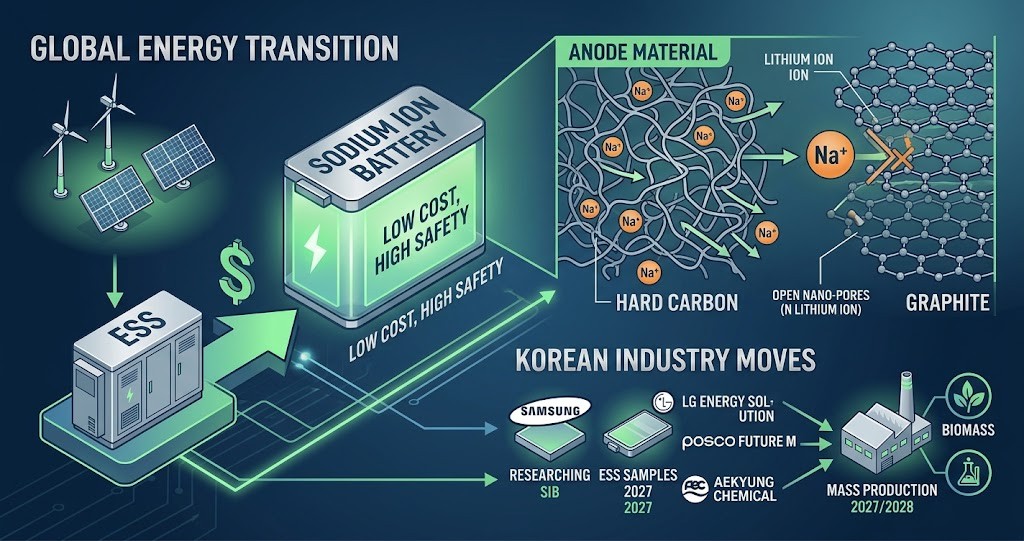
世界的なエネルギー転換と蓄電池需要の急速な拡大に伴い、安価で資源豊富な「ナトリウムイオン電池(SIB)」が次世代蓄電池として世界的に脚光を浴びています。特に、設置スペースや重量への制約が比較的ゆるやかで、コストと安全性が最優先されるエネルギー貯蔵システム(ESS)用途において、その存在感が高まっています。
こうした状況を踏まえ、韓国の電池・素材業界では、ナトリウムイオンの蓄積に欠かせない負極材「ハードカーボン」の量産および採用に向けた動きを本格化させています。以下にニュースの概要と背景となる関連情報をまとめました。
ニュース要約と関連情報
韓国電池業界が「ナトリウムイオン電池」と「ハードカーボン」に注力する背景
ナトリウムイオン電池(SIB)は、リチウムの代わりに安価で豊富な塩(ナトリウム)を用いる次世代電池です。
- コストと資源の強み: リチウムやコバルトなどのレアメタルに依存せず、集電体にも安価なアルミニウム箔が使用できるため、電池全体のコストを大きく削減できます。
- 低温特性・安全性: 低温環境(-20度など)でも性能低下が小さく、熱暴走のリスクが低いという特長を持ちます。
- 課題と用途(ESS向け): リチウムイオンよりもイオン半径が大きいため、エネルギー密度が低くなり大型化しやすい課題があります。しかし、車載用とは異なり重量やサイズの制約が少ない「電力貯蔵システム(ESS)」用途においては、コストと安全性の強みが大きく活きるため最適とされています。
ハードカーボン(難黒鉛化性炭素)が必要とされる理由
既存のリチウムイオン電池では負極材に密な構造を持つ「黒鉛(グラファイト)」が使用されます。しかし、ナトリウムイオンはリチウムイオンよりも大きいため、黒鉛の隙間にはスムーズに入り込めません。 そこで、結晶構造が乱れており、ナノサイズの微細な孔を多く持つ構造の「ハードカーボン」が代替材料として不可欠になります。
各社の動向まとめ
電池メーカー
- サムスンSDI: SIBの商用化に合わせてハードカーボンを採用できるよう研究・開発を進行。
- LGエナジーソリューション: 2027年にESS顧客向けのサンプル出荷を目指す。商用初期は黒鉛を一部混入し、段階的にハードカーボンの比率を高めて置き換える計画。
素材メーカー
- 愛敬(エギョン)ケミカル: 2012年に負極材用ハードカーボンを発売。2024年に原料をポリウレタン樹脂からバイオマスへ転換し、2025年に性能改善品を発表。現在は全州工場を中心に生産設備を増強中。
- ポスコフューチャーエム: 次世代素材戦略として組み込み、2027年第3四半期までに開発完了、2028年の量産を目指す。
今後の展望
ESS市場での需要拡大に伴い、低コスト化と高性能化に向けた素材メーカー間のハードカーボン供給・開発競争がさらに激化すると予想されています。
出典:https://news.yahoo.co.jp/articles/465c347d0a757e96b73b1f9e8be3fcf975016275
South Korean Battery and Material Industry Shifts All-Out Toward Mass Production of Sodium-Ion Batteries and Hard Carbon for ESS
Driven by the global energy transition and rapid expansion in battery demand, low-cost and resource-abundant Sodium-Ion Batteries (SIBs) are gaining global spotlight as next-generation storage batteries. Their presence is growing particularly in Energy Storage System (ESS) applications, where space and weight constraints are relatively flexible, and cost and safety are top priorities.
In light of this background, South Korea’s battery and materials industry is stepping up efforts toward the mass production and adoption of hard carbon, an essential anode material for storing sodium ions. Below is a summary of the news and relevant context.
News Summary and Related Context
Background Behind South Korean Battery Industry’s Focus on Sodium-Ion Batteries and Hard Carbon Sodium-ion batteries (SIBs) are next-generation batteries that use low-cost, abundant sodium instead of lithium.
- Cost and Resource Advantages: By eliminating reliance on rare metals such as lithium and cobalt, and using low-cost aluminum foil for current collectors, total battery costs can be substantially reduced.
- Low-Temperature Performance and Safety: They feature minimal performance degradation even in low-temperature environments (such as -20 degrees C) and carry a lower risk of thermal runaway.
- Challenges and Target Application (ESS): Because sodium ions have a larger ionic radius than lithium ions, energy density is lower, leading to larger battery sizes. However, for Energy Storage Systems (ESS), where weight and size constraints are less critical than in automotive applications, the advantages of low cost and safety make them an ideal fit.
Why Hard Carbon (Non-Graphitizable Carbon) Is Required Conventional lithium-ion batteries use graphite, which has a dense structure, as the anode material. However, because sodium ions are larger than lithium ions, they cannot smoothly insert into the tight gaps of graphite structure. Consequently, hard carbon—which features a disordered crystal structure with numerous nano-sized pores—is essential as an alternative material.
Company Developments Summary
Battery Manufacturers
- Samsung SDI: Proceeding with research and development so that hard carbon can be adopted in line with the commercialization of SIBs.
- LG Energy Solution: Aiming for sample shipments to ESS customers in 2027. Plans to initially mix in graphite during early commercialization and gradually increase the ratio of hard carbon to replace it.
Material Manufacturers
- Aekyung Chemical: Launched hard carbon for anode materials in 2012. Shifted raw materials from polyurethane resin to biomass in 2024, and announced an upgraded product in 2025. Currently expanding production capacity centered around its Jeonju plant.
- POSCO Future M: Integrated hard carbon into its next-generation materials strategy, aiming to complete anode development by Q3 2027 and start mass production in 2028.
Future Outlook As demand expands in the ESS market, competition among material manufacturers in hard carbon supply and development for lower costs and higher performance is expected to intensify further.
コメント