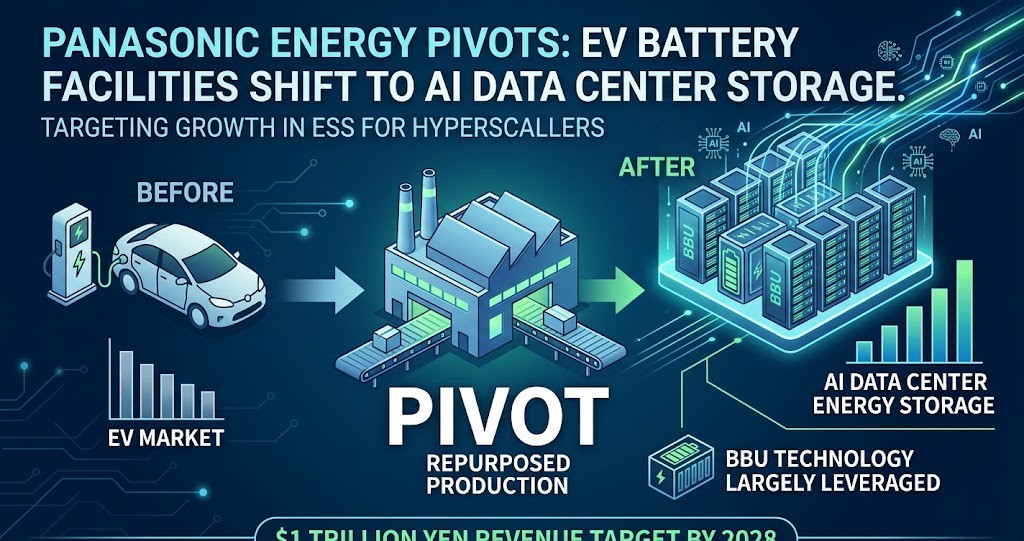
パナソニックホールディングス(HD)傘下で電池事業を担うパナソニックエナジーが、EV(電気自動車)向け電池の生産設備をAIデータセンター(DC)向け蓄電システムへ転換し、成長軌道を確実なものとしています。急速なAI需要の拡大に伴い、株式市場でも同社は「AI関連株」として大きな注目を集めています。
以下に、発表内容と業界の背景・関連情報をまとめた詳細情報を記載します。
事業転換の背景と設備転換の強み
- EV市場停滞への対応: 北米を中心としたEV市場の伸び悩みを受け、大型投資を進めていた車載電池の生産調整を実施。その打開策として、需要が急増するAIデータセンター向けへの設備転換(ピボット)を決定しました。
- 限定的な設備改修: 車載用とデータセンター用で電池の製造工程に共通部分が多いため、設備切り替えのハードルや変更点は最小限に抑えられています。米カンザス工場でも車載用設備を改造し、2028年度からデータセンター向けセルの量産を開始する予定です。
収益見通しと投資計画
- 売上高目標: 2025年度の3,220億円から、2026年度に5,500億円、2028年度に1兆円規模へと拡大し、2030年度には最大で1兆5,000億円規模に達する見通しです。
- 大規模投資: 2026~2028年度の3年間で計3,500億円をデータセンター向け蓄電システム事業に投じ、2030年頃までの成長を支える生産体制を整備します。
核となる技術とプロダクト(BBU)
- BBU(Battery Backup Unit)の役割: サーバーラックに直接搭載されるバックアップ電源システムです。停電時の予備電源としての機能に加え、GPUなどの画像処理半導体が瞬間的に大量の電力を消費する際の急激な負荷変動(ピークロード)に対して電力を補い、データセンター全体の電力負荷を平準化します。
- 競合に対する優位性:
- 長年の車載電池開発で培った高出力・高安全性・高信頼性を有する円筒形リチウムイオン電池の技術力を活用。
- セル内部の材料選定・開発から、電源設計、制御モジュール、最終的なユニット組み上げまでを自社で一貫して手掛ける垂直統合型のビジネスモデルを構築(世界的に見ても稀有な強み)。
- 大手Hyperscaler(ハイパースケーラー:超大型データセンター事業者)との長期にわたる共同開発実績と強固な信頼関係を保持。
株価および市場の評価
- 株価の急増: 車載電池の低迷から一転、AIインフラを支える本命銘柄として市場の評価が一変しました。
- 株価推移: 2026年1月8日の年初来安値2,003円から、2026年8月14日には上場来高値となる4,982円(約2.5倍)を記録。9月10日の終値は4,292円となっています。
関連情報・業界コンテキスト
- 生成AIの急速な普及と電力課題: 構造的に大規模なGPUサーバー群を稼働させるAIデータセンターでは、従来のデータセンターと比較して圧倒的な電力消費と急激な電圧・電力変動が発生します。そのため、単なる非常用電源ではなく、電力安定化機能を備えたBBUの重要性が爆発的に高まっています。
- アセットライトな戦略展開: 全く新しい工場を立ち上げるのではなく、既存のEV用電池ラインや建屋、インフラを流用・改造することで、設備投資の回収リスクを低減しつつ、需要に対して迅速に供給能力を立ち上げられるスピード感が大きな強みとなっています。
出典:https://news.yahoo.co.jp/articles/33b9d96768e6327aacf3f1adb97a679da5e1d44a
From Automotive to AI Data Centers: Panasonic’s Strengths in Existing Line Utilization and Vertical Integration
Panasonic Energy, the battery business unit under Panasonic Holdings, is securing a strong growth trajectory by pivoting its EV battery production facilities toward energy storage systems for AI data centers. Driven by the rapid expansion of AI demand, the company has attracted significant attention in the stock market as a key AI-related stock.
Below is a detailed summary combining official announcements, industry context, and related insights.
Background of Pivot and Strengths in Facility Conversion
- Response to EV Market Slowdown: In response to decelerating growth in the EV market, particularly in North America, the company adjusted its automotive battery production capacity, where it had previously made massive investments. As a solution, it decided to pivot facilities toward the rapidly surging AI data center market.
- Limited Equipment Modification: Because automotive and data center battery manufacturing processes share many common steps, the barriers and necessary changes for line conversion are kept to a minimum. The Kansas plant in the United States is also retrofitting its automotive production equipment, with mass production of data center cells scheduled to begin in fiscal year 2028.
Revenue Outlook and Investment Plan
- Revenue Targets: Revenue is projected to expand from 322 billion yen in fiscal year 2025 to 550 billion yen in fiscal year 2026, reaching 1 trillion yen in fiscal year 2028, with potential to scale up to 1.5 trillion yen by fiscal year 2030.
- Large-Scale Investment: The company will invest a total of 350 billion yen into the data center energy storage business over the three-year period from fiscal year 2026 to 2028, establishing a production structure to sustain growth through around 2030.
Core Technology and Product (BBU)
- Role of BBU (Battery Backup Unit): A backup power system mounted directly onto server racks. Beyond providing emergency backup power during outages, it compensates for sudden peak power loads when GPUs and other processing chips consume massive amounts of power instantaneously, helping smooth out the overall power load of the data center.
- Competitive Advantages:
- Leverages high-output, high-safety, and high-reliability cylindrical lithium-ion cell technology cultivated through long-standing automotive battery development.
- Utilizes a vertically integrated business model, handling everything internally from active material selection and development inside the cell to power supply design, control modules, and final unit assembly—a rare global strength.
- Maintains long-term joint development track records and strong, trusted relationships with major hyperscalers.
Stock Price and Market Evaluation
- Surge in Stock Price: Market evaluation transformed dramatically, shifting from concerns over the EV battery slowdown to recognizing the company as a prime beneficiary supporting AI infrastructure.
- Stock Price Movement: From a year-to-date low of 2,003 yen on January 8, 2026, the stock climbed to an all-time high of 4,982 yen on August 14, 2026 (approximately a 2.5-fold increase). The closing price on September 10 stood at 4,292 yen.
Related Information and Industry Context
- Rapid Spread of Generative AI and Power Challenges: AI data centers running large-scale GPU clusters experience vastly higher power consumption and sharp voltage/power fluctuations compared to traditional data centers. As a result, the importance of BBUs featuring power stabilization capabilities is skyrocketing far beyond simple emergency backup.
- Asset-Light Strategic Execution: Instead of constructing entirely new factories, repurposing and modifying existing EV battery lines, facilities, and infrastructure lowers capital expenditure recovery risks while enabling rapid capacity scaling to meet market demand.


コメント