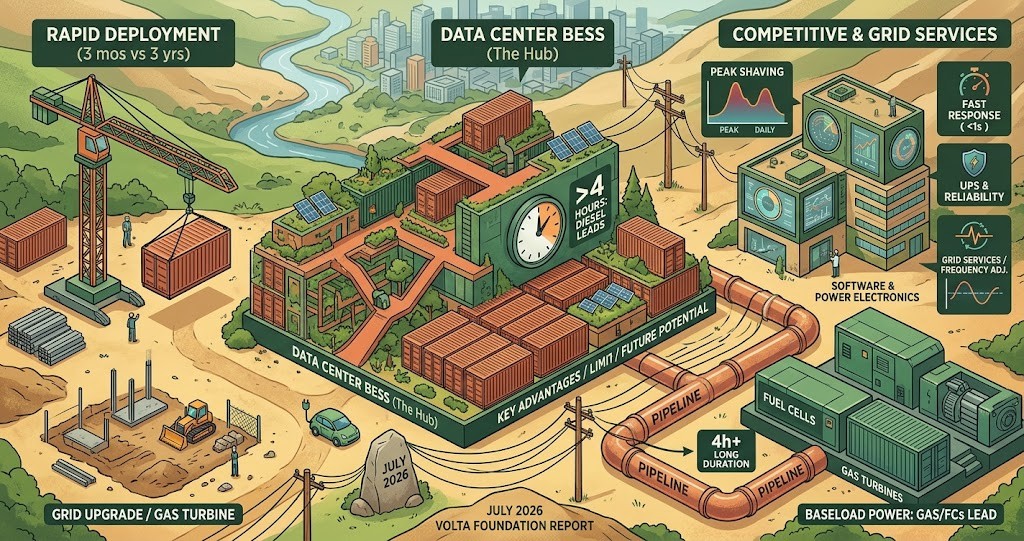
データセンターにおけるBESS(蓄電池エネルギー貯蔵システム)は、急速に拡大する電力需要と送電網接続の遅延を背景に、単なるバックアップ電源を超えた不可欠なインフラとして存在感を高めています。Volta Foundation(ボルタ財団)が2026年7月に発表したレポート「データセンター用途におけるバッテリーの優位性」によると、BESSはすべての用途で他技術を圧倒しているわけではなく、明確な強み、競合状況、そして課題が存在します。
本稿では、同レポートの分析をもとに、現在の技術動向や市場背景などの関連情報を加えて、データセンターにおけるBESSの競争力を整理・解説します。
- 1. BESSのポジショニング(優劣の分析)
- 2. 背景と関連情報:なぜ今BESSが急速に注目されるのか
- 3. 導入・運用における主な課題
- 4. 業界への提言と今後の見通し
- 1. Positioning of BESS (Analysis of Advantages and Disadvantages)
- 2. Background and Relevant Information: Why BESS is Rapidly Gaining Attention Now
- 3. Key Challenges in Implementation and Operation
- 4. Recommendations for Industry and Future Outlook
- Conclusion
1. BESSのポジショニング(優劣の分析)
Volta Foundationの分析によると、データセンター市場におけるBESSの適用分野は「優位」「競合」「劣勢」の3つに分類されます。
(1) BESSが優位に立っている分野(2領域)
- 電力供給(系統連系)までのスピード
- 送電網の増強やガスタービンの設置には数年単位の期間を要しますが、BESSは比較的短期間で設置・稼働が可能です。系統接続の待機列(インターコネクション・キュー)を回避する「ブリッジ電源」として素早く導入できます。
- ピークカットおよびデマンド料金削減
- 電力単価が高騰する時間帯やピーク時に放電することで、需要家側の基本料金(デマンド料金)を大幅に抑制します。日々の充放電サイクル運用において、ガス発電機等と比較して圧倒的な低コスト(MWhあたりの電力コスト)を実現します。
(2) 改善が必要・競合段階にある分野(4領域)
- 出力抑制(カテイルメント)への柔軟な対応
- 無停電電源装置(UPS)機能を備えた停電耐性
- 系統サービス(周波数調整や需給調整市場への参加)
- 1秒未満の高速応答による電力品質(電圧・周波数)の維持
- これらはソフトウェア制御およびパワーエレクトロニクス技術の進化に伴い、BESSの適用範囲として急速に競争力を高めている領域です。
(3) 他の技術に対して劣勢な分野(2領域)
- 4時間を超える長時間のバックアップ電力供給
- 現状のLFP(リン酸鉄リチウム)を中心とするBESSでは長時間のエネルギー保持コストが高いため、従来のディーゼル発電機が依然として主役を務めています。
- 連続的な主電源(ベースロード電力)としての供給
- 持続的かつ安定的なエネルギー供給においては、ガスタービンや燃料電池(水素・天然ガス等)が優位に立っています。
2. 背景と関連情報:なぜ今BESSが急速に注目されるのか
(1) AI需要に伴う電力需要の爆発的増加と系統接続のボトルネック
生成AIや大型言語モデル(LLM)の普及に伴い、ハイパースケーラー(Meta、Google、Microsoft、Amazon、ByteDance、Alibabaなど)のデータセンター消費電力は桁違いに増加しています。しかし、送電網への接続(グリッド・インターコネクション)の順番待ちには数年を要するケースが頻発しており、データセンターの稼働遅延が深刻なビジネスリスクとなっています。この「接続待ち」期間を埋める仮設・暫定電源(ブリッジ電力)として、BESSのスピード感が決定的なアドバンテージとなっています。
(2) ハイパースケーラーによる垂直統合の動き
大型IT企業はBESSを単なるサードパーティからの調達にとどめず、自社インフラとしての垂直統合を強めています。Energy Vault、Eolian、Fluence、Hithium、ZincFiveなどの主要BESS・電池ベンダーと提携・直接投資を行い、自社の負荷プロファイルに合わせた最適なシステム構築を推進しています。
(3) 電池技術の進化(LFPおよび高出力・高密度セル)
安全性が高くサイクル寿命に優れるLFP(リン酸鉄リチウム)電池の低価格化が、BESSの経済性を一段と高めました。さらに、1秒未満の即時応答が求められるUPS用途向けには「高出力セル」、長時間バックアップ用途向けには「高エネルギー密度セル」や「ナトリウムイオン電池」など、用途に応じた電池化学(セル・ケミストリー)の使い分けが進んでいます。
3. 導入・運用における主な課題
- 統合・制御・運用管理(EMS/BMS)の問題
- 初期トラブルの多くはバッテリー自体の不具合ではなく、試運転時や稼働後最初2年間に起きるシステム統合、パワーエレクトロニクス、制御ソフトウェアの不具合に集中しています。
- 標準化された負荷プロファイルの欠如
- データセンター固有の急激な負荷変動(AI学習・推論時の電力スパイクなど)に対して、送電網事業者やBESSイングレーターが正確な負荷プロファイルを把握しきれていない点が課題です。
- 規制と料金体系への依存
- デマンド料金制度や出力抑制ルールが存在しない地域では、BESS導入による経済的メリット(裁定取引やコスト削減)が限定的になります。
4. 業界への提言と今後の見通し
今後2~3年が、BESSがデータセンターにとって「過渡期の過渡的手段(渡った橋)」で終わるか、それとも「持続的で不可欠な恒久インフラ」へと定着するかを分ける重要な局面となります。
- データセンター開発者・ハイパースケーラーへの提言
- 単なる非常用電源としてではなく、日常的にピークカットや電力最適化を行う「ハイブリッド・アーキテクチャ」を最初から設計すること。これにより、日常的なコスト削減とバックアップ機能を同時に実現できます。
- 電力調達の評価軸として、単なるLCOE(均等化発電原価)だけでなく、「電力供給までのスピード(Time to Power)」を同等に重視すること。
- 送電網事業者・政策立案者への提言
- 出力抑制を前提とした系統連系枠組みの標準化や、大口需要家向け蓄電池の市場参加ルールの明確化を進め、遅延や混乱を防ぐこと。
- システムインテグレーター・電池メーカーへの提言
- 急激な高出力要求(UPS・電力品質向け)と、高容量要求(長時間バックアップ向け)など、データセンターの具体的な負荷種別に最適化した製品設計を進めること。
まとめ
データセンターにおけるBESSは、単なる停電対策から「電力管理層(Power Management Layer)」へと役割を拡大しています。短期的な「系統接続までの時間稼ぎ」だけでなく、日々のピークカットや系統サービスの提供を通じた恒常的な運用価値を引き出せるかが、今後の市場定着のカギとなります。
Can BESS Solve Power Shortages in the AI Era? The Advantages and Limitations of BESS in Data Centers
Against the backdrop of rapidly expanding power demand and grid connection delays, Battery Energy Storage Systems (BESS) in data centers are increasing their presence as essential infrastructure beyond mere backup power sources. According to the July 2026 report “The Advantage of Batteries in Data Center Applications” published by the Volta Foundation, BESS does not overwhelm other technologies in every application, but possesses clear strengths, competitive conditions, and challenges.
Based on the analysis in that report, this article clarifies and explains the competitiveness of BESS in data centers, incorporating relevant information such as current technology trends and market backgrounds.
1. Positioning of BESS (Analysis of Advantages and Disadvantages)
According to the Volta Foundation’s analysis, the application areas of BESS in the data center market are classified into three categories: “Dominant,” “Competitive,” and “Disadvantaged.”
(1) Areas Where BESS holds a Advantage (2 Areas)
- Speed to Power (Grid Interconnection) Grid expansion and gas turbine installation require several years, but BESS can be installed and operated in a relatively short period. It can be quickly deployed as a “bridge power supply” to bypass the interconnection queue.
- Peak Shaving and Demand Charge Reduction Discharging during peak hours or high electricity price periods significantly suppresses basic charges (demand charges) on the consumer side. In daily charge-discharge cycle operations, it achieves overwhelmingly low costs (power cost per MWh) compared to gas generators and other sources.
(2) Areas Needing Improvement / In the Competitive Stage (4 Areas)
- Flexible response to curtailment
- Outage resilience with Uninterruptible Power Supply (UPS) functions
- Grid services (participation in frequency regulation and capacity markets)
- Power quality maintenance (voltage and frequency) via sub-second response
These are areas where BESS is rapidly building competitiveness as an application scope due to advancements in software control and power electronics technology.
(3) Areas Disadvantaged Against Other Technologies (2 Areas)
- Long-duration backup power supply exceeding 4 hours Because current BESS centered on LFP (Lithium Iron Phosphate) has high long-duration energy retention costs, conventional diesel generators continue to play the primary role.
- Supply as a continuous primary power source (baseload power) Gas turbines and fuel cells (hydrogen, natural gas, etc.) hold the advantage for sustained, stable energy supplies.
2. Background and Relevant Information: Why BESS is Rapidly Gaining Attention Now
(1) Explosive Growth in Power Demand Driven by AI and Grid Connection Bottlenecks
With the widespread adoption of generative AI and Large Language Models (LLMs), the power consumption of hyperscaler (Meta, Google, Microsoft, Amazon, ByteDance, Alibaba, etc.) data centers is increasing exponentially. However, waiting times for grid interconnection often take years, posing a severe business risk by delaying data center operations. The speed of BESS provides a decisive advantage as temporary/interim power (bridge power) to bridge this waiting period.
(2) Vertical Integration Movements by Hyperscalers
Major IT companies are going beyond procuring BESS from third parties and are strengthening vertical integration into their own infrastructure. They are partnering with and making direct investments in major BESS and battery vendors such as Energy Vault, Eolian, Fluence, Hithium, and ZincFive to push forward the construction of optimal systems tailored to their load profiles.
(3) Evolution of Battery Technology (LFP and High-Power / High-Density Cells)
The price drop of LFP (Lithium Iron Phosphate) batteries, which offer high safety and excellent cycle life, has further improved the economics of BESS. Furthermore, cellular chemistry is being differentiated based on applications: high-power cells for UPS applications requiring sub-second immediate response, and high energy density cells or sodium-ion batteries for long-duration backup applications.
3. Key Challenges in Implementation and Operation
- Integration, Control, and Operational Management (EMS/BMS) Issues Most initial problems are not caused by defects in the batteries themselves, but are concentrated in system integration, power electronics, and control software defects that occur during commissioning and within the first two years of operation.
- Lack of Standardized Load Profiles A key challenge is that grid operators and BESS integrators do not fully understand accurate load profiles for data center-specific sharp load fluctuations (power spikes during AI training and inference).
- Dependence on Regulations and Tariff Structures In regions where demand charge systems or curtailment rules do not exist, the economic benefits (arbitrage and cost reduction) of adopting BESS are limited.
4. Recommendations for Industry and Future Outlook
The next 2 to 3 years will be a crucial juncture determining whether BESS ends up as a temporary bridge for data centers or becomes established as a sustainable, indispensable, and permanent infrastructure.
- Recommendations for Data Center Developers and Hyperscalers Design a “hybrid architecture” from the outset that performs daily peak shaving and power optimization, rather than treating BESS merely as an emergency power supply. This enables simultaneous daily cost reduction and backup capabilities. Prioritize “Time to Power” equally alongside simple LCOE (Levelized Cost of Electricity) as an evaluation metric for power procurement.
- Recommendations for Grid Operators and Policy Makers Standardize grid interconnection frameworks based on curtailment and clarify market participation rules for large-consumer storage batteries to prevent delays and confusion.
- Recommendations for System Integrators and Battery Manufacturers Advance product designs optimized for specific data center load types, such as rapid high-power demands (for UPS and power quality) versus high-capacity demands (for long-duration backup).
Conclusion
BESS in data centers is expanding its role from simple outage protection to a comprehensive “Power Management Layer.” The key to future market permanence lies in whether BESS can unlock ongoing operational value through daily peak shaving and provision of grid services, beyond just short-term time-buying until grid connection.
コメント