次世代のエネルギー貯蔵市場(ESS)では、安全性の高い「水系電池」の開発が世界中で加速しています。特に発火リスクが低く安価な亜鉛イオン電池は期待を集める一方で、充放電の遅さが大きな課題とされてきました。このボトルネックを打破する画期的な研究成果が、韓国の研究チームによって発表されました。
1. ニュースのポイント(研究成果まとめ)
KAISTとPOSTECHの共同研究チームは、水系亜鉛イオン電池の性能を大幅に引き上げる新しい二次元導電性MOF(金属有機構造体)電極の開発に成功しました。
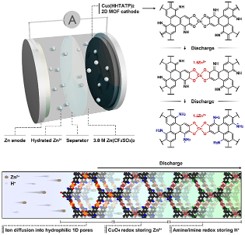
- 課題の克服(プロトンの活用):従来は電極を劣化させる「厄介者」として抑制対象だった「プロトン(水素イオン)」の反応を抑制せず、逆に亜鉛イオンとの貯蔵順序を制御することでエネルギー源として活用。
- 革新的な電極構造:アミン官能基を組み込んだ二次元MOF電極(
Cu3(HHTATP)2)を設計。高電圧域で大きな亜鉛イオンを先に貯蔵し、低電圧域で小さなプロトンを追加貯蔵する「二段構え(順次貯蔵)」を実現。 - 圧倒的な性能数値:
- 高容量:
0.5A/gで368.7mAh/gの貯蔵容量を達成。 - 高速充放電: 速度を16倍に上げても初期容量の46.9%を維持。
- 高耐久: 500サイクル以上の急速充放電でも安定した性能を維持。
- 高容量:
2. 関連情報・技術背景の深掘り(補足解説)
本研究のすごさと背景を理解するための専門解説です。
① 「水系亜鉛イオン電池」が注目される理由と課題
現在主流のリチウムイオン電池は発火リスクやコストが課題です。これに対し、電解液に水を使う「水系亜鉛イオン電池」は非危険物・低コスト・低環境負荷であるため、大型蓄電池(ESS)の決定版として期待されています。しかし、亜鉛イオンは二価(Zn2+)でサイズが大きく、電極内を素早く移動できないため「高容量」と「急速充放電」の両立が困難でした。
② 「プロトン(H+)」はなぜ「厄介者」だったのか?
プロトンはサイズが極めて小さく超高速で動けるため、理想的な電荷担体(電気を運ぶ粒子)です。しかし、水系電解液中でプロトンが過剰に反応すると、電極表面に副生成物(不溶性の塩など)が固着し、メインである亜鉛イオンの移動をブロックして電池を劣化させてしまう「害悪」とされてきました。
③ なぜ「順次貯蔵(シーケンシャル・ストレージ)」で解決できたのか?
研究チームは「プロトンを追い出す」のではなく「入れる順番を決める」発想の転換を行いました。
- 高電圧領域: まず比較的サイズの大きい「亜鉛イオン」をMOFの微細孔に受け入れる。
- 低電圧領域: 電圧が下がったタイミングで、空いたスペースに小さくすばやい「プロトン」を滑り込ませる。
電圧によってアクセスを分散(二重の貯蔵ステップ)させたことで、両イオン同士の干渉や副生成物の発生を防ぎ、プロトンの超高速移動能力だけを安全に引き出すことに成功しました。
3. 将来の展望とインパクト
本技術は、単なる材料開発にとどまらず「複数種類のイオンを安全に順次貯蔵する仕組み」という新しい電極設計の指針を示しました。
- 大型蓄電システム(ESS)への応用:安全かつ急速充放電が可能な大容量蓄電池として、太陽光や風力などの再生可能エネルギーの出力変動を吸収する系統用蓄電池への導入が期待されます。
- 他材料への応用展開:パク教授が語る通り、この「イオン順次貯蔵の原理」を他の汎用電極材料にも応用することで、次世代二次電池全体の性能向上に寄与すると期待されています。
出典:https://spap.jst.go.jp/korea/news/260903/topic_nk_03.html
A New Leading Candidate for Large-Scale Energy Storage Systems (ESS): South Korea’s KAIST Overcomes Key Bottleneck in Aqueous Zinc-Ion Batteries
In the next-generation energy storage system (ESS) market, the development of highly safe “aqueous batteries” is accelerating worldwide. In particular, aqueous zinc-ion batteries have drawn high expectations due to their low fire risk and low cost; however, their slow charge/discharge rate has long been a major drawback. A research team in South Korea has announced a breakthrough that overcomes this bottleneck.
1. Key Highlights (Research Summary)
A joint research team from KAIST and POSTECH successfully developed a novel two-dimensional (2D) conductive metal-organic framework (MOF) electrode that significantly enhances the performance of aqueous zinc-ion batteries.
- Overcoming the Challenge (Utilizing Protons):Instead of suppressing protons (hydrogen ions)—which were previously viewed as “troublemakers” that degrade electrodes—the team controlled the storage sequence of protons alongside zinc ions, turning them into an energy source.
- Innovative Electrode Structure:Designed a 2D MOF electrode incorporating amine functional groups ($\text{Cu}_3(\text{HHTATP})_2$). This enables a two-step “sequential storage” mechanism: larger zinc ions are stored first at high voltages, followed by smaller protons at lower voltages.
- Outstanding Performance Metrics:
- High Capacity: Achieved a storage capacity of $368.7\text{ mAh g}^{-1}$ at $0.5\text{ A g}^{-1}$.
- Fast Charging/Discharging: Maintained $46.9\%$ of initial capacity even when the charge rate was increased 16-fold.
- High Durability: Demonstrated stable performance over more than 500 rapid charge/discharge cycles.
2. Technical Background & Insights
① Why Aqueous Zinc-Ion Batteries Matter (and Their Challenges)
Conventional lithium-ion batteries face safety and cost concerns. In contrast, aqueous zinc-ion batteries use water-based electrolytes, making them non-hazardous, cost-effective, and environmentally friendly—ideal for large-scale ESS applications. However, divalent zinc ions ($\text{Zn}^{2+}$) are large and move slowly within electrodes, making it difficult to achieve both high capacity and fast charging.
② Why Were Protons ($\text{H}^+$) Considered “Troublemakers”?
Protons are extremely small and fast-moving, making them ideal charge carriers. However, excessive proton reactions in aqueous electrolytes form insoluble byproducts on the electrode surface, blocking zinc-ion transport and degrading performance.
③ How “Sequential Storage” Solved the Problem
The team shifted paradigms from “suppressing protons” to “regulating their entry order”:
- High-Voltage Range: The larger zinc ions enter the MOF micropores first.
- Low-Voltage Range: As voltage drops, the smaller, faster protons slip into the remaining available spaces.
By staggering ion storage across distinct voltage regimes, the team prevented interference and unwanted byproducts while fully harnessing the rapid movement of protons.
3. Future Outlook & Impact
This study provides a new design blueprint for electrode engineering by demonstrating how multiple ion species can be safely stored in sequence.
- Applications in Large-Scale ESS:Expected to serve as grid-scale batteries to absorb power fluctuations from renewable energy sources like solar and wind power.
- Broad Applicability:As Professor Park noted, applying this “sequential ion storage principle” to other commercial electrode materials could boost the performance of next-generation batteries overall.


コメント