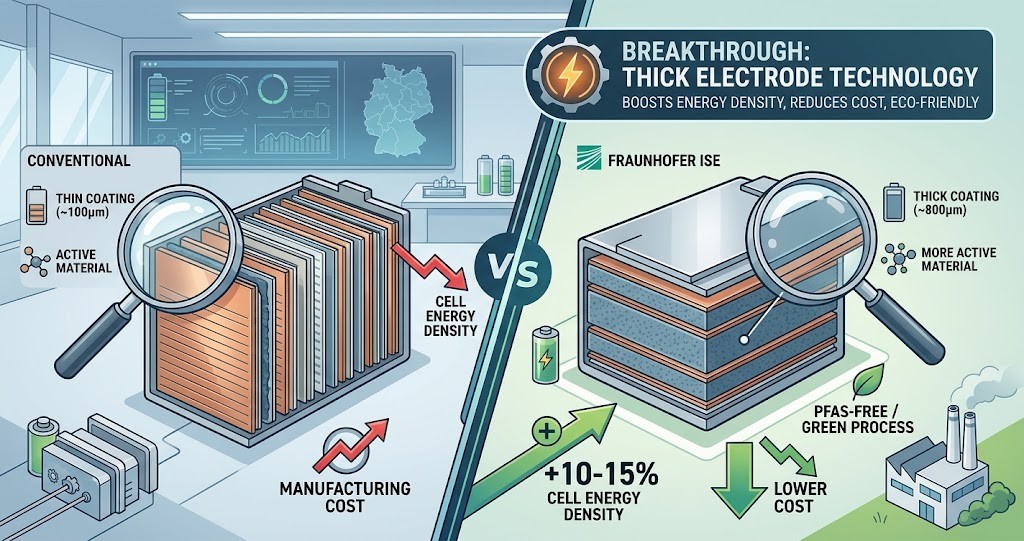
ドイツのフラウンホーファー太陽エネルギーシステム研究所(Fraunhofer ISE)を中心とする研究コンソーシアムが、電池のエネルギー密度向上と製造コスト削減を両立する画期的な厚型電極技術を発表しました。持続可能な次世代電池製造技術として世界的な注目を集めています。
本技術の概要と、背景となる業界動向などの関連情報をまとめた内容は以下の通りです。
ドイツ研究機関による革新的厚型電極設計の概要
フラウンホーファーISEおよびパートナー機関(Acp systems、Helmut Hechinger、シュトゥットガルト大学、カールスルーエ工科大学/ヘルムホルツ研究所ウルム校など)は、バッテリーの重量を増やすことなく、セルレベルのエネルギー密度を10%から15%向上させる新しい電極技術を開発しました。
1. 技術的特徴と性能
- 電極の厚型化: 従来の電極コーティングの厚さは100〜200 um程度ですが、新技術では最大800 umまで厚くすることに成功しました。
- エネルギー密度の向上: 電極を厚くすることで、セル内部に必要な集電体(金属箔など)やセパレータの枚数を減らすことができます。これにより、重量を増やすことなく活性物質(エネルギー貯蔵材料)の充填率を高め、セルレベルのエネルギー密度を10〜15%向上させます。
- 環境親和性: PFAS(有機フッ素化合物)を含まず、有毒な有機溶剤を使用しない環境負荷の低いプロセスで製造されます。
2. 製造コストおよび設備へのメリット
従来の湿式コーティング(溶剤塗装・乾燥工程)と比較して、プロセスが劇的に簡素化されています。
- CAPEX(設備投資)の削減: 乾燥炉などの大規模設備が不要または縮小されるため、製造ラインの初期投資を大幅に抑えられます。
- OPEX(運営コスト)の削減: フットプリント(必要設置面積)の縮小に加え、乾燥にかかるエネルギー消費を大幅に削減できます。
- 中小企業の参入支援: 設備投資のハードルが下がることで、ドイツ国内の中小企業が自前の電池セル製造施設を設立・運営しやすくなります。
3. 適用範囲と実証プロジェクト
本技術は単一の電池化学組成に留まらず、広範な系に適用可能です。研究チームはすでにリチウムイオン電池(パウチ型試作品)、ナトリウムイオン電池、亜鉛イオン電池で実証を完了しています。 関連する研究プロジェクト:
- VORAN: 定置型および移動型向けの革新的ナトリウムイオン電池ストレージ
- INFAB: 定置型エネルギー貯蔵向け亜鉛イオン電池の製造・組み立て
- WinZIB2: グローバル展開可能な革新的な亜鉛イオン電池システム
関連情報・背景解説
厚型電極(Thick Electrodes)の課題と技術的ブレイクスルー
電極を厚くすることは理論的にはエネルギー密度向上に有効ですが、従来は厚くするほど「電解液の浸透・濡れ性の悪化」「リチウムイオン等の移動抵抗(曲折度)増大に伴う出力特性(Cレート)の低下」「乾燥時のヒビ割れや集電体からの剥離」が深刻な課題でした。 今回の発表では具体手法の詳細は明かされていないものの、溶剤フリー(ドライプロセス等)や造粒・押出成形技術を活用することで、厚膜化に伴う機械的・電気化学的課題を克服したとみられます。
溶剤フリー(ドライプロセス)化の世界的トレンド
現在、テスラ(Tesla)の4680セル製造や、様々な電池・材料メーカーが「ドライ電極コーティング(Dry Electrode Coating)」の開発を競っています。従来の湿式法で使われるNMP(N-メチル-2-ピロリドン)などの有毒溶剤を排除することは、環境規制(PFAS規制やVOC排出規制)への適合だけでなく、工場建屋のコンパクト化と大幅な省エネ(脱炭素製造)に不可欠なトレンドとなっています。
欧州における「定置型蓄電池(BESS)」とサプライチェーンの内製化
フラウンホーファーISEのアンドレアス・ベット所長が言及している通り、太陽光や風力発電など変動性再生可能エネルギーの導入が進む欧州では、電力系統の安定化を担う定置型蓄電池(BESS)の需要が急増しています。 中国勢が主導権を握る電池市場において、欧州(特にドイツ)がエネルギー安全保障と産業競争力を維持するためには、環境負荷が低く、設備投資を抑えたローカルな電池製造能力の構築が急務となっています。本技術は、低コストなナトリウムイオン電池や亜鉛イオン電池と組み合わせることで、定置型蓄電システムのコストパフォーマンスを劇的に改善する可能性を秘めています。
15 Percent Increase in Energy Density with Electrodes Up to 800 um Thick: A New PFAS-Free Electrode Technology Developed by German Research Institutes
A research consortium led by Germany’s Fraunhofer Institute for Solar Energy Systems (Fraunhofer ISE) has announced a groundbreaking thick-electrode technology that achieves both higher battery energy density and reduced manufacturing costs. It is attracting global attention as a sustainable, next-generation battery production technology.
Below is an overview of the technology and related background information regarding industry trends.
Overview of Innovative Thick-Electrode Design by German Research Institutes
Fraunhofer ISE and its partner institutions (including Acp systems, Helmut Hechinger, the University of Stuttgart, and the Karlsruhe Institute of Technology / Helmholtz Institute Ulm) have developed a new electrode technology that improves energy density at the cell level by 10 to 15 percent without increasing battery weight.
- Technical Features and Performance
- Thicker Electrodes: While conventional electrode coatings are typically around 100 to 200 um thick, the new technology successfully increases coating thickness up to 800 um.
- Increased Energy Density: Thicker electrodes reduce the number of current collectors (metal foils) and separators required inside the cell. This raises the active material (energy storage material) loading ratio without increasing weight, enhancing cell-level energy density by 10 to 15 percent.
- Environmental Friendliness: Manufactured via an environmentally low-impact process that is PFAS-free and uses no toxic organic solvents.
- Benefits for Manufacturing Costs and Facilities Compared to traditional wet coating (solvent application and drying processes), the manufacturing process is dramatically simplified.
- Reduced CAPEX (Capital Expenditure): Eliminating or downsizing large-scale equipment like drying ovens significantly lowers initial capital investments for production lines.
- Reduced OPEX (Operating Expenses): In addition to a smaller plant footprint (required installation area), energy consumption for drying is substantially reduced.
- Support for Small and Medium Enterprises: Lower barriers to capital investment make it easier for small and medium enterprises in Germany to establish and operate their own battery cell production facilities.
- Scope of Application and Demonstration Projects This technology is not limited to a single battery chemistry and can be applied across a broad range of systems. The research team has already completed demonstrations in lithium-ion batteries (pouch-cell prototypes), sodium-ion batteries, and zinc-ion batteries.
Related Research Projects:
- VORAN: Innovative sodium-ion battery storage for stationary and mobile applications
- INFAB: Zinc-ion batteries for stationary energy storage – manufacturing and assembly
- WinZIB2: Globally deployable innovative zinc-ion battery systems
Related Information and Industry Context
Challenges of Thick Electrodes and Technical Breakthroughs Making electrodes thicker is theoretically effective for improving energy density, but historically presented severe technical challenges: poor electrolyte wetting/penetration, increased tortuosity (ion transport resistance) leading to reduced rate capabilities (C-rate performance), and electrode cracking or delamination from the current collector during drying.
While specific process details were not disclosed in this announcement, the team appears to have overcome the mechanical and electrochemical hurdles of thick coatings by utilizing solvent-free methods (such as dry processing) or granulation/extrusion technologies.
Global Trend Toward Solvent-Free (Dry Process) Manufacturing Currently, battery and material manufacturers—along with Tesla in its 4680 cell production—are competing to develop dry electrode coating techniques. Eliminating toxic solvents like NMP (N-Methyl-2-pyrrolidone) used in traditional wet processes is an essential trend not only for regulatory compliance (PFAS and VOC emission restrictions), but also for shrinking factory footprints and achieving substantial energy savings (decarbonized manufacturing).
Stationary Energy Storage Systems (BESS) and Supply Chain Localization in Europe As noted by Andreas Bett, Director of Fraunhofer ISE, demand for Battery Energy Storage Systems (BESS) to stabilize power grids is surging in Europe due to the growing adoption of variable renewable energy like solar and wind power.
In a global battery market dominated by Chinese players, establishing local, environmentally friendly, and low-CAPEX battery manufacturing capabilities is an urgent priority for Europe (especially Germany) to maintain energy security and industrial competitiveness. When combined with low-cost sodium-ion or zinc-ion batteries, this technology holds strong potential to dramatically improve the cost-performance ratio of stationary energy storage systems.

コメント