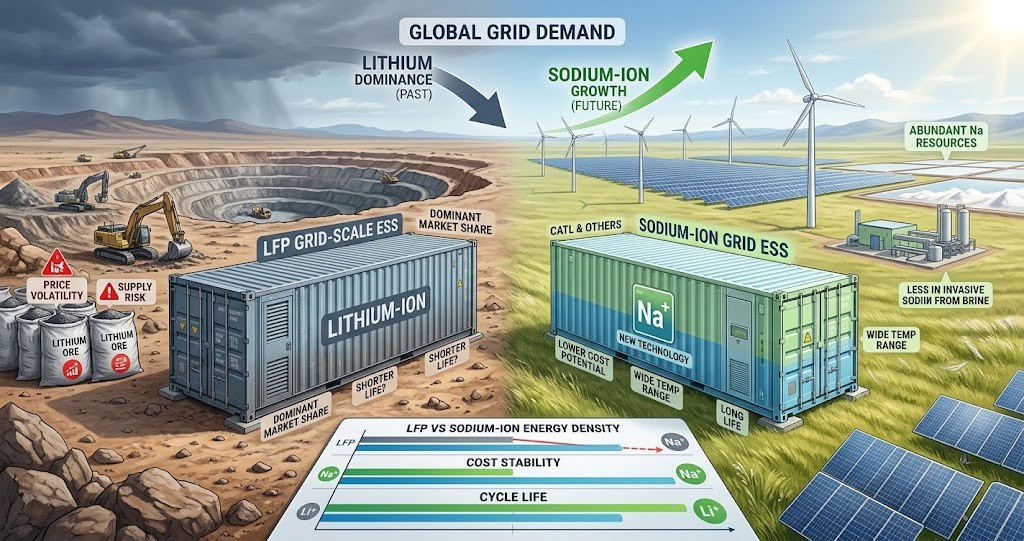
再生可能エネルギーの導入拡大に伴い、電力系統の安定化を担う大型(系統用)蓄電システムの需要が世界的に急増しています。これまでこの市場ではリン酸鉄リチウム(LFP)電池が主流を占めてきましたが、近年、エネルギー密度で劣る「ナトリウムイオン電池」が実用化および大型プロジェクトでの採用期を迎えています。
背景には、リチウム資源の価格乱高下や供給リスク、さらに長寿命化や広い動作温度範囲といった系統用蓄電特有のニーズが存在します。本稿では、中国大手電池メーカーCATLの動きや市場背景、技術進化の経緯、および今後の課題について、関連情報や客観的なデータを補足しながら分かりやすく解説します。
1. ナトリウムイオン電池が系統用蓄電で選ばれる理由
系統用蓄電(定置用蓄電池)における評価軸は、電気自動車(EV)向けとは大きく異なります。
- 「軽さ」や「エネルギー密度」よりも重要な指標 EVでは車体重量や積載スペースに直結するエネルギー密度(Wh/kg)が最重視されますが、地上に固定設置される系統用蓄電では、重さや容積の制約が相対的に小さくなります。そのため、IEA(国際エネルギー機関)の集計でナトリウムイオンセル(最大175Wh/kg)がLFP(205Wh/kg)に及ばない点(約15%低下)は致命的な欠点とはなりません。
- サイクル寿命と長寿命性 系統用蓄電は毎日充放電を繰り返して収益を生む資産です。CATLの系統用ナトリウムイオン電池システム「Tener Sodium」は、25度で15,000サイクル(SOH 70%到達時)、25~30年の想定寿命と公表されています。長期間にわたり安定して稼働できる耐久性が重要な選定基準となります。
- 優れた温度特性と補機電力の削減 マイナス20度といった低温環境下でも92%以上の容量を保持する特性があり、空調などの補機電力を抑えられるため、システム全体の往復効率(RTE)向上に寄与します。
- ボラティリティに対するリスクヘッジ 主要原料であるリチウムは過去数年で急激な価格乱高下を見せました(炭酸リチウム価格は2022年の60万元/t超から2025年5月に約5万8,860元/tへ落とし、2026年1月には18万1,500元/tへ再上昇)。これに対し、ナトリウムは地殻中に豊富に存在(リチウムの1,000倍以上)し、コバルトやニッケルを使用せず、集電体に高価な銅箔ではなくアルミニウム箔を使用できるため、リチウム価格から独立した長期的なコスト安定化手段として期待されています。
2. 技術開発と量産の歩み
ナトリウムイオン電池の研究は1970年代から始まっていましたが、商用化までの道のりには明確な技術的・経済的フェーズが存在します。
- 初期研究(1976年〜2000年代初頭)1976年にインターカレーション型化合物、1980年に層状酸化物正極が報告されましたが、リチウムが入るグラファイト負極にナトリウムが実用的に挿入できない問題があり、1991年のソニーによるリチウムイオン電池商用化以降、研究投資はリチウムへ集中しました。
- 負極技術の突破(2000年)2000年にStevensとDahnがグルコース由来のハードカーボン(硬質炭素)負極(約300mAh/g)を報告したことで技術的障壁が大きく下がりました。
- 製品化と製品世代の推移(2021年〜2026年)
- 2021年(第1世代): セル密度最大160Wh/kg。自動車用(リチウムとの混載)および蓄電向けに展開。
- 2025年(Naxtra): セル密度175Wh/kg、10,000サイクル超。乗用車・トラック向け。
- 2026年(Tener Sodium): セル密度約160Wh/kg、25度で15,000サイクル。系統用蓄電専用として設計。5年間の進化の軸はエネルギー密度の向上ではなく、サイクル寿命、温度耐性、量産プロセス(水分管理やガス発生抑制)の克服に置かれました。
- コスト動向ハードカーボン負極の価格低下(2024年の6万〜7万元/tから2026年には3万5,000〜4万元/tへ半減)が進む一方、2025〜2026年時点では規模の経済においてLFPが勝る場面も残ります。しかし、2026年末にはセルコストでLFPと同等に到達し、その後下回ると見込まれています。
3. グローバル市場の動向と事業展開
大型蓄電市場における主要国の動向とプレイヤーの動きは以下の通りです。
- 中国(量産と大規模導入のリード)
- CATL: 2026年6月にTener Sodiumを発表。中国国内では2026年9月に納入開始(年内出荷目標1GWh)。HyperStrongと3年・60GWhの供給契約を締結し、福建省福鼎市に40GWh規模の生産ライン増設(投資額約50億元)を進めています。
- その他メーカー: BYD(MC Cube-SIBの実証)、HiNa Battery(GWh級ライン稼働)、Hithium、Envision Energyなどが参入しています。
- 欧州(実証と製品適合の期間)
- CATLはオランダのAlfenと5GWh、Solarproと2GWhの導入に向けた協定(MOU)を締結。国際出荷開始予定は2027年6月であり、Alfenの決算資料では導入時期を「2027年下半期より前には見込まない」としています。この約1年のタイムラグは、現地グリッドコードへの製品適合および運用データの検証期間として位置づけられています。
- 米国(分業体制とプレイヤーの交代)
- 初期のパイオニア企業であったNatron Energyが2025年秋に事業を停止した一方、GMが2026年6月にPeak Energyとの提携を通じて系統用蓄電市場へ参入(2028年商用化目標)。ESS TechもAlsym Energyとの連携を進めるなど、「セル製造」と「システム統合(インテグレーター)」の分業化が進んでいます。
- 日本(中長期的な研究開発段階)
- NEDO事業において、東京理科大学(駒場慎一教授)を筆頭にGSユアサ、クラレ、東亞合成など13機関が参加する産学連携で「次世代ナトリウムイオン電池の技術開発」が推進されています。目標時期は2030年代半ばの実用化に置かれており、商用大型セルの量産化においては海外勢と約10年のフェーズ差が存在します。一方、国内の系統用蓄電需要(2030年に累計14.1〜23.8GWh見込み)の拡大に対し、当面は海外製セルの活用が前提となります。
まとめ
ナトリウムイオン電池が系統用蓄電市場で選ばれる理由は、単なる「安さ」や「エネルギー密度の高さ」ではなく、「長寿命」「広い動作温度範囲」、そして「リチウム資源価格の変動リスクを回避できる構造」にあります。
2026年9月に開始される中国での実地納入を皮切りに、実際の稼働データ、2026年末にかけてのLFPとのコスト逆転、ならびに2027年以降の欧州・グローバルへの展開が、今後の蓄電市場の勢力図を占う重要な指標となります。
出典:https://xenospectrum.com/catl-tener-sodium-grid-storage-timeline/
“Longevity” over “Lightness”: Why Sodium-Ion Batteries Can Compete with LFP in Grid-Scale Energy Storage
Driven by the global expansion of renewable energy integration, demand for large-scale (grid-scale) energy storage systems responsible for power grid stabilization is surging worldwide. While lithium iron phosphate (LFP) batteries have dominated this market, sodium-ion batteries—despite their lower energy density—are entering the phase of commercial implementation and adoption in large-scale projects.
This shift is backed by wild fluctuations in lithium resource prices and supply chain risks, along with grid-specific requirements such as extended cycle life and wide operating temperature ranges. This article provides a clear, accessible overview of the latest market landscape, technical evolution, and future challenges, featuring key developments from major Chinese battery maker CATL alongside supporting background data.
1. Why Sodium-Ion Batteries Are Chosen for Grid-Scale Energy Storage
The evaluation criteria for grid-scale energy storage (stationary batteries) differ significantly from those for electric vehicles (EVs).
- Metrics More Critical Than “Lightness” or “Energy Density”In EVs, energy density (Wh/kg) is paramount because it directly impacts vehicle weight and space constraints. For stationary grid storage installed on the ground, however, weight and volume constraints are far less stringent. Thus, the fact that sodium-ion cells reach up to 175 Wh/kg—roughly 15% lower than LFP at 205 Wh/kg according to IEA data—is not a fatal flaw.
- Cycle Life and LongevityGrid storage assets generate revenue by repeating charge and discharge cycles daily. CATL’s grid-scale sodium-ion battery system, “Tener Sodium,” is rated for 15,000 cycles at 25 degrees Celsius (reaching 70% SOH) and offers an estimated operational lifespan of 25 to 30 years. Long-term operational durability serves as a primary selection criterion.
- Superior Temperature Performance and Reduced Auxiliary PowerSodium-ion technology retains over 92% of its capacity even in cold environments down to minus 20 degrees Celsius. By minimizing auxiliary energy consumption for HVAC and thermal management, it improves overall system round-trip efficiency (RTE).
- Hedging Against Commodity VolatilityLithium prices have experienced extreme volatility in recent years (battery-grade lithium carbonate dropped from over 600,000 yuan/t in 2022 to roughly 58,860 yuan/t in May 2025, before rebounding to 181,500 yuan/t in January 2026). In contrast, sodium is abundant in the Earth’s crust (over 1,000 times more abundant than lithium), requires no cobalt or nickel, and allows the use of aluminum foil instead of expensive copper foil for current collectors at both electrodes. This offers strong potential as a long-term cost stabilizer independent of lithium price swings.
2. Technical Evolution and Mass Production Milestones
Sodium-ion battery research dates back to the 1970s, but the path toward commercialization has progressed through distinct technical and economic phases.
- Early Research (1976 to Early 2000s)Intercalation-type compounds were reported in 1976, followed by layered oxide cathodes in 1980. However, because sodium ions could not be practically intercalated into graphite anodes like lithium ions, R&D investment shifted overwhelmingly toward lithium following Sony’s commercialization of lithium-ion batteries in 1991.
- Anode Breakthrough (2000)In 2000, Stevens and Dahn reported glucose-derived hard carbon anodes (achieving roughly 300 mAh/g), significantly lowering technical barriers.
- Product Generations (2021 to 2026)
- 2021 (1st Generation): Cell energy density up to 160 Wh/kg. Aimed at automotive (hybrid AB battery packs with lithium) and general energy storage applications.
- 2025 (Naxtra): Cell density of 175 Wh/kg, over 10,000 cycles. Targeted at passenger EVs and 24V starter batteries for heavy trucks.
- 2026 (Tener Sodium): Cell density around 160 Wh/kg, 15,000 cycles at 25 degrees Celsius. Custom-designed for grid-scale energy storage (1- to 8-hour duration).Over this five-year period, development focused not on increasing energy density, but on extending cycle life, broadening temperature tolerance, and overcoming manufacturing bottlenecks such as electrode moisture control and gassing.
- Cost DynamicsWhile hard carbon anode prices have dropped significantly (halving from 60,000–70,000 yuan/t in 2024 to 35,000–40,000 yuan/t in 2026), LFP maintains economies of scale advantages as of 2025–2026. However, cell-level manufacturing costs for sodium-ion are projected to reach parity with LFP by late 2026 and undercut them thereafter.
3. Global Market Trends and Industry Landscape
Key developments across major regional markets highlight distinct deployment strategies:
- China (Leading Mass Production and Deployment)
- CATL: Unveiled Tener Sodium in June 2026, with initial domestic deliveries starting in September 2026 (targeting 1 GWh in cumulative shipments by end of year). CATL signed a 3-year, 60 GWh supply agreement with HyperStrong and is expanding a 40 GWh production line in Fuding, Fujian Province (investment around 5 billion yuan).
- Other Players: BYD (demonstrating MC Cube-SIB), HiNa Battery (operating GWh-scale lines), Hithium, and Envision Energy have all entered the space.
- Europe (Validation and Grid Integration Phase)CATL signed MOUs for 5 GWh with Netherlands-based Alfen and 2 GWh with Solarpro. International deliveries are scheduled to begin in June 2027, with Alfen stating in its financial reports that initial deployment is not expected before the second half of 2027. This approximately one-year timeframe reflects period required for local grid code optimization and operational data collection.
- United States (Division of Labor and Player Shifts)After early pioneer Natron Energy ceased operations in autumn 2025, General Motors entered the grid storage space in June 2026 through a partnership with Peak Energy (targeting commercialization by 2028). ESS Tech is similarly accelerating sodium-ion developments alongside Alsym Energy, highlighting a growing division of labor between cell manufacturers and system integrators.
- Japan (Mid- to Long-Term R&D Phase)Under a NEDO project, a consortium of 13 academic and industrial partners—led by Tokyo University of Science (Prof. Shinichi Komaba) alongside GS Yuasa, Kuraray, Toagosei, and others—is advancing next-generation sodium-ion battery technology. Commercial implementation is targeted for the mid-2030s, leaving an approximate 10-year gap compared to overseas mass production schedules. Consequently, domestic grid storage demand (projected to reach 14.1 to 23.8 GWh by 2030) will rely primarily on imported cells in the near term.
Summary
Sodium-ion batteries are gaining traction in grid-scale energy storage not simply because of low cost or high energy density, but due to their long cycle life, broad operational temperature tolerance, and structural immunity to lithium raw material price volatility.
Starting with real-world deployments in China in September 2026, key indicators to watch include field performance data, cell-level cost parity against LFP toward the end of 2026, and international expansion into Europe and global markets from 2027 onward.

コメント