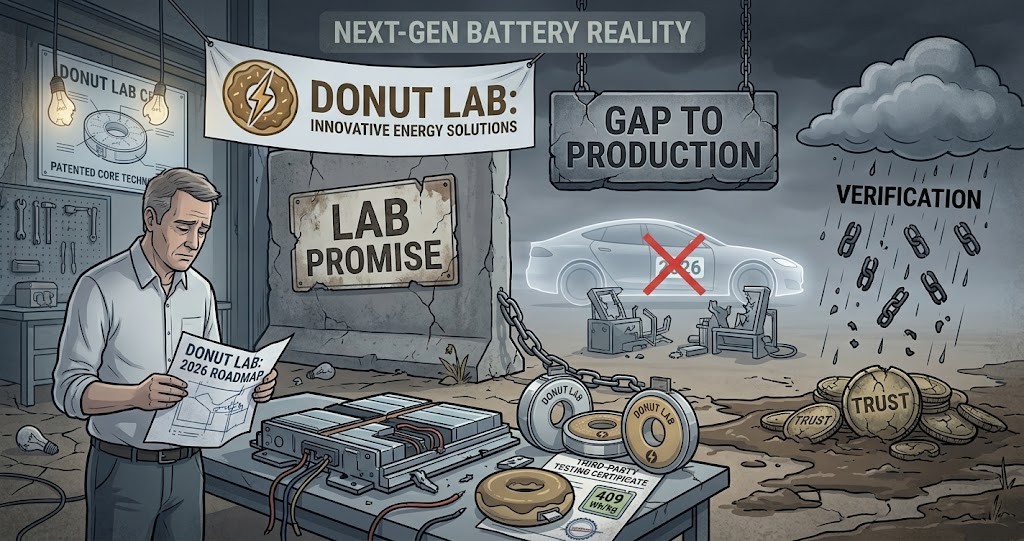
次世代電池として注目を集める全固体電池ですが、研究室レベルの性能数値と「量産・実装」の現実との間には依然として大きなギャップが存在します。北欧のスタートアップ企業であるDonut Lab(ドーナツラボ)は、エネルギー密度409Wh/kgという優れた第三者テスト結果を提示したものの、同社が当初掲げていた「2026年第1四半期までの量産車への搭載」という公約の破綻や不透明な検証プロセスにより、業界からの信頼を大きく失う事態に陥っています。
1. 信頼喪失の根本原因:数値ではなく「量産時期」の公約破綻
- 破られたタイムライン:Donut Labは2026年1月のCESにおいて、「OEM車両で使用可能な世界初の全固体電池」と主張。Verge Motorcyclesの量産車に搭載し、2026年第1四半期に納車を開始すると発表していた。
- 実態との乖離:2026年9月現在、同社製電池を搭載した量産EVは公道を走っていない。内部映像やCEOのコメントにより、テスト車両は試作段階であり、テスト中のセルすら顧客出荷用ではないことが判明している。
- メディアの評価変転:EVメディアが本件に注目したのは「実用化の早さ」ゆえであり、単なるラボデータへの失望と誇大広告に対する警戒感から、同社への見方は厳しさを増している。
2. VTT独立テスト(DL6 / V1.5セル)の検証内容と限界
- 測定結果:フィンランドのVTT技術研究センターによるテストにおいて、「DL6(V1.5セル)」単体で質量エネルギー密度409.3 Wh/kg、体積エネルギー密度804.7 Wh/Lを計測(25℃、0.1C放電、2.3〜4.25V)。
- テスト条件の最適化:従来の試験(1C放電、2.7V終止)から放電レートを1/10に落とし、下限電圧を下げることで、数値を最大化抽出する最良条件(ベストケース)下で測定された。
- サンプルの不連続性:試験ごとに異なるセル(V1、V1.5、Intertek調査用セル等)が用いられており、一貫した同一セルの評価になっていない懸念がある。
3. 技術的数値の冷静な分析:リチウムイオン電池の領域内
- 化学の証明にならない数値:409 Wh/kgは優れた数値であるものの、既存の先進的リチウムイオン電池(例:Ampriusの液体電解質+シリコン負極で450 Wh/kg)の範囲内であり、これをもって「全固体電池である証拠」とは言えない。
- 「双極性(バイポーラ)」と「全固体」の混同:Intertekが確認したとされる双極性構造から「したがって全固体である」と結論付けるのは同社の推論であり、第三者機関が化学組成として全固体であることを認定したわけではない。VTTのレポートでも「全固体」は顧客指定のプロジェクト名として掲載されているに留まる。
- 欠落している重要データ:同社が主張していた「最大10万サイクル」という設計寿命に関するデータは、今回の6回の独立テストでも一切示されていない(今回のテストも2サイクルで終了)。
4. 結論と業界への教訓
- 立証責任の転換:「ラボでの数値」ではなく「量産車への搭載と実走」を示さない限り、失われた信頼を回復することは困難である。
- 開発姿勢への教訓:製品開発においては透明性と着実な履行が不可欠であり、「動作・出荷できる状態になってから公表・受注する」という明確な境界線を設けることが、新興電池メーカーが市場で生き残るための最低条件となっている。
The Myth of “Commercial Readiness”: Next-Gen Battery Startup Donut Lab Faces a Credibility Crisis
While solid-state batteries continue to draw significant attention as next-generation energy storage, a substantial gap remains between lab-scale performance metrics and the realities of mass production and commercial deployment. Nordic startup Donut Lab recently presented impressive third-party test results showing an energy density of 409 Wh/kg. However, the company has suffered a major loss of industry trust due to the breakdown of its original commitment—delivering battery-powered production vehicles by Q1 2026—coupled with a opaque verification process.
1. Root Cause of Lost Trust: Broken Delivery Promises, Not Numbers
- Broken Timeline: At CES in January 2026, Donut Lab claimed to offer the “world’s first solid-state battery ready for OEM production vehicles,” announcing that deliveries of Verge Motorcycles bikes equipped with the technology would begin in Q1 2026.
- Divergence from Reality: As of September 2026, no production EVs powered by Donut Lab batteries are on the road. Internal video footage and statements from the CEO revealed that the test motorcycles were mere prototypes and that the cells being tested were not even customer-grade production units.
- Shift in Media Coverage: EV media originally took interest specifically because of the promised timeline to commercialization. Disappointment over mere lab data and growing caution toward hype have driven increasingly harsh scrutiny of the company.
2. Analysis and Limits of the Independent VTT Test (DL6 / V1.5 Cell)
- Test Results: In testing conducted by Finland’s VTT Technical Research Centre, a single “DL6 (V1.5 cell)” achieved a gravimetric energy density of 409.3 Wh/kg and a volumetric energy density of 804.7 Wh/L (discharged at 0.1C from 2.3 to 4.25V at 25°C).
- Optimized Test Conditions: Compared to earlier tests (1C discharge down to 2.7V), the discharge rate was reduced tenfold and the cutoff voltage lowered, resulting in a best-case scenario designed to maximize extractable energy metrics.
- Sample Inconsistency: Different cells (V1, V1.5, Intertek test cells) were used across separate tests, raising concerns over a lack of consistent, single-cell continuous evaluation.
3. Objective Technical Evaluation: Within Conventional Lithium-Ion Territory
- Metrics Do Not Prove Chemistry: While 409 Wh/kg is impressive, it falls within the range of existing advanced lithium-ion batteries (e.g., Amprius achieving 450 Wh/kg with liquid electrolyte and silicon anodes) and thus does not serve as proof of solid-state chemistry.
- Conflating “Bipolar” with “Solid-State”: Donut Lab’s conclusion that the bipolar structure confirmed by Intertek implies solid-state chemistry is its own inference, not a third-party certification of solid-state materials. In VTT’s report, “solid-state” appears merely as a client-designated project name.
- Critical Missing Data: Despite Donut Lab’s claim of a design life reaching “up to 100,000 cycles,” none of the six independent tests provided cycle-life data (the current test was halted after just two capacity cycles).
4. Conclusion and Key Takeaways for the Industry
- Shift in the Burden of Proof: Rebuilding lost credibility will be nearly impossible without demonstrating actual road deployments in production vehicles rather than lab figures.
- Lessons for R&D Approaches: Transparency and execution are paramount in product development. Setting a clear boundary—announcing and accepting orders only when technology is operational and ready to ship—serves as the baseline requirement for battery startups to survive in this market.
コメント