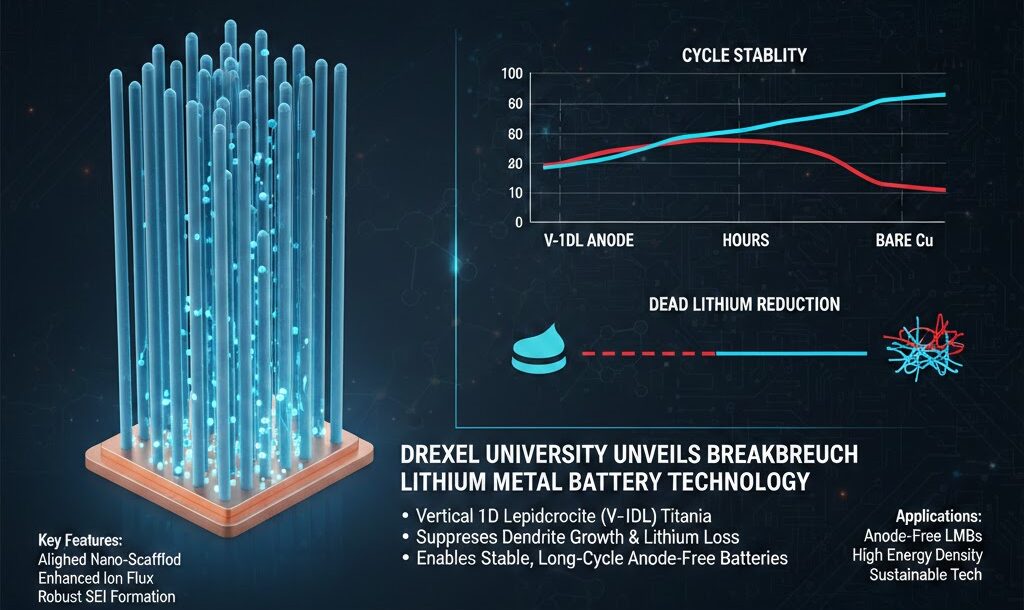
ドレクセル大学の研究チームを中心とするグループは、リチウム金属電池のアノード(負極)において課題となっているデンドライト(樹枝状結晶)の成長と活性リチウムの損失を抑制するため、新しい形態のチタニア材料である「垂直配向1次元レピドクロサイト(V-1DL)」を開発しました。
この材料は、特異な層状構造と高い親石性(リチウムとのなじみやすさ)を持ち、リチウムを均一に析出させるための「土台(スキャフォールド)」として機能します。
- 主な技術ポイントと開発の背景
- 研究結果と性能指標
- アノードフリー電池(AFLMB)への道
- 実験手法の概要
主な技術ポイントと開発の背景
1. 新材料「1次元レピドクロサイト (1DL)」とは
- 構造: 基本単位は Ti-O(チタン-酸素)鎖で、断面積は 5 x 7 オングストロームという原子レベルの細さです。これが擬似2Dナノフレーク状に組み立てられています。
- 合成: 市販の3Dバルク固体から、室温・大気圧に近い温和な条件でのボトムアップ反応により直接合成が可能です。
- 特性: 本質的に親石性であり、層状構造の間にリチウムイオンを挿入(インターカレーション)できるため、リチウムの核形成を助けます。
2. 「垂直配向 (V-1DL)」による3D構造の構築
研究チームは、水性スラリーの「方向制御凍結(フリーズキャスティング)」技術を用いて、これらのナノフレークを銅集電体に対して垂直に並べることに成功しました。
- 利点: 垂直なチャネル(通り道)ができることで、リチウムイオンの流束(フラックス)が均一化されます。
- 効果: 従来の水平配向(H-1DL)や裸の銅と比較して、リチウムが析出する際の「過電圧」を低下させ、より大きく安定した核を形成させます。
研究結果と性能指標
1. サイクル特性の向上
対称セルを用いた充放電試験(2 mAh/cm2, 2 mA/cm2)において、以下の結果が得られました。
- 裸の銅: 約 40時間で性能低下が始まり、90時間で故障。
- 垂直配向 V-1DL: 150時間以上、安定したサイクルを維持。
- 低負荷条件: 1 mAh per cm2 の条件では 170時間以上の安定性を示しました。
2. リチウム損失の低減(デッドリチウムの測定)
滴定ガスクロマトグラフィー(TGC)を用いた特殊な分析により、サイクル中に電気化学的な活性を失った「デッドリチウム」の量を定量化しました。
- V-1DLは、1DLのヒドロキシル(水酸基)官能基化と低屈曲性(まっすぐな道)構造により、デッドリチウムへの損失を最小限に抑えていることが証明されました。
3. 強固なSEI(固体電解質界面)の形成
事後XPS(X線光電子分光)分析により、V-1DL表面では、イオン伝導性の高い水酸化リチウム(LiOH)や窒化リチウム(Li3N)を多く含む、より強固で安定したSEI層が形成されていることが確認されました。
アノードフリー電池(AFLMB)への道
現在のリチウムイオン電池(LIB)の限界を超えるため、理論容量が極めて高い(3860 mAh per g)リチウム金属電池への期待が高まっています。特に、最初から負極にリチウムを置かない「アノードフリー電池」は、エネルギー密度の向上と製造時の二酸化炭素排出量削減(リチウム1トンあたり15トンのCO2を排出)という観点から注目されています。
今回のV-1DL技術は、アノードフリー電池において最も深刻な課題である「デンドライトによる短絡」と「リチウム枯渇」の両方を解決する、環境に優しく拡張性の高い戦略を提供します。
実験手法の概要
- 合成: TiB2粉末と水酸化テトラメチルアンモニウム(TMAOH)を 80度C で4日間反応。
- 電極作製: 1DLナノフレーク、カーボンブラック、バインダーのスラリーを銅箔に塗布し、液体窒素で垂直方向に凍結後、凍結乾燥(氷の昇華)。
- 評価: SEM(走査電子顕微鏡)による形態観察、コインセルを用いた電気化学試験、TGCによるデッドリチウム定量、XPSによる表面分析。
出典:https://pubs.rsc.org/en/content/articlelanding/2026/eb/d5eb00196j
Stabilization of Lithium Metal Anodes and Dendrite Suppression via Vertically Aligned Titania Nanoflakes
A research group led by Drexel University has developed a new form of titania material called Vertically Aligned 1D Lepidocrosite (V-1DL). This innovation aims to suppress dendrite (tree-like crystal) growth and the loss of active lithium, which are major challenges for the anodes of lithium metal batteries.
This material features a unique layered structure and high lithiophilicity (affinity for lithium), acting as a “scaffold” that guides the uniform deposition of lithium.
Key Technical Points and Development Background
1. What is “1D Lepidocrosite (1DL)”?
- Structure: The basic units are Ti-O (titanium-oxygen) chains with an atomic-scale cross-section of 5 x 7 Angstroms. These are assembled into pseudo-2D nanoflakes.
- Synthesis: It can be synthesized directly from commercially available 3D bulk solids through a bottom-up reaction under mild conditions (near room temperature and atmospheric pressure).
- Characteristics: It is inherently lithiophilic and allows lithium ions to be inserted (intercalated) between the layered structures, which aids in lithium nucleation.
2. Building 3D Structures via “Vertical Alignment (V-1DL)”
The research team successfully aligned these nanoflakes vertically on a copper current collector using a “directionally controlled freezing (freeze-casting)” technique with an aqueous slurry.
- Advantages: The creation of vertical channels ensures a uniform flux (flow) of lithium ions.
- Effects: Compared to traditional horizontal alignment (H-1DL) or bare copper, it reduces the “overpotential” during lithium deposition, allowing for the formation of larger, more stable nuclei.
Research Results and Performance Metrics
1. Improved Cycling Stability
In charge-discharge tests using symmetric cells (2 mAh per cm2, 2 mA per cm2), the following results were obtained:
- Bare Copper: Performance began to degrade at approximately 40 hours, failing completely by 90 hours.
- Vertically Aligned V-1DL: Maintained a stable cycle for over 150 hours.
- Low-Load Conditions: Demonstrated stability for over 170 hours at 1 mAh per cm2.
2. Reduction of Lithium Loss (Dead Lithium Measurement)
Using a specialized analysis called Titration Gas Chromatography (TGC), the team quantified the amount of “dead lithium” (lithium that loses electrochemical activity during cycles).
- It was proven that V-1DL minimizes losses to dead lithium thanks to the hydroxyl functionalization of the 1DL and the low-tortuosity (straight-path) structure.
3. Formation of a Robust SEI (Solid Electrolyte Interphase)
Post-mortem XPS (X-ray Photoelectron Spectroscopy) analysis confirmed that a more robust and stable SEI layer is formed on the V-1DL surface. This layer is rich in lithium hydroxide (LiOH) and lithium nitride (Li3N), both of which have high ionic conductivity.
Broader Context: The Road to Anode-Free Batteries (AFLMB)
To exceed the limits of current lithium-ion batteries (LIB), there are high expectations for lithium metal batteries due to their extremely high theoretical capacity (3860 mAh per g). In particular, “anode-free batteries”—which do not place lithium on the negative electrode from the start—are attracting attention for their potential to increase energy density and reduce CO2 emissions (producing 1 ton of lithium currently emits 15 tons of CO2).
The V-1DL technology provides an eco-friendly and scalable strategy to solve the most critical issues of anode-free batteries: short circuits caused by dendrites and lithium depletion.
Overview of Experimental Methods
- Synthesis: Reacting TiB2 powder with tetramethylammonium hydroxide (TMAOH) at 80 degrees C for 4 days.
- Electrode Fabrication: Applying a slurry of 1DL nanoflakes, carbon black, and binder to copper foil, freezing it vertically with liquid nitrogen, and then freeze-drying (ice sublimation).
- Evaluation: Morphological observation via SEM (Scanning Electron Microscopy), electrochemical testing using coin cells, dead lithium quantification via TGC, and surface analysis via XPS.


コメント