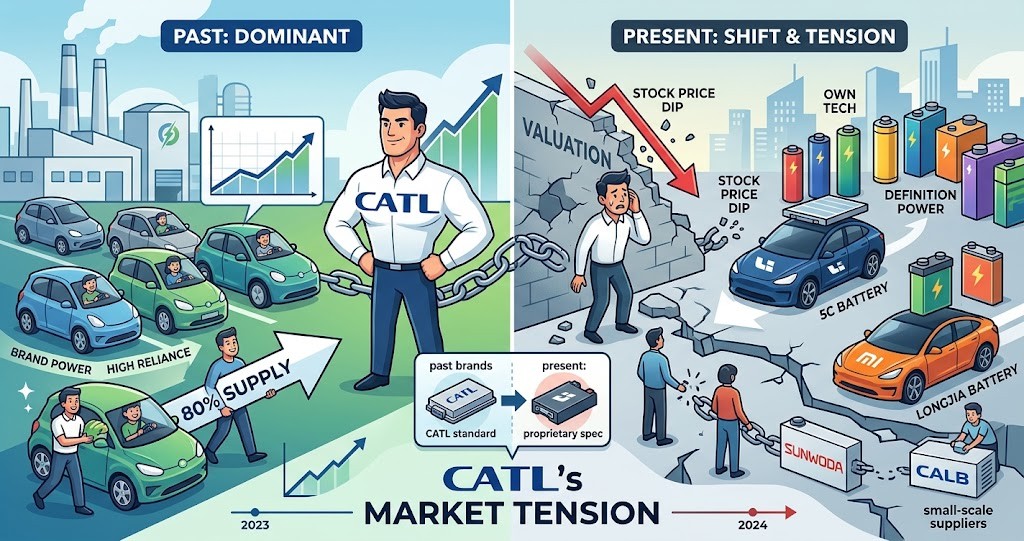
世界の電気自動車(EV)用電池市場で首位を誇る中国のCATL(寧徳時代)が、大きな構造的転換点に直面しています。これまで市場を圧倒してきた同社ですが、主要なEVメーカーが脱CATLへ動いていることや、自社株買いの遅れなどが重なり、株式市場でのバリュエーション(企業価値評価)が見直される事態となっています。
記事の重要要素に業界の背景情報を加え、全体像を分かりやすくまとめました。
CATLの株価下落と「脱CATL」加速の構造
中国の車載電池最大手・CATL(300750.SZ)の株価が、2026年5月の高値から約3割下落しました。9月9日時点の時価総額は約1.56兆元(約35.8兆円)となり、わずか4カ月で約5,000億元(約11.5兆円)の時価総額が消失した計算になります。
背景には、顧客である新興EVメーカーによる脱依存の動きと、資本市場に対する投資家の不信感があります。
1. 顧客側の変化:標準品調達から「定義権」の奪還へ
これまで中国のEV市場では、CATL製の高性能電池を搭載することがブランド力や走行性能の担保となっていました。しかし、新興EV大手の動きが変化しています。
- Li Auto(理想汽車): 新型「MEGA」の納車において、CATL製の在庫枯渇を理由に11月納車分から自社開発の5C三元系リチウム電池へ全面切り替えを発表。「L8」や「i6」などのモデルでも、競合である欣旺達(Sunwoda)やCALB(中創新航)への移行を進めています。さらに欣旺達の動力電池部門に26.5億元(約610億円)を出資して第2位株主となり、合弁会社も設立しました。
- Xiaomi Auto(小米汽車): CALBおよび欣旺達と共同で「龍甲電池」を発表。これまで納車されたXiaomi車におけるCATLの電池供給比率は80%を超えていましたが、供給網の分散を図っています。
【ポイント:2022年の第1波との違い】 2022年当時のEVメーカーの脱CATLは「高高委託(電池代が車両コストの40〜60%を占めることへの不満)」によるコスト削減とセカンドサプライヤーの確保が目的でした。
今回の波は、EVメーカーが電池の「定義権(仕様や構造の決定権)」を自ら握る動きです。Appleがチップを自社設計してTSMCに製造委託するように、EVメーカーが電池の材料配合やパック構造を定義し、電池メーカーには受託製造(OEM)を行わせるスタイルへシフトしています。これにより、EVメーカーは自社のペースで製品開発を行えるようになり、調達コストも約10%削減できます。
2. 利益偏重に対するEVメーカー側の反発
2026年上半期、主要上場EVメーカー15社の合計純利益が前年同期比で大幅減となる210.48億元(約4,800億円)にとどまったのに対し、CATLの単体純利益は432.84億元(約9,900億円)に達しました。EVメーカー側が激しい価格競争で採算悪化に苦しむ中、CATLが「1日あたり2.4億元(約55億円)」を稼ぎ出す構造に対して、EVメーカー側が自社開発や他社への切り替えを武器に価格交渉力を強めようとしています。
3. 200億〜400億元規模の自社株買いが未実施
市場の失望を広げたもう一つの決定打は、株価下支え策の不履行です。CATLは7月に200億〜400億元(約4,600億〜9,200億円)規模という大規模な自社株買い計画(買い付けた株式は全数消却方針)を発表しましたが、8月末時点で1株も買い付けを行っていません。手元資金が3,720億元(約8.5兆円)と豊富な同社が買い付けを実行しない姿勢に対し、投資家の警戒感が強まっています。
CATLの現状と今後の成長戦略
市場では懸念が先行していますが、実態の業績や世界市場でのポジションが即座に崩壊しているわけではありません。
現状の圧倒的シェアと課題
- 圧倒的な市場シェア: 中国国内の車載電池搭載量シェアは47.8%(1〜7月)、世界シェアは約40%で9年連続首位を維持しています。上半期の売上高は2,769.17億元(約6.3兆円)で前年同期比54.8%増、工場稼働率は94.86%とフル稼働状態です。
- 高付加価値受注の打撃: Li AutoやXiaomiの離脱は全体量で見れば13〜17%程度ですが、利益率の高いハイエンド向け電池(5C急速充電対応品など)の失注であるため、将来的な高収益性の維持に疑問符が打たれています。また、受注を獲得している二線級メーカー(欣旺達やCALB)側も過去に品質問題や赤字を抱えており、利益の移行がスムーズに進んでいるわけではありません。
CATLの対抗策(3つの成長曲線)
自動車メーカーに対する交渉力の希薄化に対し、CATLは事業領域の多角化で防戦を図っています。
- 蓄電事業(第1の曲線): 上半期の売上高は532.6億元(約1.2兆円)で前年同期比87.5%増。出荷量は5年連続世界一であり、今後3年で車載用と蓄電用の売上比率を1対1にする計画です。
- 電池交換サービス「チョコレート電池交換」(第2の曲線): 年内に3,000カ所以上のステーション設置を目指し、バッテリーサブスクリプション(月額399元)を展開。規格を統一することで自動車メーカーとの継続的な関係を築きます。
- 海外市場と技術ライセンス(第3の曲線): 海外売上比率は31.5%まで上昇。米国市場では出資を伴わないLRS(ライセンス・ロイヤルティ・サービス)モデルにより、フォードやテスラへ技術と生産ラインを供与する戦略を進めています。
出典:https://finance.biggo.jp/news/33ae114b-5431-4d62-bf9f-ef5950142ab9
CATL Shares Drop 30 Percent in 4 Months: Background on Chinese EV Giants’ “De-CATLization” and Changes in Industry Structure
CATL (Contemporary Amperex Technology Co., Limited), China’s leading global EV battery manufacturer, is facing a major structural turning point. While the company has long dominated the market, a combination of major EV makers moving away from CATL and delays in its share buyback program has led to a re-evaluation of its stock valuation in capital markets.
Below is a comprehensive summary adding key industry context to the main elements of the news.
CATL’s Stock Decline and the Mechanics Behind Accelerated “De-CATLization”
Shares of CATL (300750.SZ), China’s largest automotive battery maker, have fallen by approximately 30 percent from their peak in May 2026. As of September 9, its market capitalization stood at approximately 1.56 trillion yuan (around 35.8 trillion yen), meaning about 500 billion yuan (around 11.5 trillion yen) in market value evaporated in just four months.
This decline is driven by emerging EV manufacturers reducing their reliance on CATL and growing investor distrust in the capital market.
- Shifts on the Customer Side: Reclaiming “Definition Rights” from Standard Sourcing Previously in the Chinese EV market, equipping a vehicle with CATL’s high-performance batteries served as a guarantee of brand power and driving performance. However, the strategy of leading emerging EV makers is shifting.
- Li Auto: For new deliveries of its “MEGA” model, Li Auto announced a full transition starting in November to its self-developed 5C ternary lithium batteries, citing inventory depletion of CATL units. The company is also shifting models like the “L8” and “i6” to competitors Sunwoda and CALB (China Aviation Lithium Battery). Furthermore, Li Auto invested 2.65 billion yuan (around 61 billion yen) into Sunwoda’s power battery division to become its second-largest shareholder, and established a joint venture.
- Xiaomi Auto: Xiaomi unveiled its “Longjia Battery” co-developed with CALB and Sunwoda. While CATL previously supplied over 80 percent of the batteries for delivered Xiaomi vehicles, Xiaomi is now diversifying its supply chain.
[Key Point: Difference from the First Wave in 2022] In 2022, EV makers’ shift away from CATL was driven by cost reduction and securing secondary suppliers due to complaints over battery costs making up 40 to 60 percent of vehicle production costs.
The current wave is a move by EV makers to claim “definition rights” (control over specifications and structural design) for themselves. Similar to how Apple designs its own chips and contracts manufacturing to TSMC, EV automakers are defining chemical formulations and pack architecture while contracting cell production out to battery vendors as OEMs. This allows EV makers to develop products at their own pace while reducing procurement costs by roughly 10 percent.
- Backlash Against CATL’s Profit Concentration In the first half of 2026, the combined net profit of 15 major listed Chinese EV makers dropped significantly year-on-year to 21.048 billion yuan (around 480 billion yen). In contrast, CATL’s standalone net profit reached 43.284 billion yuan (around 990 billion yen). As EV manufacturers suffer from squeezed margins amid fierce price competition, CATL’s ability to generate “240 million yuan (around 5.5 billion yen) per day” has prompted automakers to leverage self-development and supplier shifts to strengthen their bargaining power.
- Unexecuted 20 Billion to 40 Billion Yuan Share Buyback Another decisive factor worsening market disappointment is the failure to execute promised stock support measures. In July, CATL announced a massive share buyback plan worth 20 billion to 40 billion yuan (around 460 billion to 920 billion yen), intending to cancel all repurchased shares. However, as of late August, not a single share had been bought. With cash reserves sitting at 3,720 billion yuan (around 8.5 trillion yen), CATL’s inaction has heightened investor caution.
CATL’s Current Status and Future Growth Strategies
While market concerns are ahead of actual performance, CATL’s underlying business and dominant global position have not collapsed overnight.
Current Market Dominance and Challenges
- Overwhelming Market Share: CATL maintained a 47.8 percent domestic market share for automotive battery installations in China (January to July) and held a global market share of around 40 percent, holding the top spot for nine consecutive years. First-half revenue reached 2,769.17 billion yuan (around 6.3 trillion yen), up 54.8 percent year-on-year, with factory utilization operating at near full capacity at 94.86 percent.
- Hit to High-Value Orders: The volume lost from Li Auto and Xiaomi accounts for only 13 to 17 percent of CATL’s domestic total. However, because these were lost high-margin orders for premium products (such as 5C fast-charging batteries), questions remain about CATL’s ability to sustain long-term high profitability. Furthermore, tier-two suppliers gaining these orders (such as Sunwoda and CALB) face historical quality issues and ongoing losses, meaning profits are not smoothly shifting away from CATL either.
CATL’s Countermeasures (Three Growth Curves) To counter the erosion of its leverage over automakers, CATL is diversifying its business scope.
- Energy Storage Systems (First Curve): First-half ESS revenue reached 53.26 billion yuan (around 1.2 trillion yen), an 87.5 percent increase year-on-year. ESS shipments have ranked first globally for five consecutive years, and CATL plans to bring the revenue split between automotive batteries and energy storage to 1:1 within three years.
- Battery Swapping “Choco-SEB” (Second Curve): CATL aims to install over 3,000 swap stations by the end of the year under a battery subscription model (399 yuan per month). Standardizing swapping modules helps secure ongoing long-term relationships with automakers.
- Overseas Expansion and Technology Licensing (Third Curve): The overseas revenue share has risen to 31.5 percent. In the U.S. market, CATL uses an asset-light LRS (Licensing, Royalty, Service) model to provide technology and production line support to partners like Ford and Tesla without direct equity investment.
Summary
What capital markets are currently pricing in is not CATL’s strong present financial results, but rather structural shifts expected over the next three years.
As EV manufacturers transition to customizing and defining battery specs internally, whether CATL can maintain its strong pricing power and high profit margins—or establish new supply chain advantages through ESS, battery swapping, and technology licensing—will be the key determinant of its long-term valuation.
コメント