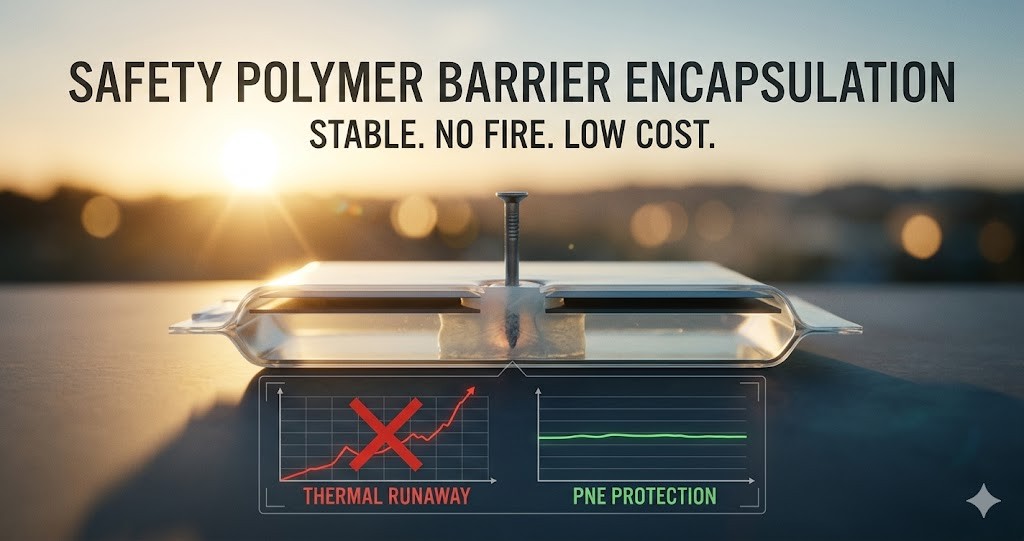
リチウムイオン電池に代わる低コストな蓄電デバイスとして、ナトリウムイオン電池(NIB)の開発が加速しています。しかし、従来の有機電解液は可燃性が高く、大型化に伴う火災リスクが大きな課題でした。 本研究が提案する「PNE(重合型不燃電解質)」は、単に燃えにくいだけでなく、異常加熱時に電解質自体が「固体のポリマーバリア」へと変化する自己保護機能を備えています。これにより、従来の不燃電解質では防げなかった大容量セルでの熱暴走を、化学的・物理的の両面から封じ込めることに成功しました。
1. 具体的な電解液の組成
本研究で最適化されたPNE(PolyNonflyte)の組成は、コスト、粘度、および界面形成のバランスを考慮して設計されています。
- 主溶媒: TEP(リン酸トリエチル)
- 難燃剤として知られる成分を主溶媒として使用。
- 支持塩(混合塩): * 1.0 mol/L NaBF4: メインの塩。Na+との結合が弱く、負極での脱溶媒化をスムーズにする役割。
- 0.2 mol/L NaPF6: 補助的な塩。安定な界面(SEI/CEI)を形成するための「種」として機能。
- 特徴: 高価なフッ素化溶媒や超高濃度塩(HCE)を使用せず、汎用的な材料のみで構成されている点が実用的です。
2. 安全性能の詳細データ
大容量セル(3.5 Ahおよび1.45 Ah)を用いた過酷な試験結果は以下の通りです。
釘刺し試験(Nail Penetration)
- PNE(本技術): 釘が貫通しても煙、火、爆発は一切なし。セル表面の最高温度は95.2 ℃に抑制されました。
- 従来型(EC/DEC系): 貫通直後に激しく発火・爆発。
- TMP系不燃電解液: 不燃性溶媒であるにもかかわらず、内部短絡による熱を抑えきれず、最終的に煙と火災が発生。
ARC(加速速度熱量計)試験
ARCは断熱状態での自己発熱を計測する最も厳しい安全試験の一つです。
- 熱暴走開始温度(T2): 従来型は208.4 ℃で制御不能な熱暴走に陥りますが、PNEは300 ℃に達しても熱暴走が検出されませんでした。
- 吸熱反応: PNEは200 ℃付近で重合反応に伴う吸熱挙動を示し、これが「熱のブレーキ」として機能します。
3. 電池性能と寿命データ
安全性を高めると寿命や出力が犠牲になるのが一般的ですが、PNEは独自の界面制御により高い実用性を維持しています。
サイクル寿命(長寿命化の根拠)
- 容量保持率: * ハードカーボン(HC)負極と層状酸化物正極を用いたフルセルにおいて、優れたサイクル安定性を確認。
- 1.0 mol/L NaBF4 + 0.2 mol/L NaPF6の組み合わせが、強固な無機質リッチ(B, F, PO2)な保護膜を形成し、電解液の継続的な分解を抑制します。
- 高温サイクル: 60 ℃の過酷環境下でも、安定した充放電が可能です。これは高温で生成されるポリマー膜が、電極からの金属イオン溶出を防ぐためです。
充放電特性
- 初回充放電効率(ICE): 従来のリン酸エステル系電解液は負極との相性が悪く効率が著しく低い(または動作しない)のが課題でしたが、PNEは適切な溶媒構造設計により、実用レベルの効率を達成しました。
- エネルギー密度: 高電圧(4.3 V)パウチ型セルにおいて、211 Wh/kgというナトリウムイオン電池としてトップクラスの数値を記録しています。
まとめ
このPNE電解質は、「不燃性溶媒(TEP)」、「低結合性塩(NaBF4)」、そして「熱誘起重合」という3つの要素を組み合わせることで、以下の3点を同時に実現しました。
- 300 ℃まで熱暴走しない圧倒的安全性
- 200 Wh/kgを超える高いエネルギー密度
- 汎用材料による低コスト化
この成果は、電気自動車や大型電力貯蔵用バッテリーの安全基準を根本から変える可能性を秘めています。
Thermal Runaway-Free Even at 300 ℃ ! Development of the World’s First Self-Protecting Sodium-Ion Battery
The development of Sodium-Ion Batteries (NIBs) is accelerating as a low-cost energy storage alternative to Lithium-Ion batteries. However, conventional organic electrolytes are highly flammable, posing significant fire risks as cells scale up in size. The “PNE (Polymerizable Non-flammable Electrolyte)” proposed in this study is not only flame-retardant but also features a self-protecting function: the electrolyte itself transforms into a “solid polymer barrier” during abnormal heating. This innovation successfully suppresses thermal runaway in large-capacity cells—a feat unachievable with previous non-flammable electrolytes—by providing both chemical and physical protection.
1. Specific Electrolyte Composition
The PNE (PolyNonflyte) composition optimized in this study is designed to balance cost, viscosity, and interface formation.
- Primary Solvent: TEP (Triethyl Phosphate)
- Utilizes a component well-known as a flame retardant as the main solvent.
- Supporting Salts (Hybrid Salt System):
- 1.0 mol/L NaBF4: The primary salt. Its weak binding with Na+ ions facilitates smooth desolvation at the anode.
- 0.2 mol/L NaPF6: A supplementary salt. It acts as a “seed” to form a stable interface (SEI/CEI).
- Key Features: It is highly practical, composed entirely of versatile materials without relying on expensive fluorinated solvents or ultra-high concentration electrolytes (HCE).
2. Detailed Safety Performance Data
Rigorous testing conducted on large-scale cells (3.5 Ah and 1.45 Ah) yielded the following results:
Nail Penetration Test
- PNE (This Technology): No smoke, fire, or explosion occurred even when penetrated by a nail. The maximum temperature of the cell surface was suppressed to 95.2 ℃.
- Conventional (EC/DEC-based): Violent ignition and explosion occurred immediately upon penetration.
- TMP-based Non-flammable Electrolyte: Despite being a non-flammable solvent, it failed to suppress heat from internal short-circuits, eventually leading to smoke and fire.
ARC (Accelerating Rate Calorimetry) Test The ARC is one of the most stringent safety tests, measuring self-heating under adiabatic conditions.
- Thermal Runaway Onset Temperature (T2): While conventional types fall into uncontrollable thermal runaway at 208.4 ℃, no thermal runaway was detected for PNE even up to 300 ℃.
- Endothermic Reaction: PNE exhibits endothermic behavior (heat absorption) near 200 ℃ due to the polymerization reaction, acting as a “thermal brake.”
3. Battery Performance and Longevity Data
While increasing safety typically sacrifices lifespan or output, PNE maintains high practicality through unique interface control.
Cycle Life (Rationale for Longevity)
- Capacity Retention: Excellent cycle stability was confirmed in full cells using Hard Carbon (HC) anodes and layered oxide cathodes. The combination of 1.0 mol/L NaBF4 + 0.2 mol/L NaPF6 forms a robust, inorganic-rich (B, F, PO2) protective layer, suppressing continuous electrolyte decomposition.
- High-Temperature Cycling: Stable charging and discharging are possible even in harsh environments at 60 ℃. This is because the polymer film generated at high temperatures prevents transition metal dissolution from the electrodes.
Charge/Discharge Characteristics
- Initial Coulombic Efficiency (ICE): Conventional phosphate-based electrolytes suffered from poor anode compatibility and extremely low efficiency. PNE achieves practical efficiency levels through optimized solvent structure design.
- Energy Density: Recorded 211 Wh/kg in high-voltage (4.3 V) pouch cells, a top-tier value for sodium-ion batteries.
Summary
By combining three elements—Non-flammable Solvent (TEP), Weak-binding Salt (NaBF4), and Thermally-induced Polymerization—this PNE electrolyte simultaneously achieves:
- Extreme safety with no thermal runaway up to 300 ℃.
- High energy density exceeding 200 Wh/kg.
- Low cost through the use of versatile, common materials.
This breakthrough has the potential to fundamentally redefine safety standards for electric vehicles and large-scale grid energy storage batteries.


コメント