北陸先端科学技術大学院大学の研究グループが、リチウムイオン電池の耐久性と長寿命化を大幅に向上させる新たな電解液添加剤「FPTI」を開発しました。FPTIの化学構造および合成・反応ルートを含む発表内容の要約と、関連情報は以下の通りです。
発表内容のまとめ
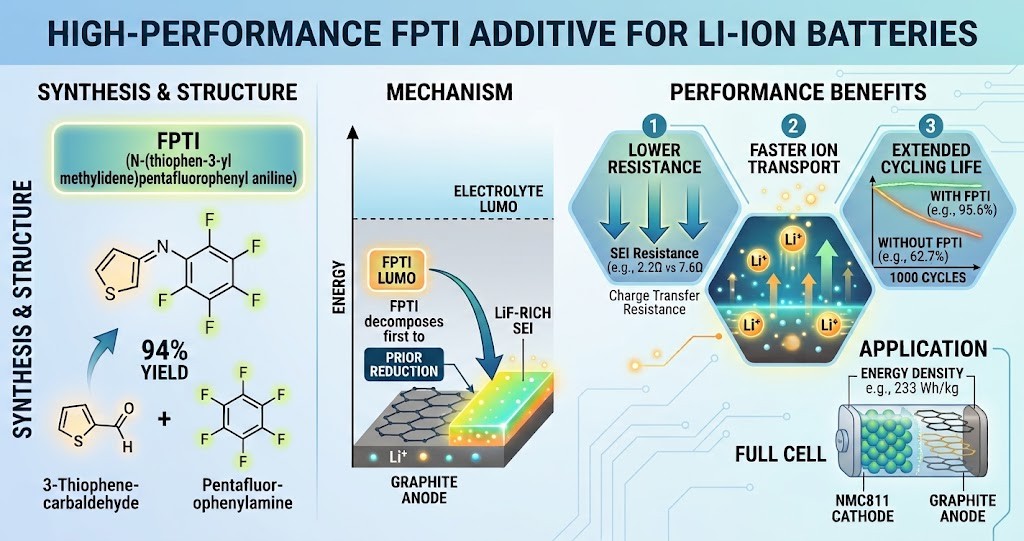
- 化学構造と合成反応ルート 新開発の「FPTI」はフッ素を高濃度に含むイミン化合物(化学構造:フッ素化イミン誘導体)です。原料となる「3-チオフェンカルボアルデヒド」と「ペンタフルオロフェニルアミン」を脱水縮合(イミン形成反応)させるルートにより、94%という高い収率で効率的に合成されます。
- 低抵抗な保護膜(SEI)の優先形成 計算化学(DFT計算)により、FPTIは従来の電解液成分よりも低いLUMO(最低空軌道)準位を持つことが判明しました。これにより、初期充電時に電解液より優先してグラファイト負極上で還元分解され、フッ化リチウム(LiF)を多く含む安定した固体電解質界面(SEI)保護膜を形成します。
- 抵抗低減とイオン伝達の向上 FPTIを4mg/mL添加した場合、SEI抵抗は2.2オーム(非添加時7.6オーム)、電荷移動抵抗は19.8オーム(非添加時41.8オーム)へ大幅に低下し、リチウムイオンの拡散係数も向上しました。
- 優れた長寿命化・容量維持性能 1000サイクル経過後の容量維持率は、非添加セルの62.7%に対し、4mg/mL添加セルでは95.6%と高い耐久性を実証しました。NMC811正極とのフルセル評価でも233Wh/kgのエネルギー密度を達成しています。
関連情報・背景解説
- チオフェン環とペンタフルオロフェニル基の相乗効果 FPTIの分子構造は、硫黄原子を含む「チオフェン基」と、5つのフッ素で置換された「ペンタフルオロフェニル基」がイミン結合(C=N)で結ばれています。フッ素原子の強い電解引きつけ作用が電子受容性(LUMO準位の低下)を高めて負極での優先的な還元を可能にし、分解時に豊富なLiF(フッ化リチウム)を生成して薄く強固なSEIの構築に寄与します。
- SEI(Solid Electrolyte Interphase)の重要性 初回充電時に負極表面に作られるSEIは電池寿命を左右します。質の悪いSEIは充放電のたびに破壊と再生を繰り返し、電解液とリチウムイオンを無駄に消費して劣化を進めます。FPTIによって作られる密着性の高いLiF系SEIは、この副反応を防ぐ重要な役割を果たします。
出典:https://eetimes.itmedia.co.jp/ee/articles/2609/09/news036.html
Prioritizing the Formation of Low-Resistance, Highly Heat-Resistant SEI: Synthesis and Durability Enhancement Effects of FPTI, a New Electrolyte Additive Developed by JAIST
A research group at the Japan Advanced Institute of Science and Technology (JAIST) has developed a new electrolyte additive, “FPTI,” which significantly improves the durability and operational lifespan of lithium-ion batteries. Below is a summary of the announcement, including the chemical structure and synthesis/reaction route of FPTI, along with relevant background information.
Summary of the Announcement
- Chemical Structure and Synthetic Reaction Route The newly developed “FPTI” is a highly fluorinated imine compound (chemical structure: fluorinated imine derivative). It is efficiently synthesized with a high yield of 94 percent via the dehydration condensation (imine formation reaction) of “3-thiophenecarboxaldehyde” and “pentafluoroaniline.”
- Preferential Formation of Low-Resistance Protective Film (SEI) Computational chemistry (DFT calculations) revealed that FPTI has a lower LUMO (Lowest Unoccupied Molecular Orbital) level than conventional electrolyte components. Consequently, during initial charging, it undergoes reductive decomposition on the graphite anode prior to the electrolyte, forming a stable solid electrolyte interphase (SEI) protective film rich in lithium fluoride (LiF).
- Resistance Reduction and Enhanced Ion Transport When 4 mg/mL of FPTI was added, the SEI resistance significantly dropped to 2.2 ohms (compared to 7.6 ohms without addition), the charge transfer resistance decreased to 19.8 ohms (compared to 41.8 ohms without addition), and the lithium-ion diffusion coefficient also improved.
- Superior Long Life and Capacity Retention Performance After 1000 cycles, the capacity retention rate reached 95.6 percent with the addition of 4 mg/mL FPTI, demonstrating high durability compared to 62.7 percent in the un-added cell. In a full-cell evaluation paired with an NMC811 cathode, an energy density of 233 Wh/kg was achieved.
Relevant Background Information
- Synergistic Effect of Thiophene Ring and Pentafluorophenyl Group The molecular structure of FPTI features a sulfur-containing “thiophene group” and a “pentafluorophenyl group” substituted with five fluorine atoms, linked by an imine bond (C=N). The strong electron-withdrawing effect of the fluorine atoms enhances electron acceptability (lowering the LUMO level) to enable preferential reduction at the anode. Upon decomposition, it generates abundant LiF (lithium fluoride), contributing to the construction of a thin and robust SEI.
- Importance of the SEI (Solid Electrolyte Interphase) The SEI formed on the anode surface during the initial charge governs battery longevity. A poor-quality SEI undergoes continuous breakdown and regeneration during charge-discharge cycles, consuming electrolyte and lithium ions and accelerating degradation. The highly adherent, LiF-rich SEI created by FPTI plays a crucial role in preventing these side reactions.


コメント