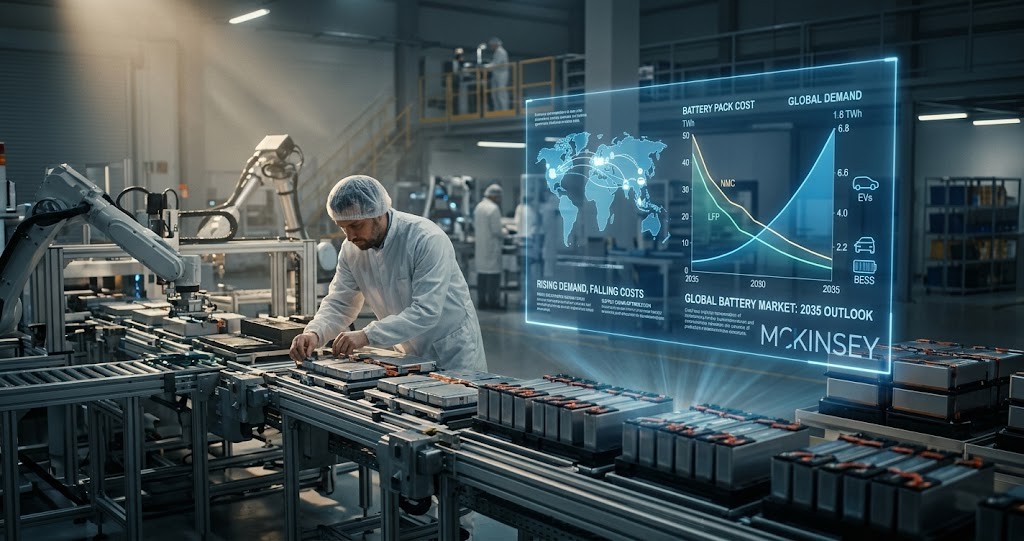
マッキンゼーの最新ホワイトペーパーによると、世界のバッテリー市場は2035年に向けて急速な拡大を続ける一方で、深刻な供給過剰と激しい価格低下に直面しています。これに伴い、企業の競争軸はこれまでの「単純な増産」から、「コスト削減(部材構成の最適化)・歩留まり向上・地域密着型サプライチェーンの構築」へとシフトしています。
McKinsey
以下に、ホワイトペーパーに示された単価・技術動向および関連情報をまとめた要約を記載します。
1. 市場見通しと需給ギャップ
- 需要の拡大: 世界のバッテリー需要は、電気自動車(EV)やバッテリーエネルギー貯蔵システム(BESS)の普及により、2025年の約 1.6 TWh から、2030年に 4.2 TWh、2035年には 6.8 TWh へ達する見込みです。2035年の用途別内訳は、モビリティ用途が約 85%、BESSが約 12% と予測されています。 McKinsey他 1 件
- 供給過剰と価格の下落: 2025年時点の過剰生産能力は約 900 GWh に達し、激しい価格競争が進行しています。2025年のバッテリーパック価格は過去最低の 108 ドル / kWh(セル単価は 74 ドル / kWh)まで落とし込みが進みました。 McKinsey他 1 件
2. 電極(系・材料)ごとの単価・コスト構造
- LFP(リン酸鉄リチウム): コスト効率と熱安定性に優れるため、量産型EVやBESSの主流であり続けます。原材料安のシナリオにおいて、2035年の世界平均パックコストは 55〜65 ドル / kWh に達すると予測されています。 McKinsey他 1 件
- NMC(ニッケル・マンガン・コバルト): 航続距離を重視するプレミアムEV向けに高いエネルギー密度を提供しますが、コバルトやニッケルなどの高い原材料リスクを抱えます。2035年の世界平均パックコストは 75〜90 ドル / kWh と予測されており、LFPとの価格差が継続します。 McKinsey他 1 件
- 負極におけるシリコン添加: 負極材の主流である黒鉛(グラファイト)にシリコンを配合する割合は、2025年の 5% 未満から2035年には約 10% まで増加し、エネルギー密度と急速充電性能が向上する見込みです。 McKinsey他 1 件
3. 次世代電池および先進技術のタイムライン
- 全固体電池(Solid-State Battery):
- 量産時期: 商用規模での本格的な量産は 2030年以降 になると分析されています。
- 性能・コスト: 2030年時点で、エネルギー密度 400〜450 Wh / kg、生産コストは約 100 ドル / kWh、充電時間は12〜20分程度と試算されています。 McKinsey & Company
- 課題: 界面形成の制御や歩留まりの確保など、製造技術上の課題克服が鍵となります。 McKinsey
- その他の次世代・関連技術: McKinsey
- ナトリウムイオン電池など: リチウムフリーの選択肢として注視されていますが、2035年までの主軸は引き続き既存リチウムイオン電池の進化系(LFP/NMC)が担います。 McKinsey他 1 件
- ドライ電極コーティング(Dry Electrode Coating): 溶剤を使わない乾式製法を導入することで、欧州の工場などにおいて設備投資とエネルギー消費を抑え、2〜3 ユーロ / kWh のコスト削減が可能と試算されています。
4. 歩留まり向上と製造プロセス
- スクラップ(廃棄)率の削減: 工場の立ち上げ初期にはスクラップ率が 70〜80% に達するケースがあり、原材料価格の下落よりもスクラップ削減(歩留まり向上)の方が利益に大きな影響を与えます。 McKinsey
- 目標指標: 競争力のある工場では、セル生産開始から18ヶ月以内に 歩留まり 95% 以上、総合設備効率(OEE) 85% 以上 の達成を目指すべきとされています。
5. サプライチェーンの偏在と地政学リスク
- 中流工程の極端な集中: 世界で販売されるバッテリーの 75% 以上がアジア製であるだけでなく、負極用黒鉛や正極前駆体の世界生産シェアは、米国・EUともに 10% 未満にとどまります。
- 包括的な地域化: 域内での単なるセル組み立て工場の建設にとどまらず、鉱物採掘・精錬から中流加工、リサイクルまで一貫したサプライチェーンの構築が必要です。
【関連情報】背景と業界への示唆
- 中国メーカーの圧倒的コスト優位性と欧米の政策CATLやBYDをはじめとする中国企業は、垂直統合されたサプライチェーンと巨大な生産規模を背景に価格競争力を維持しています。これに対して米国(インフレ抑制法:IRAなど)やEUは保護主義的関税や法規制を通じて域内供給網の構築を目指していますが、中流工程の中国依存を短期間で解消することは難しく、生産コストの高止まりが課題となっています。
- 日本企業が取るべき戦略的アプローチ日本の自動車・バッテリー・材料・製造装置メーカーにとって、「全固体電池などの技術開発」だけに頼る手法は危険です。LFPやNMCのさらなる改良・製造プロセス(ドライ電極など)の自動化・高度化を進めるとともに、立ち上げから短期間で歩留まり 95% に達する優れた製造技術(オペレーショナルエクセレンス)を確立することが、2035年に向けた市場での生存条件となります。
出典:https://prtimes.jp/main/html/rd/p/000000037.000094688.html
2035 Battery Market Forecast: Shifting from Expansion Race to “Cost, Yield, and Supply Chain”
According to McKinsey’s latest white paper, while the global battery market continues to expand rapidly toward 2035, it faces severe overcapacity and sharp price declines. Consequently, the focus of competition is shifting from simple capacity expansion to cost reduction via bill-of-materials optimization, yield improvement, and the construction of localized supply chains.
Below is a summary of unit prices, technological trends, and related insights presented in the white paper.
1. Market Outlook and Supply-Demand Gap
- Demand Expansion: Driven by the adoption of electric vehicles (EVs) and battery energy storage systems (BESS), global battery demand is projected to grow from approximately 1.6 TWh in 2025 to 4.2 TWh in 2030 and 6.8 TWh by 2035. Mobility application is expected to account for about 85% of demand in 2035, with BESS comprising around 12%.
- Overcapacity and Price Declines: Excess production capacity reaches roughly 900 GWh in 2025, driving intense price competition. Battery pack prices dropped to a record low of 108 USD/kWh in 2025, with cell prices at 74 USD/kWh.
2. Unit Prices and Cost Structures by Chemistry and Material
- LFP (Lithium Iron Phosphate): LFP remains dominant in mass-market EVs and BESS due to cost efficiency and thermal stability. Under a low-raw-material price scenario, global average pack costs are projected to reach 55–65 USD/kWh by 2035.
- NMC (Nickel Manganese Cobalt): Offers high energy density for premium EVs prioritizing range, but carries high raw material risks for cobalt and nickel. Global average pack costs are projected at 75–90 USD/kWh in 2035, maintaining a price gap with LFP.
- Silicon Addition in Anodes: The share of silicon blended into graphite—the primary anode material—is expected to increase from under 5% in 2025 to around 10% by 2035, boosting energy density and fast-charging capability.
3. Timeline for Next-Generation Batteries and Advanced Technologies
- Solid-State Batteries:
- Mass Production Timeline: Commercial-scale mass production is analyzed to begin after 2030.
- Performance and Cost: By 2030, energy density is estimated at 400–450 Wh/kg, production cost at around 100 USD/kWh, and charge times at 12–20 minutes.
- Challenges: Overcoming manufacturing hurdles such as interface formation control and yield assurance is key.
- Other Next-Gen Technologies:
- Sodium-ion Batteries: Watched as a lithium-free option, but evolved versions of existing lithium-ion batteries (LFP/NMC) will remain the mainstream through 2035.
- Dry Electrode Coating: Eliminating solvents reduces capex and energy consumption, offering estimated cost savings of 2–3 EUR/kWh in European factories and elsewhere.
4. Yield Improvement and Manufacturing Processes
- Scrap Rate Reduction: Scrap rates can reach 70–80% in early factory ramp-ups. Reducing scrap yields a greater financial impact than negotiating raw material price reductions.
- Target Metrics: Competitive plants should aim for yields above 95% and Overall Equipment Effectiveness (OEE) above 85% within 18 months of starting cell production.
5. Supply Chain Concentration and Geopolitical Risks
- Extreme Midstream Concentration: Over 75% of global batteries are manufactured in Asia. Furthermore, the US and EU each hold less than 10% global production share in midstream steps like synthetic graphite and cathode precursors.
- Comprehensive Localization: Simply building local cell assembly plants is insufficient; establishing an end-to-end supply chain—from mineral extraction and refining to midstream processing and recycling—is required.
Background and Industry Implications
- Chinese Manufacturers’ Cost Advantage and Western PoliciesChinese companies such as CATL and BYD maintain price competitiveness through vertically integrated supply chains and massive scale. In response, the US (via the Inflation Reduction Act and tariffs) and the EU rely on protective measures and regulations to build local supply chains. However, short-term decoupling from Chinese midstream processing remains difficult, keeping local production costs high.
- Strategic Approach for Japanese CompaniesRelying solely on R&D for next-generation tech like solid-state batteries presents significant risks for Japanese automotive, battery, material, and equipment suppliers. Survival through 2035 requires refining existing LFP/NMC technologies, automating advanced processes like dry electrode coating, and achieving operational excellence to reach 95% yield rapidly after plant startup.
コメント