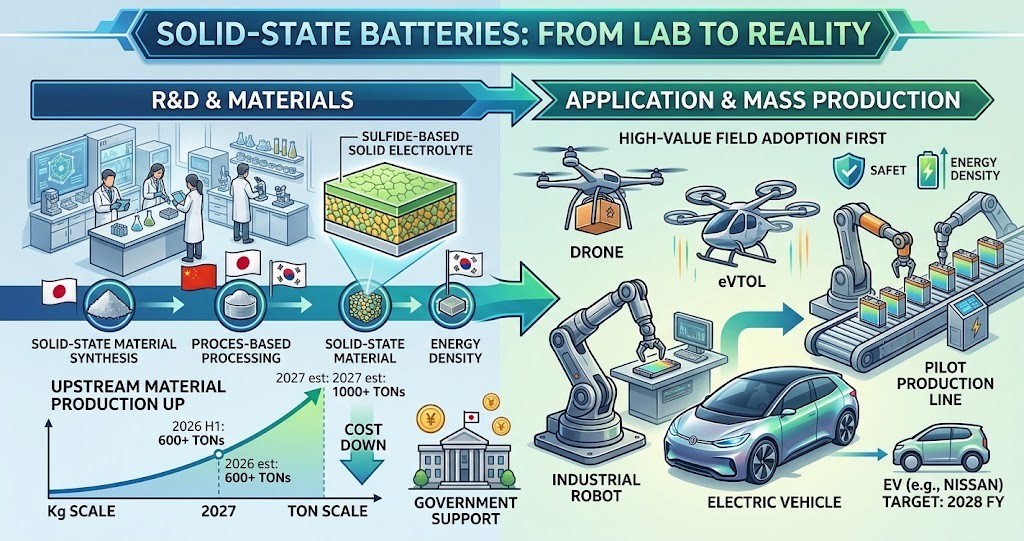
次世代電池の真命目として期待を集める全固体電池は、研究室での性能試験から実機への適用と量産化を見据えた技術検証へと大きく舵を切り始めました。2026年9月現在、車載用途での実用化に向けたハードルは依然として存在するものの、ドローンや産業用ロボット、eVTOL(電動垂直離着陸機)などの高付加価値分野での先行採用や、上流材料市場の急拡大を通じて、日中韓を中心に強固なサプライチェーン構築が急ピッチで進められています。
以下に、ニュースの要約および関連情報を加えた詳細なまとめを記載します。
全固体電池の開発動向と実証段階への移行
- 競争軸のシフト: トヨタ自動車、本田技研工業、日産自動車などの日本勢をはじめ、韓国のサムスンSDIや中国の主要企業がパイロットラインを立ち上げ、研究開発から量産プロセスの確立および歩留まり改善への検証フェーズに移行しています。
- 日産自動車の計画: セルおよびモジュールの検証を進めており、2028年度に自社開発の全固体電池を搭載した電気自動車(EV)の発売を目指しています。
- 高付加価値分野での先行導入: コスト面が課題となるため、初期用途はEVに限られず、エネルギー密度と安全性を追求するドローン、eVTOL、ロボット、小型電子機器などで実証が先行しています。
上流材料市場の急拡大とサプライチェーン構築
- 硫化物系への注力: 高いイオン伝導率を持つ硫化物系固体電解質の原料となる硫化リチウムの需要が急速に増加しています。研究開発用の「キロ単位」から「トン単位」の需要へ拡大し、世界の生産能力は2026年上半期までに 600 トンを超え、2027年には 1000 トン規模に達する見込みです。価格も過去半年で約 50% 下落しました。
- 日本の国内供給網強化: 経済産業省は蓄電池の安定供給確保に向け、2026年6月までに全固体電池関連の5事業を認定。総額 1000 億円を超える助成金のうち約 18% を固体電解質および硫化リチウムの生産技術開発に投入しています。
中国勢の動向と大規模量産に対する冷徹な見方
- CATL(寧徳時代)の慎重姿勢: 2027年までに小規模量産を目指すものの、技術成熟度はレベル4(最大レベル9)に過ぎないと評価。2030年までに100万台規模へ普及する可能性は極めて低いとしています。また、市場で「固体電池」として宣伝されているものの多くは液体電解質が残る半固体電池であり、本物の全固体電池とは区別が必要であると指摘しています。
- 中国各社のロードマップ: BYDは2027年に高級モデル約 1000 台での実証搭載を開始し、2030年に約 4 万台への拡大を計画。広州汽車(GAC)や国軒高科(Gotion)なども2026から2027年を転換点として、実機実装試験や小規模生産を開始する予定です。
【関連情報】背景と産業へのインパクト
- 半固体電池による「橋渡し」: 本格的な全固体電池(オールソリッドステート)の量産・車載コスト低減には2030年以降まで時間がかかる見込みであるため、現状では電解液を極小化した半固体電池(セミソリッド)を中継地点としてプレミアムEVに搭載する動きが主流となりつつあります。
- 製造プロセスと歩留まりの壁: 固体電解質と電極材料の密着度(界面形成)の維持、水分を嫌う硫化物系材料の超ドライ環境での連続塗工技術など、既存のリチウムイオン電池ラインとは異なる設備投資が必要となります。量産初期のスクラップ率をどれだけ迅速に抑制できるかが、各社の収益性を左右します。
- 地政学的アプローチの差異: 中国が巨大な既存サプライチェーンと半固体電池の迅速な実証で先行する一方、日本や韓国は高品質な硫化物系材料の特許および国内サプライチェーンの囲い込みによって、2030年以降の技術的覇権を狙う構造となっています。
出典:https://news.yahoo.co.jp/articles/ff95beb717e8252bcb501a0dbae28ab220026357
Solid-State Batteries Enter the Era of “Technical Verification”: Intensifying Competition in Mass Production and Supply Chain Construction Across Japan, China, and South Korea
Solid-state batteries, highly anticipated as the definitive solution for next-generation energy storage, have shifted significantly from laboratory performance testing to technical verification aimed at practical application and mass production. As of September 2026, hurdles toward commercialization in automotive applications remain. However, through early adoption in high-value-added sectors such as drones, industrial robots, and electric vertical takeoff and landing (eVTOL) aircraft, alongside the rapid expansion of the upstream material market, the construction of robust supply chains is progressing at a fast pace, centered on Japan, China, and South Korea.
Below is a detailed summary combining news highlights with relevant background information.
Solid-State Battery Development Trends and the Shift to Verification Stages
- Shift in Competitive Focus: Japanese players including Toyota, Honda, and Nissan, along with South Korea’s Samsung SDI and major Chinese enterprises, have launched pilot lines. The industry is moving from R&D to a verification phase focused on establishing mass production processes and improving yields.
- Nissan Motor’s Plan: Nissan is advancing verification of cells and modules, aiming to launch an electric vehicle (EV) powered by its in-house developed solid-state battery in fiscal year 2028.
- Early Adoption in High-Value Fields: Due to cost challenges, initial applications are not limited to EVs. Demonstrations are progressing first in sectors prioritizing high energy density and safety, such as drones, eVTOLs, robots, and small electronic devices.
Rapid Expansion of the Upstream Material Market and Supply Chain Construction
- Focus on Sulfide-Based Chemistry: Demand for lithium sulfide—the primary raw material for sulfide-based solid electrolytes known for high ionic conductivity—is increasing rapidly. Demand is shifting from kilogram-scale R&D quantities to metric-ton scale. Global production capacity is expected to exceed 600 metric tons by the first half of 2026 and reach 1,000 metric tons in 2027. Prices have also dropped by roughly 50% over the past six months.
- Strengthening Japan’s Domestic Supply Chain: To secure a stable battery supply, Japan’s Ministry of Economy, Trade and Industry (METI) certified five solid-state battery-related projects by June 2026. Roughly 18% of the total subsidy of over 100 billion yen is allocated to developing and refining production technologies for solid electrolytes and lithium sulfide.
Chinese Players’ Moves and Sober Outlooks on Large-Scale Mass Production
- CATL’s Cautious Stance: Although targeting small-scale mass production by 2027, CATL assesses the technology readiness level at only level 4 (out of a maximum of 9). The company considers widespread adoption reaching 1 million vehicles by 2030 highly unlikely. CATL also noted that many products marketed as “solid-state batteries” are actually semi-solid batteries containing liquid electrolyte, emphasizing that they should be distinguished from true all-solid-state batteries.
- Roadmaps of Chinese Automakers and Suppliers: BYD plans to start demonstration testing on roughly 1,000 premium vehicles in 2027, expanding to about 40,000 units in 2030. Other players like GAC Group and Gotion High-Tech also view 2026–2027 as a turning point to initiate vehicle implementation tests and small-scale production.
Background and Industry Impact
- Semi-Solid Batteries as a “Bridge”: Because mass production and cost reduction for true all-solid-state batteries are expected to take until after 2030, adopting semi-solid batteries with minimized liquid electrolyte in premium EVs is becoming a mainstream interim solution.
- Manufacturing Process and Yield Barriers: Maintaining contact (interface formation) between solid electrolytes and electrode materials, as well as continuous coating technology in ultra-dry environments required for moisture-sensitive sulfide materials, demand capital expenditure separate from existing lithium-ion lines. How quickly companies can suppress scrap rates during early mass production will determine profitability.
- Geopolitical Strategic Differences: While China leads with a massive existing supply chain and rapid deployment of semi-solid batteries, Japan and South Korea aim for technological dominance post-2030 by securing patents for high-quality sulfide materials and establishing domestic supply chains.

コメント