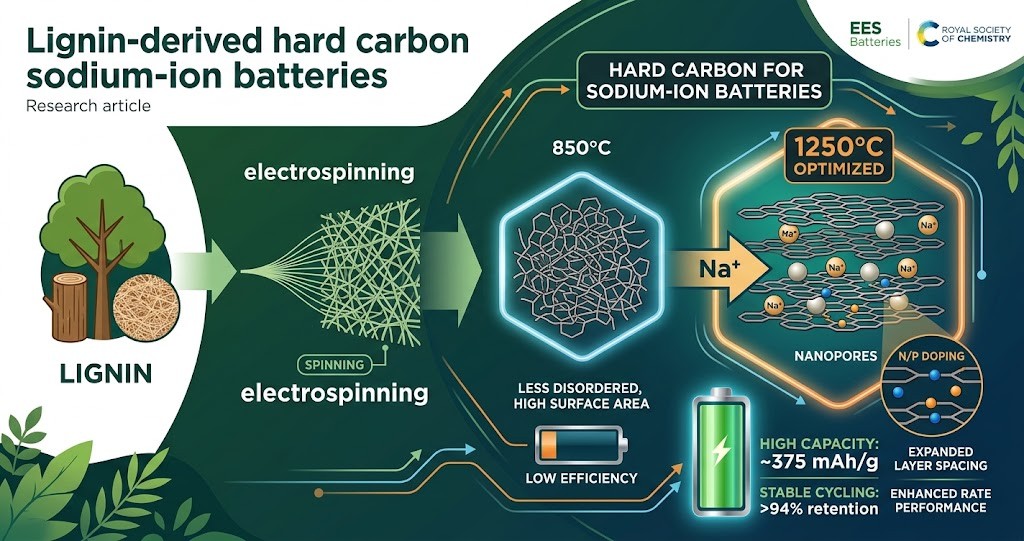
脱炭素社会の実現に向け、リチウムに依存しない次世代蓄電池としてナトリウムイオン電池(SIB)への期待が高まっています。その実用化を左右するカギが、安価で持続可能な負極材料の開発です。そうした中、製紙業などの副産物である「リグニン」を活用し、ミクロ構造を最適化することで高い電池性能を引き出す新技術が発表されました。
本稿では、英国王立化学会の学術誌『EES Batteries』に掲載された最新論文をもとに、リグニン由来ハードカーボンの構造制御メカニズムと性能向上の要点を解説します。
論文の基本情報
- 論文タイトル: Microstructural optimization of lignin-derived hard carbon: balancing disorder, porosity, layer spacing, and doping for high-performance sodium-ion anodes
- 著者・機関: Misbah Mushtaq, Tadhg Kennedy, Maurice N. Collins ほか(アイルランド・リムリック大学 Bernal Institute)
- 掲載誌: EES Batteries(Royal Society of Chemistry, 2026年8月24日公表)
1. 研究の背景:なぜ「ハードカーボン」と「リグニン」なのか?
- リチウムの資源的制約とナトリウムの優位性
- 地球上に豊富に存在するナトリウムを用いるSIBは、コスト面やサプライチェーンの安定性において大きなアドバンテージを持ちます。
- ハードカーボンの必然性
- リチウムイオン電池で一般的なグラファイト(黒鉛)は、ナトリウムイオン(Na+)の半径が大きいため層間に挿入しづらい性質があります。そのため、結晶構造が乱れた非グラファイト化炭素(ハードカーボン)が負極の主流候補となっています。
- バイオマス「リグニン」の活用
- 木材の主成分でありパルプ製造工程などで大量に発生するリグニンは、芳香族構造を豊富に含むためハードカーボンの前駆体として非常に有望視されています。
2. 主な研究成果とデータ
本研究では、エレクトロスピニング法(電界紡糸)によりリグニン由来のナノ繊維を形成し、焼成温度やヘテロ元素ドープがマイクロ構造および電極特性に与える影響を系統的に検証しました。
① 焼成温度の最適化(1250 °C)
850 ℃から1500℃の温度域を比較した結果、1250℃での熱処理が最もすぐれた物性と電極特性を示しました。
- 結晶層間隔(d002): 0.373 nm(グラファイトの 0.335 nm より大きく、 Na+ のスムーズな挿入に適した間隔)
- 比表面積(BET): 74.9 m2/g(850 ℃処理時の 355.7 m2/g から大幅に低減し、SEI形成に伴う不可逆容量を抑制)
- 初期充放電容量: 375 mAh/g(電流密度 30 mA/g 時)
- 初回充放電効率(ICE): 84.0%
- サイクル耐久性: 100 mA/g で500サイクル後も 94.0% の容量を維持
② ヘテロ元素ドープ(N/Pドープ)による特性強化
- 窒素ドープ(N-HCFs): 電子導電性の向上と適度な欠陥導入により、ICEが 87.5% まで向上。高電流密度(1000 mA/g)での容量低下を小幅にとどめ(約21.2%減)、すぐれたレート特性を発揮。
- リンドープ(P-HCFs): 原子半径の大きなリンを導入することで層間距離を 0.383 nm まで押し広げ、低い作動電位領域(平坦部容量)の拡大に寄与。
3. ナトリウム貯蔵のメカニズムと構造最適化のポイント
ハードカーボンにおける Na+ の貯蔵メカニズムは、主に以下の2つの領域に分かれます。
- 傾斜領域(Sloping Region: 約 0.9 V 〜 0.1 V) 表面欠陥や官能基への Na+ の吸着、および層間への初期挿入に対応。低温焼成などで欠陥が多い場合に優勢となります。
- 平坦領域(Plateau Region: 約 0.1 V 〜 0.01 V) 層間への本格的な Na+ インターカレーションや、ナノ閉孔への細孔充填(Pore filling)に対応。
1250 °C処理品(HCF-1250)では、過剰な表面欠陥を低減させつつ良好な層間距離と適度な閉孔構造を保つことで、傾斜領域と平坦領域(平坦部寄与率 約57%)の絶妙なバランスを実現しています。これにより、高エネルギー密度と高速なイオン伝導性の両立を可能にしました。
補足 :エレクトロスピニング法(電界紡糸)の狙い
- 原料のリグニンにポリ乳酸(PLA)を添加してナノ繊維化し、焼成時にPLAを消失させることで「三次元ネットワーク構造」を持つ多孔質カーボンファイバーを形成させています。
- これにより電解液の浸透性と電子伝導パスが大幅に向上し、不織布状の自立膜電極としても応用可能な構造が得られます。
まとめ
本研究は、未利用バイオマスであるリグニンから、焼成温度の精密な制御とヘテロ元素ドープを組み合わせることで、高性能なナトリウムイオン電池用ハードカーボン負極を創出できることを示しました。持続可能かつ低コストな次世代蓄電池の社会実装に向け、材料設計の明確な指針を与える重要な成果と言えます。
From Wood Components to High-Capacity Anodes: The Frontline of Lignin-Utilized Sodium-Ion Batteries
To achieve a decarbonized society, expectations are growing for sodium-ion batteries (SIBs) as next-generation energy storage devices that do not rely on lithium. The key to their practical application lies in the development of low-cost, sustainable anode materials. Against this backdrop, a new technology has been announced that leverages “lignin”—a byproduct of the papermaking industry and other processes—to unlock high battery performance by optimizing its microstructure.
Based on a recent paper published in EES Batteries, a journal of the Royal Society of Chemistry, this article explains the mechanisms of structural control in lignin-derived hard carbon and the key points of its performance enhancement.
Basic Paper Information
- Paper Title: Microstructural optimization of lignin-derived hard carbon: balancing disorder, porosity, layer spacing, and doping for high-performance sodium-ion anodes
- Authors & Affiliations: Misbah Mushtaq, Tadhg Kennedy, Maurice N. Collins, et al. (Bernal Institute, University of Limerick, Ireland)
- Journal: EES Batteries (Published by the Royal Society of Chemistry on August 24, 2026)
1. Research Background: Why “Hard Carbon” and “Lignin”?
- Resource Constraints of Lithium vs. Advantages of SodiumSIBs utilizing abundant sodium on Earth offer significant advantages in terms of cost and supply chain stability.
- The Necessity of Hard CarbonGraphite, commonly used in lithium-ion batteries, has difficulty accommodating sodium ions ($\text{Na}^+$) between its layers due to their larger ionic radius. Therefore, non-graphitizable carbon (hard carbon) with a disordered crystalline structure has become the leading candidate for anodes.
- Utilization of the Biomass “Lignin”Lignin, a primary constituent of wood generated in large quantities during the pulp manufacturing process, is highly promising as a precursor for hard carbon due to its rich aromatic structure.
2. Main Research Results and Data
In this study, lignin-derived nanofibers were fabricated via electrospinning, and the effects of carbonization temperature and heteroatom doping on the microstructure and electrochemical properties were systematically investigated.
(1) Optimization of Carbonization Temperature (1250 °C)
Comparing the temperature range from 850 °C to 1500 °C, thermal treatment at 1250 °C yielded the most superior physical and electrochemical properties.
- Interlayer Spacing ($d_{002}$): $0.373 \text{ nm}$ (larger than graphite’s $0.335 \text{ nm}$, providing suitable spacing for smooth $\text{Na}^+$ insertion)
- Specific Surface Area (BET): $74.9 \text{ m}^2/\text{g}$ (significantly reduced from $355.7 \text{ m}^2/\text{g}$ at 850 °C, suppressing irreversible capacity caused by SEI formation)
- Initial Discharge Capacity: $375 \text{ mAh/g}$ (at a current density of $30 \text{ mA/g}$)
- Initial Coulombic Efficiency (ICE): 84.0%
- Cycling Durability: Maintained 94.0% capacity retention after 500 cycles at $100 \text{ mA/g}$
(2) Property Enhancement via Heteroatom Doping (N/P Doping)
- Nitrogen Doping (N-HCFs): Enhanced electronic conductivity and moderate defect introduction increased the ICE to 87.5%. It demonstrated excellent rate capability with minimal capacity drop (only about 21.2% decrease) at a high current density of $1000 \text{ mA/g}$.
- Phosphorus Doping (P-HCFs): Introducing phosphorus, which has a larger atomic radius, expanded the interlayer distance to $0.383 \text{ nm}$, contributing to the expansion of the low working potential region (plateau capacity).
3. Sodium Storage Mechanism and Key Points of Structural Optimization
The storage mechanism of $\text{Na}^+$ in hard carbon is mainly divided into two regions:
- Sloping Region (approx. 0.9 V to 0.1 V)Corresponds to $\text{Na}^+$ adsorption on surface defects and functional groups, as well as initial insertion between layers. This region dominates when defects are abundant, such as in low-temperature carbonization.
- Plateau Region (approx. 0.1 V to 0.01 V)Corresponds to full-scale $\text{Na}^+$ intercalation between layers and pore filling in closed nanovoids.
In the sample carbonized at 1250 °C (HCF-1250), an exquisite balance between the sloping region and the plateau region (plateau contribution ratio of approx. 57%) is achieved by reducing excessive surface defects while maintaining good interlayer distance and moderate closed pore structures. This enables the simultaneous realization of high energy density and fast ion conduction.
Supplementary Note: Objective of Electrospinning
By adding polylactic acid (PLA) to the raw material lignin to form nanofibers, the PLA decomposes and disappears during carbonization, forming porous carbon fibers with a “three-dimensional network structure”.
This significantly improves electrolyte permeability and electronic conduction pathways, yielding a structure that can also be applied as a non-woven, self-supporting membrane electrode.
Summary
This study demonstrates that high-performance hard carbon anodes for sodium-ion batteries can be created from unutilized lignin biomass through precise control of carbonization temperature combined with heteroatom doping. These findings serve as an important guideline for material design toward the social implementation of sustainable, low-cost next-generation energy storage batteries.

コメント