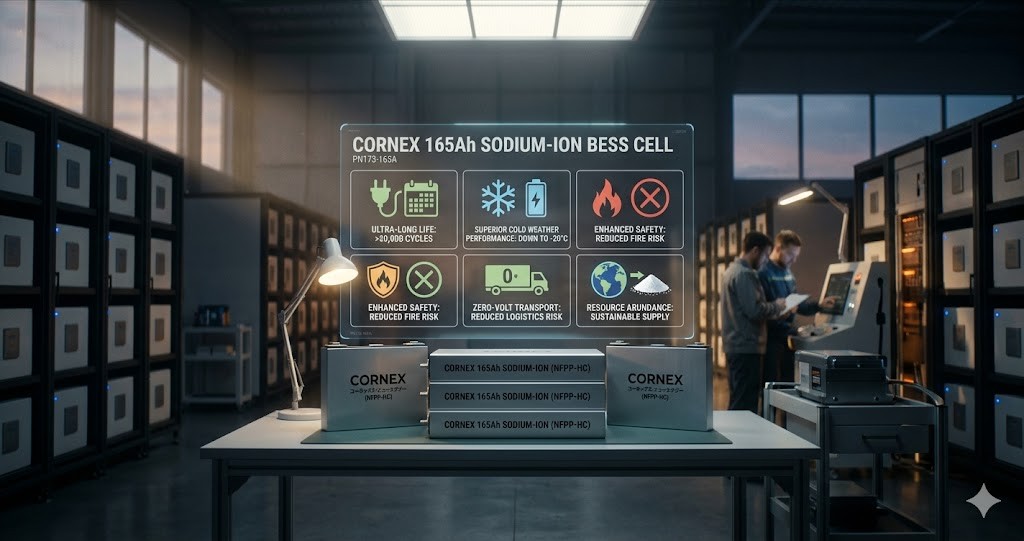
2026年4月7日、中国の電池メーカーCornex New Energy(コーネックス・ニューエナジー)は、定置型エネルギー貯蔵システム(ESS)市場向けに、長寿命を特徴とする165Ahナトリウムイオン角型電池セルを発表しました。リチウムイオン電池(LFP)の代替選択肢として、特に電力網の周波数調整などの高頻度な充放電用途での普及を目指しています。
- 1. 新型165Ahナトリウムイオン電池(PN173-165A)の仕様
- 2. ナトリウムイオン電池の利点と課題
- 3. その他の展開:588Ahセルの量産と円筒形モデル
- 4. 関連情報:市場の背景と用語解説
- Cornex Unveils Ultra-Long Life Sodium-Ion Battery with 20,000 Cycles!
1. 新型165Ahナトリウムイオン電池(PN173-165A)の仕様
Cornexが発表した新型セルは、正極にピロリン酸鉄ナトリウム(NFPP)、負極にハードカーボンを採用したポリアニオン型構成です。
- 容量: 165Ah / 58Ah
- サイクル寿命: 20,000サイクル以上(業界トップクラス)
- エネルギー密度: 重量密度 102 Wh/kg、体積密度 182 Wh/L
- エネルギー効率: 94.5%以上 (1P動作時)
- 物理仕様: 重量 4.5kg、寸法 71.7 x 174.4 x 207.2mm
- 取得認証: GB(中国)、UN38.3、UL、IEC 62619
2. ナトリウムイオン電池の利点と課題
LFP(リン酸鉄リチウム)電池と比較した際、ナトリウムイオン電池には独自のメリットと、依然として残る物理的な制限があります。
主なメリット
- 優れた低温特性: 氷点下でも動作可能で、リチウムイオン電池のようにヒーターによる自己消費を必要としません。
- 安全性: 熱暴走開始温度が高く、火災リスクが低減されています。
- 物流の容易さ: ゼロボルト(放電状態)での輸送が可能であり、輸送時の火災リスクを大幅に排除できます。
- 資源の豊富さ: ナトリウムはリチウムよりも入手しやすく、持続可能なサプライチェーン構築が可能です。
課題と制限(LFPとの比較)
Cornex社のLFPセル(314Ah、5.6kg)と比較すると、ナトリウムイオンセルは重量エネルギー密度が低く、同じエネルギー量を確保するために、より多くのスペースと重量を必要とします。
3. その他の展開:588Ahセルの量産と円筒形モデル
Cornexは大型ESS向けのリチウムイオン電池および小型モビリティ向け製品のラインナップも強化しています。
- 588Ah LFPセル: 2025年9月に発表された超大容量セルが正式に量産開始。重量密度 190 Wh/kg、サイクル寿命 12,000回以上を実現しています。
- 円筒形ナトリウムイオン電池: 電動自転車や電動工具向けに4種類(10Ah、12.5Ah、16Ah、26.5Ah)を展開。冬場の航続距離低下や低温起動の課題に対応します。
4. 関連情報:市場の背景と用語解説
なぜ今、ナトリウムイオン電池なのか?
リチウム価格の変動や供給不安に対し、安価で豊富な塩から抽出できるナトリウムは、大規模なグリッド貯蔵用として注目されています。特に「周波数調整」のように、瞬時に充放電を繰り返す用途では、2万サイクルという長寿命がライフサイクルコストの劇的な低減に寄与します。
用語解説
- ESS (Energy Storage System): 太陽光や風力などの不安定な再生可能エネルギーを蓄え、電力網を安定させるシステム。
- ポリアニオン型 (NFPP): ナトリウムイオン電池の正極材料の一種。構造が安定しており、長寿命で安全性が高いのが特徴。
- 周波数調整 (Frequency Regulation): 電力供給と需要のバランスを秒単位で調整し、電力網の周波数を一定に保つこと。
Cornex Unveils Ultra-Long Life Sodium-Ion Battery with 20,000 Cycles!
On April 7, 2026, Chinese battery manufacturer Cornex New Energy announced the launch of a 165Ah sodium-ion prismatic cell characterized by its exceptional longevity for the stationary Energy Storage System (ESS) market. Positioned as an alternative to Lithium Iron Phosphate (LFP) batteries, it aims for widespread adoption in high-frequency charge/discharge applications, such as grid frequency regulation.
1. Specifications of the New 165Ah Sodium-Ion Battery (PN173-165A)
The new cell announced by Cornex features a polyanionic configuration using sodium iron pyrophosphate (NFPP) for the cathode and hard carbon for the anode.
- Capacity: 165Ah / 58Ah
- Cycle Life: Over 20,000 cycles (industry-leading)
- Energy Density: Gravimetric density of 102 Wh/kg, volumetric density of 182 Wh/L
- Energy Efficiency: 94.5% or higher (at 1P operation)
- Physical Specs: Weight 4.5kg, dimensions 71.7 x 174.4 x 207.2mm
- Certifications: GB (China), UN38.3, UL, IEC 62619
2. Advantages and Challenges of Sodium-Ion Batteries
Compared to LFP batteries, sodium-ion batteries offer unique benefits along with certain inherent physical limitations.
Key Advantages
- Superior Low-Temperature Performance: Capable of operating in sub-zero temperatures without requiring self-consumption of energy for heaters, unlike lithium-ion batteries.
- Enhanced Safety: Features a higher thermal runaway onset temperature, significantly reducing fire risks.
- Logistical Ease: Can be transported at zero volts (fully discharged state), largely eliminating fire hazards during transit.
- Resource Abundance: Sodium is more readily available than lithium, enabling the construction of a more sustainable supply chain.
Challenges and Limitations (Compared to LFP)
Compared to Cornex’s LFP cell (314Ah, 5.6kg), the sodium-ion cell has a lower gravimetric energy density, requiring more space and weight to secure the same amount of energy.
3. Other Developments: 588Ah Cell Mass Production and Cylindrical Models
Cornex is also strengthening its lineup for large-scale ESS and micromobility.
- 588Ah LFP Cell: The ultra-large capacity cell announced in September 2025 has officially entered mass production. It achieves a gravimetric density of 190 Wh/kg and a cycle life of over 12,000 cycles.
- Cylindrical Sodium-Ion Batteries: Four models (10Ah, 12.5Ah, 16Ah, 26.5Ah) are being rolled out for e-bikes and power tools. These address issues such as range reduction in winter and cold-start difficulties.
4. Market Background and Terminology
Why Sodium-Ion Batteries Now?
In response to lithium price volatility and supply concerns, sodium—which can be extracted from cheap and abundant salt—is drawing attention for large-scale grid storage. Particularly for applications like “Frequency Regulation,” where batteries undergo rapid and frequent cycles, a long life of 20,000 cycles contributes to a dramatic reduction in lifecycle costs.
Terminology
- ESS (Energy Storage System): A system that stores unstable renewable energy, such as solar or wind, to stabilize the power grid.
- Polyanionic (NFPP): A type of cathode material for sodium-ion batteries. It is characterized by a stable structure, long life, and high safety.
- Frequency Regulation: The process of balancing power supply and demand second-by-second to maintain a constant frequency on the power grid.


コメント