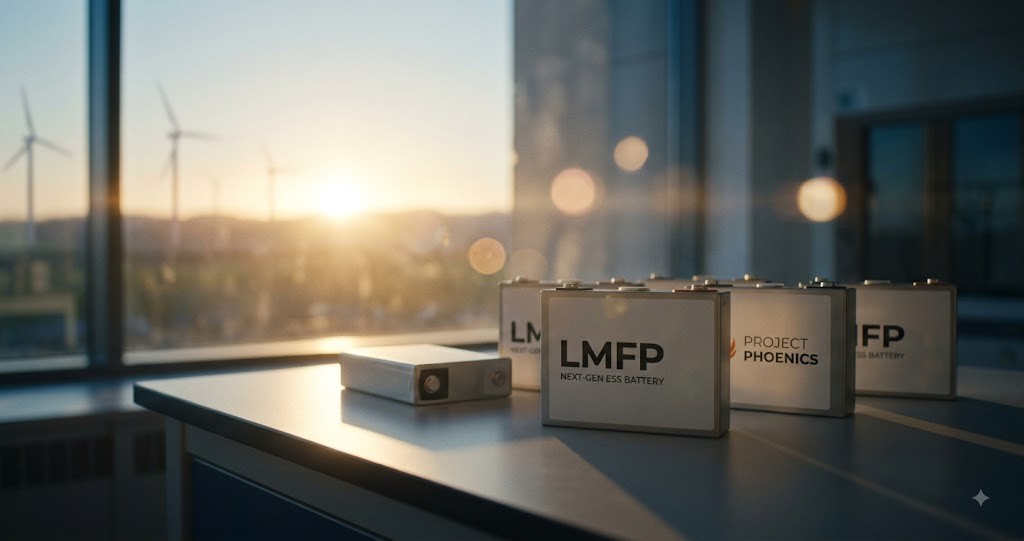
再生可能エネルギーの導入拡大に伴い、定置型蓄電システム(ESS)市場では「安全性」「低コスト」「高エネルギー密度」を兼ね備えた次世代電池のニーズが急増しています。これまで主流だったリン酸鉄リチウム(LFP)電池は安全性とコストに優れる一方、エネルギー密度の低さが課題でした。 こうした背景のもと、オーストリアの産学官コンソーシアムは、LFPの安全性を維持しつつ高電圧化・高エネルギー密度化を図るLMFP(リン酸マンガン鉄リチウム)技術の開発プロジェクト「Phoenics(フェニックス)」を発足させました。
1. プロジェクト概要(Phoenics Project)
- 目的: 定置型蓄電システム(ESS)向けLMFP電池の開発、および開発プロセスの高速化
- 期間: 36ヶ月(3年間)
- 総予算: 290万ユーロ(約4.6億円)
- 助成金: 約200万ユーロ(オーストリア研究振興庁「エネルギー研究2024」プログラムより拠出)
- 開発目標数値:
- エネルギー密度: 従来のLFP比で +20% 向上
- 耐用年数(サイクル寿命): 従来のLFP比で +40% 延長
2. コンソーシアム構成と各機関の役割
グラーツの「Virtual Vehicle Research」が全体統過(コーディネート)を行い、シミュレーション・AI技術と産業界の製造・評価ノウハウを融合させる体制を構築しています。
                      【Phoenics プロジェクト体制】
                                    │
   ┌──────────┬──────┴────┬───────────┐
   ▼                 ▼                       ▼                  ▼
【Virtual Vehicle】 【Varta Innovation】    【MCL】             【AVL List】
・全体調整         ・材料開発               ・電極微細構造      ・電気化学モデル
・実験/シミュ      ・電極および             ・性能/寿命/       ・AI/機械学習
  レーション連携     セル製造・統合            信頼性解析       ・安全性予測
- Virtual Vehicle Research(統括): 実験データとデジタルシミュレーションを融合し、開発サイクルの短縮・商業化を加速。
- Varta Innovation(大手電池メーカー関連): 材料開発、電極・セルの試作および統合技術を担当。
- Materials Center Leoben Forschung (MCL): 高解像度解析を用い、微細構造が電池の性能・寿命に与える影響を分析。
- AVL List(大手自動車・動力計測エンジニアリング): 電気化学モデリングとAI(機械学習)を活用し、高負荷・異常時の安全挙動や劣化を予測。
3. LMFP(リン酸マンガン鉄リチウム)の技術的解説・関連情報
なぜ今、LMFPなのか?(LFPとの比較)
LMFPは、LFP(LiFePO4)の鉄(Fe)の一部をマンガン(Mn)に置き換えた(正極固溶体)材料です。
| 項目 | 従来の LFP | 次世代 LMFP | 関連解説・技術的メカニズム |
|---|---|---|---|
| 動作電圧 | 約 3.2 V | 約 3.7〜4.1 V | マンガン(Mn3+/Mn4+)のレドックス電位を利用することで、動作電圧が上昇。 |
| 比エネルギー密度 | 基準 (150-180 Wh/kg) | 最大 +20% 向上 | 電圧上昇に伴い、重量・体積あたりのエネルギー密度(Wh/kg)が物理的に向上。 |
| レアメタル | コバルト/ニッケル 不使用 | コバルト/ニッケル 不使用 | 熱安定性が高く、発火リスクが極めて低い結晶構造(オリビン構造)を維持。 |
LMFPの課題とPhoenicsが挑む「AI・モデル駆動」アプローチ
- 技術的課題(マンガン溶出と導電性): LMFPは電圧が高まる一方、マンガンの溶出による劣化(寿命低下)や、電子伝導性の低さが実用化のボトルネックとされてきました。
- Phoenicsのアプローチ: 正極材料の微細構造からモジュール全体に至る構造を「物理モデル」と「データ駆動(AI)モデル」でマルチスケール解析。マンガン溶出のメカニズムを解明・抑止し、寿命40%延長と高速なスケールアップを目指します。
4. 市場への影響と将来展望
- 定置型蓄電池(ESS)市場の強化 現在、欧州では中国製LFP電池がESS市場を席巻しています。コバルト・ニッケルに頼らない高容量LMFPを自国・欧州内で開発・生産する技術基盤を構築することで、供給網の脱中国化と欧州のエネルギー安全保障に貢献します。
- 車載用(EV)への横展開 本プロジェクトは当初ESSを対象としていますが、確立された材料処理や安全性評価の知見は、将来的に安価で安全なEV用バッテリー(三元系とLFPの中間領域を狙うセグメント)への転用が見込まれています。
出典:https://www.bestmag.co.uk/austrian-lmfp-energy-density-lifespan-gain/
€2.9M “Phoenics” Project Launches in Austria — Aiming for 20% Higher Energy Density and 40% Longer Lifespan with LMFP Batteries
With the expanding integration of renewable energy, the stationary energy storage system (ESS) market is experiencing a rapid surge in demand for next-generation batteries that offer a combination of safety, low cost, and high energy density. While conventional lithium iron phosphate (LFP) batteries excel in safety and cost, their relatively low energy density has remained a challenge. Against this backdrop, an Austrian industry-academia-government consortium launched the “Phoenics” project to develop lithium manganese iron phosphate (LMFP) technology, which aims to achieve higher operating voltage and energy density while retaining the safety benefits of LFP.
1. Project Overview (Phoenics Project)
- Objective: Development of LMFP batteries for stationary energy storage systems (ESS) and acceleration of the R&D process
- Duration: 36 months (3 years)
- Total Budget: €2.9 million (approx. ¥460 million)
- Funding: Approx. €2 million (funded by the Austrian Research Promotion Agency’s “Energy Research 2024” program)
- Target Performance Metrics:
- Energy Density: +20% increase compared to conventional LFP
- Lifespan (Cycle Life): +40% extension compared to conventional LFP
2. Consortium Structure and Organizational Roles
Virtual Vehicle Research, based in Graz, serves as the overall coordinator, establishing a framework that integrates digital simulation and AI technologies with industrial manufacturing and testing expertise.
                      [Phoenics Project Structure]
                                   │
 ┌────────────┬────┴──────┬───────────┐
   ▼                  ▼                           ▼                 ▼
[Virtual Vehicle]   [Varta Innovation]           [MCL]           [AVL List]
・Project           ・Material Development        ・Electrode      ・Electrochemical
  Coordination      ・Electrode & Cell              Microstructure   Modeling
・Integration of       Prototyping/Integration    ・Performance,   ・AI/Machine
   Experiments &                                    Lifespan &       Learning
   Simulations                                      Reliability    ・Safety Prediction
                                                    Analysis
- Virtual Vehicle Research (Lead Coordinator): Merges experimental data with digital simulation to accelerate development cycles and commercialization.
- Varta Innovation (Affiliated with Major Battery Manufacturer): Handles material development, electrode and cell prototyping, and system integration.
- Materials Center Leoben Forschung (MCL): Utilizes high-resolution analytics to investigate how electrode microstructures impact battery performance, lifespan, and reliability.
- AVL List (Major Automotive & Powertrain Engineering Firm): Applies electrochemical modeling and AI (machine learning) to predict safety behaviors and degradation under extreme operating conditions.
3. Technical Context and Overview of LMFP (Lithium Manganese Iron Phosphate)
Why LMFP Now? (Comparison with LFP)
LMFP is a cathode material created by substituting a portion of the iron (Fe) in LFP (LiFePO4) with manganese (Mn) to form a solid solution.
| Parameter | Conventional LFP | Next-Generation LMFP | Technical Context & Mechanism |
|---|---|---|---|
| Operating Voltage | Approx. 3.2 V | Approx. 3.7–4.1 V | Operating voltage increases by utilizing the redox potential of manganese (Mn3+/Mn4+). |
| Specific Energy Density | Baseline (~150–180 Wh/kg) | Up to +20% increase | Gravimetric and volumetric energy density (Wh/kg) physically increases due to the higher operating voltage. |
| Rare Metals | Co/Ni Free | Co/Ni Free | Maintains the olivine crystal structure, offering high thermal stability and extremely low risk of thermal runaway. |
LMFP Challenges and the “AI & Model-Driven” Approach
- Technical Challenges (Manganese Dissolution & Electrical Conductivity): While LMFP offers higher voltage, key bottlenecks to commercialization include capacity degradation caused by manganese dissolution into the electrolyte and low electronic conductivity.
- The Phoenics Approach: The project employs multiscale modeling combining “physics-based models” and “data-driven (AI) models” across structures ranging from cathode microstructures to complete battery modules. This approach aims to elucidate and suppress manganese dissolution mechanisms, targeting a 40% lifespan extension alongside rapid technology scaling.
4. Market Impact and Future Outlook
- Strengthening the Stationary Energy Storage (ESS) Market: Chinese-made LFP batteries currently dominate the European ESS market. Establishing a domestic European technology and manufacturing base for high-capacity, cobalt-/nickel-free LMFP batteries supports supply chain diversification away from reliance on China while enhancing European energy security.
- Cross-Industry Expansion to Electric Vehicles (EVs): Although the project initially focuses on ESS applications, the established material processing knowledge and safety assessment frameworks are expected to translate to affordable and safe EV batteries (targeting the mid-market segment between conventional LFP and high-nickel NCM/NCA chemistries).


コメント