近年、産業用途および再生可能エネルギーの分野において、安全性の高さと希少金属(リチウムやコバルトなど)に依存しない低コスト性を両立させた「ナトリウムイオン電池」が大きな注目を集めています。リチウムイオン電池に比べ熱暴走リスクが非常に低いため、大規模な工場やデータセンターなどの定置型蓄電池システム(BESS)の分野において実用化が進められています。
以下に、現代自動車グループ(Hyundai Motor Group)によるユニグリッド社(UNIGRID Inc.)製ナトリウムイオン電池の検証結果と、関連する背景情報をまとめました。
現代自動車グループによるユニグリッド社製ナトリウムイオン電池の検証結果
1. プロジェクトの概要と背景
現代自動車グループは、スタートアップ育成プログラム「ZER01NE Accelerator(2025年参加)」を通じてユニグリッド社と提携し、同社のナトリウムイオン電池技術に関する検証・試験を完了しました。この取り組みの主な目的は、高い安全性が求められる産業・工場向け蓄電池インフラ(BESS)に適した「不燃性バッテリー技術」を特定することです。
2. 主な検証結果と技術的特長
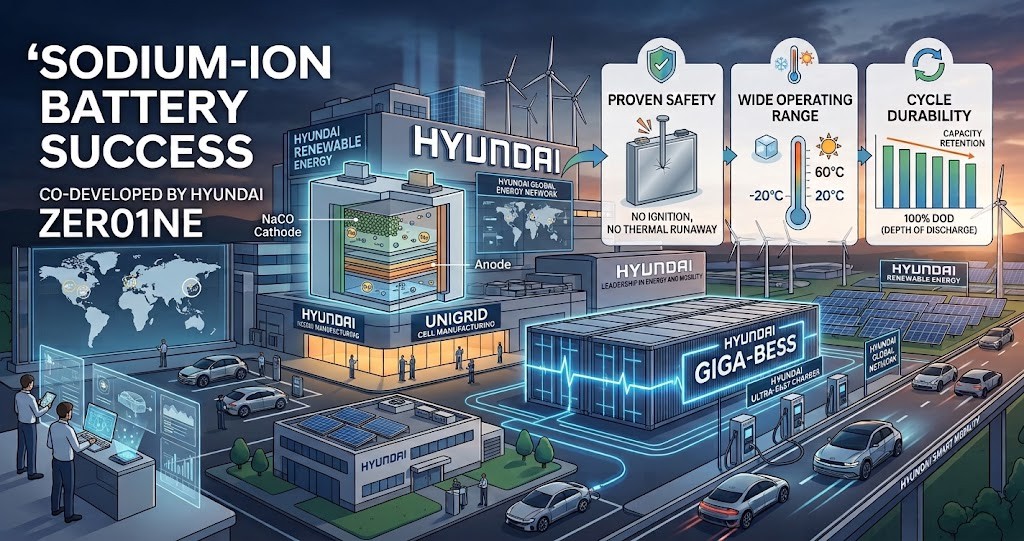
- 高い安全性の証明: ユニグリッド社製の210Ah(アンペア時)ナトリウムイオン電池セルは、過酷な使用環境試験(アビューズ試験)において発火や熱伝播(熱暴走の伝播)を起こすことなく合格しました。
- 広範な動作温度域: -20℃から60℃という幅広い温度範囲での動作実証を完了しています。
- 優れたサイクル耐久性: 100% DOD(放電深度)での連続充放電サイクル試験においても、容量劣化は最小限に抑えられました(※具体的なサイクル数や残留容量、過酷試験の詳細は公表されていません)。
3. 使用されている電池化学(NCO技術)
ユニグリッド社の電池は、正極材料に酸化クロムナトリウム(NaCrO2 / NCO)を採用しています。この独自のNCO技術により、従来の電池で課題となっていた安全性と耐久性を高水準で両立させています。
4. 今後の展開と活用シナリオ
現代自動車グループおよび韓国のシステムインテグレーター各社は、ユニグリッド社と共同でNCOセルをベースとしたナトリウムイオン蓄電池システム(BESS)を開発する計画です。
- 主な用途: 現代自動車グループの製造工場への導入、および同社エネルギー事業における分散型電源(DER)の支援。
- システム仕様: 計画されているBESSの容量、定格出力、具体的な導入時期などは未公表です。
関連情報・参考背景
- ユニグリッド社(UNIGRID Inc.)について:カリフォルニア大学サンディエゴ校(UCSD)からのスピンアウト企業として2021年に設立されたバッテリーベンチャーです。商業・産業用(C&I)および定置型エネルギー貯蔵向けに、安全性の高いNCOナトリウムイオン電池の開発を推進しています。
- 北米・グローバル市場での動向:ユニグリッド社は、2026年8月初旬にシントロピック・パワー社(Syntropic Power)と北米市場での商業化提携を発表したほか、住宅用蓄電システム「Na+Casa」の立ち上げや、UL 9540Aなどの安全認証取得を進めるなど、事業化に向けた展開を加速させています。
- 工場向けBESSにおけるナトリウムイオン電池の利点:大規模な工場内や屋内施設へ設置する蓄電池では、万が一の火災リスクを排除することが最重要視されます。ナトリウムイオン電池は原材料調達のコストが低く、熱暴走リスクが非常に極小であるため、冷暖房(HVAC)設備を抑えた完全空冷(パッシブ冷却)構成や屋内設置が可能となり、運用・導入コスト(TCO)の低減に大きく貢献すると期待されています。
出典:https://www.bestmag.co.uk/hyundai-validates-unigrid-sodium-ion/
Hyundai Motor Demonstrates the Effectiveness of UNIGRID’s NCO Sodium-Ion Batteries for Next-Generation BESS Deployment
In recent years, sodium-ion batteries have drawn significant attention in industrial and renewable energy sectors due to their combination of high safety and low cost, achieved without reliance on critical raw materials such as lithium and cobalt. Because their risk of thermal runaway is exceptionally low compared to lithium-ion batteries, commercial deployment is accelerating in stationary battery energy storage systems (BESS) for large-scale manufacturing plants and data centers.
Below is a summary of the validation results and background context regarding UNIGRID Inc.’s sodium-ion batteries evaluated by Hyundai Motor Group.
Hyundai Motor Group’s Validation Results for UNIGRID Sodium-Ion Batteries
1. Project Overview and Background Through its startup acceleration initiative, the ZER01NE Accelerator (which UNIGRID joined in 2025), Hyundai Motor Group partnered with UNIGRID to complete the validation and testing of the company’s sodium-ion battery technology. The primary objective of this effort was to identify non-flammable battery technologies suitable for industrial and factory energy storage infrastructure, where stringent safety standards are required.
2. Key Validation Results and Technical Highlights
- Proven High Safety: UNIGRID’s 210 Ah (ampere-hour) sodium-ion cells successfully passed rigorous abuse testing without fire or thermal propagation (the spread of thermal runaway).
- Broad Operating Temperature Range: Stable operation was demonstrated across a wide temperature window from -20 deg C to 60 deg C.
- Exceptional Cycle Durability: Continuous cycling tests at 100% depth of discharge (DOD) showed minimal capacity degradation (specific cycle counts, retained capacity, and precise abuse testing conditions were not disclosed).
3. Battery Chemistry (NCO Technology) UNIGRID’s cells utilize sodium chromium oxide (NaCrO2 / NCO) as the cathode material. This proprietary NCO technology effectively resolves the trade-offs between safety and durability that have traditionally challenged battery development.
4. Future Roadmap and Application Scenarios Hyundai Motor Group, alongside South Korean system integrators, plans to collaborate with UNIGRID to develop NCO-based sodium-ion BESS units.
- Primary Applications: Deployment across Hyundai Motor Group manufacturing facilities and support for distributed energy resources (DERs) within the group’s broader energy initiatives.
- System Specifications: Planned BESS parameters—including storage capacity, rated power output, and deployment timelines—remain undisclosed.
Related Context and Background Information
- About UNIGRID Inc.: Founded in 2021 as a spin-out from the University of California, San Diego (UCSD), UNIGRID is a battery startup advancing highly safe NCO sodium-ion technology tailored for commercial and industrial (C&I) as well as stationary energy storage markets.
- North American and Global Market Developments: In early August 2026, UNIGRID announced a commercialization partnership with Syntropic Power for the North American market. The company is accelerating its commercial roadmap, including the launch of its “Na+Casa” residential storage system and securing key safety certifications such as UL 9540A.
- Advantages of Sodium-Ion Batteries in Factory BESS: For energy storage installations within large production sites or indoor facilities, eliminating fire hazards is paramount. Sodium-ion technology leverages low raw material sourcing costs and minimal thermal runaway risk, enabling fully air-cooled (passive cooling) designs with reduced HVAC requirements and indoor installation, thereby contributing significantly to total cost of ownership (TCO) reduction.

コメント