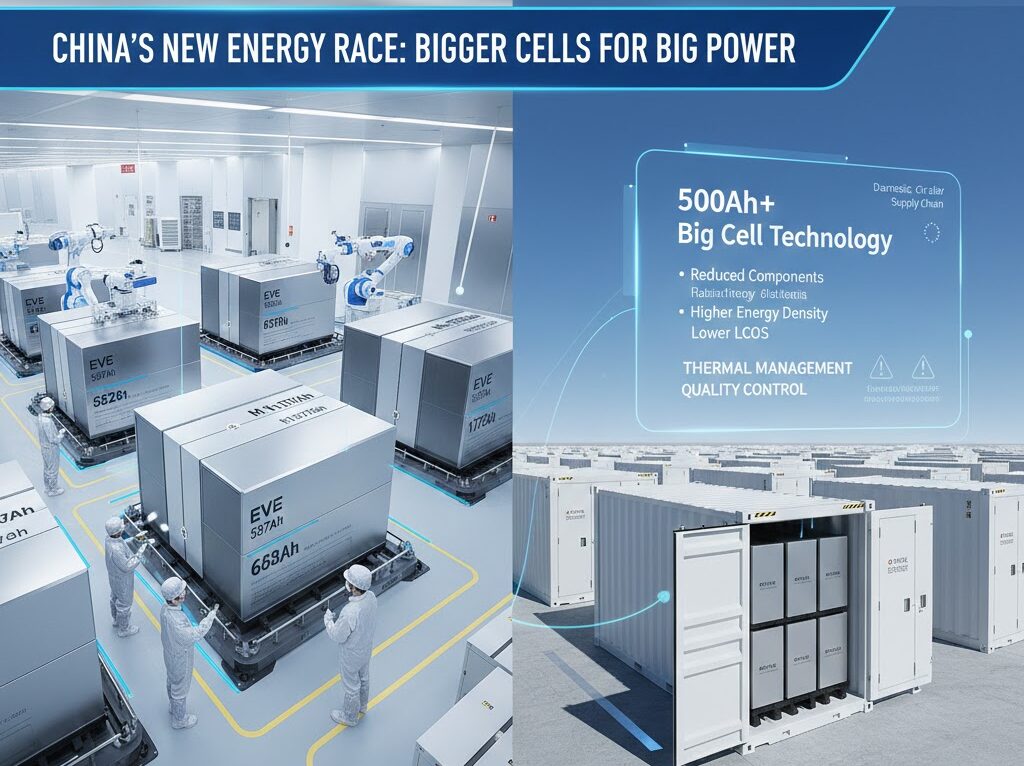
中国の蓄電池(BESS)市場において、従来の314Ahから500Ahを超える「大容量セル(ビッグセル)」への移行が加速しています。CATL、EVE Energy、HiTHIUMといった中国の主要メーカーは、2025年から2026年にかけて量産と出荷を本格化させる見通しです。
以下に、メーカー動向と技術的背景を整理してまとめます。
主要メーカーの展開状況
各社は、システム全体の部品点数を減らし、エネルギー密度を高めるために、異なる容量帯で競争を繰り広げています。
| メーカー名 | セル容量 | 量産・出荷時期 | 特徴・目標 |
| CATL | 587Ah | 2025年6月開始 | 年産60GWh体制、サイクル寿命1万回超 |
| EVE Energy | 628Ah | 2024年12月量産 | 「Mr. Big」ブランド、長期蓄電向け |
| HiTHIUM | 587Ah / 1175Ah | 2025年6月~8月 | 8時間以上の長時間蓄電(LDES)を視野 |
| Sunwoda | 684Ah | 2025年9月量産 | 440Wh/L超の密度、商用・産業用ターゲット |
| Envision AESC | 530Ah | 2024年4月発売 | 6MWh以上のコンテナ型設計に統合 |
| REPT BATTERO | 587Ah | 展開中 | 「Wending」技術による高密度化 |
| CALB | 588Ah以上 | 2026年初頭予定 | 「ZHIJIU」ロードマップの一環 |
「ビッグセル」採用の戦略的メリット
メーカーがセルの大型化を急ぐ主な理由は、システムレベルでのコスト削減(LCOSの低減)にあります。
- 部品点数の削減: セル1個あたりの容量が増えることで、コンテナ1つに必要なセル数が減少します。これにより、バスバー(接続板)、溶接箇所、電圧・温度センサーの数が大幅に削減されます。
- エネルギー密度の向上: コンテナ内のデッドスペースが減り、同じ設置面積でより多くの電力を貯蔵できるようになります(例:5MWhから6MWh超へ)。
- 製造効率: 組み立て工程が簡素化され、人件費や製造時間の短縮につながります。
直面する技術的・商業的課題
大容量化にはメリットがある一方で、安全性や標準化に関する高いハードルも存在します。
1. 熱管理と安全性
単一セルに蓄えられるエネルギーが大きいため、万が一の「熱暴走(Thermal Runaway)」が発生した際、放出されるエネルギーも増大します。システム全体に火災が広がるのを防ぐための、より高度な冷却技術と消火対策が求められます。
2. 製造の品質管理(歩留まり)
電極シートが長大化するため、塗工の均一性を保つのが難しくなります。1つのセルが故障した際の影響が大きいため、製造過程でのわずかな欠陥も許容されません。
3. 規格の乱立
現在、各社で「530Ah」「587Ah」「628Ah」など容量規格がバラバラです。これは、システムを設計するインテグレーターにとって、複数のサプライヤーから部品を調達する際の障壁(標準化の欠如)となっています。
今後の展望
2026年に向けて、世界の貯蔵システムコストはさらに低下すると予測されています。今後の市場の焦点は、単なる「容量の大きさ」から、「現場での信頼性」へと移っていくでしょう。
特に、長期のサイクル寿命を保証できるか、過酷な気候条件下で安全に動作し続けられるかといった「実証データ」が、メーカーの勝敗を分ける鍵となります。
In the Chinese Battery Energy Storage System (BESS) market, the transition from conventional 314Ah cells to “Big Cells” exceeding 500Ah is accelerating. Major Chinese manufacturers, including CATL, EVE Energy, and HiTHIUM, are set to ramp up mass production and shipments through 2025 and 2026.
Below is a summary of manufacturer trends and the technical background driving this shift.
Deployment Status by Major Manufacturers
Companies are competing across various capacity ranges to reduce the total number of system components and maximize energy density.
| Manufacturer | Cell Capacity | Mass Production / Shipping | Features & Goals |
| CATL | 587Ah | Starting June 2025 | 60GWh annual capacity; 10,000+ cycle life |
| EVE Energy | 628Ah | Dec 2024 (Mass Prod) | “Mr. Big” brand; targets long-duration storage |
| HiTHIUM | 587Ah / 1175Ah | June–Aug 2025 | Aiming for 8h+ Long-Duration Energy Storage (LDES) |
| Sunwoda | 684Ah | Sept 2025 (Mass Prod) | Density >440Wh/L; targets commercial/industrial |
| Envision AESC | 530Ah | Launched April 2024 | Integrated into 6MWh+ container designs |
| REPT BATTERO | 587Ah | Ongoing | “Wending” technology for high density |
| CALB | 588Ah+ | Early 2026 (Planned) | Part of the “ZHIJIU” technology roadmap |
Strategic Advantages of “Big Cells”
The primary driver for larger cells is the reduction of system-level costs, effectively lowering the Levelized Cost of Storage (LCOS).
- Reduction in Component Count: Increasing the capacity per cell reduces the total number of cells required per container. This significantly cuts the number of busbars, weld points, and voltage/temperature sensors.
- Improved Energy Density: By minimizing dead space within containers, companies can store more power in the same footprint (e.g., jumping from 5MWh to over 6MWh per 20ft container).
- Manufacturing Efficiency: Simplified assembly processes lead to reduced labor costs and shorter production times.
Technical and Commercial Challenges
While the benefits are clear, “going big” introduces significant safety and standardization hurdles.
- Thermal Management and SafetyBecause a single cell stores more energy, the impact of a “Thermal Runaway” event is far greater. More advanced cooling technologies and fire suppression measures are required to prevent propagation throughout the system.
- Quality Control (Yield Rates)Longer electrode sheets make it difficult to maintain coating uniformity. Since a failure in one large cell has a massive impact on the system, there is zero tolerance for manufacturing defects.
- Lack of StandardizationWith various standards emerging (530Ah, 587Ah, 628Ah, etc.), system integrators face challenges in sourcing components from multiple suppliers due to a lack of uniform specifications.
Future Outlook
Global storage system costs are expected to decline further toward 2026. The market focus is shifting from “headline capacity” to field reliability.
Success for manufacturers will depend on “bankable data”—specifically, the ability to prove long-term cycle life and safe operation under extreme climatic conditions.

コメント