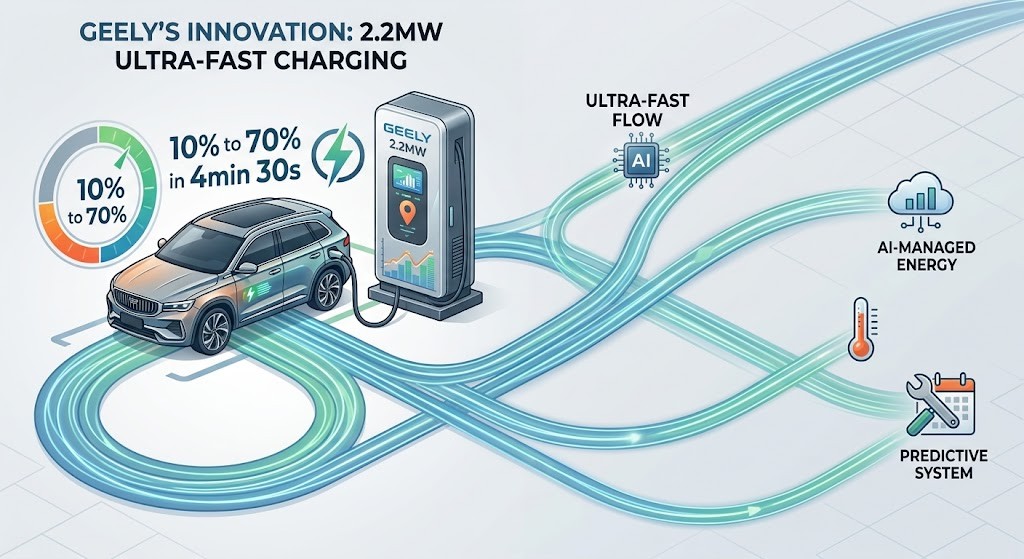
2026年9月、中国の自動車大手・吉利汽車(Geely Auto)は、わずか4分半でバッテリー容量の10%から70%まで充電可能な「2.2メガワット(MW)級・超急速充電システム」と、AIを活用した次世代バッテリーマネジメント技術を発表しました。
中国のEV市場では、単なる車体価格の値下げ合戦から「インテリジェント運転」「航続距離」「超急速充電」といった技術力で差別化を図る技術競争へと激化しています。先行する最大手・BYD(比亜迪)の超急速充電ネットワークに対抗し、ユーザーの「航続不安(Range Anxiety)」を完全に解消することがGeelyの狙いです。
大電流・高出力化に伴う発熱や劣化のリスクに対し、車載とクラウド双方の「AIモデル」で熱制御と予兆管理を行う点が大きな特徴です。本記事では、Geelyの発表内容を要約・整理するとともに、同技術のバックグラウンドや競合BYDとの対比を解説します。
1. 要約と整理
① 業界最速レベルの「4分半充電」スペック
- 最大出力: 2.2MW(メガワット)の超高出力インフラおよび高レート(12C/6C対応)バッテリーを組み合わせて実現。
- 充電時間(常温下):
- 10% → 70%: 4.5分(4分30秒)
- 10% → 97%: 8分40秒
- 幹部コメント: Geely幹部の張徳旺氏は「現在の充電速度はすでに物理的限界に近づいており、これ以上の速度追求による限界効果(メリット)は小さくなる」とし、速度以外のシステム安定性や制御技術の重要性を強調しました。
② 熱暴走と劣化を防ぐ「AIバッテリー管理」
超高出力充電(メガワット級)では、電池内部の過熱や劣化が最大の課題となります。Geelyはこれをハードウェアだけでなくソフトウェア・AIで解決するアプローチをとっています。
- デジタルツイン(クラウド): クラウド上にバッテリーのシミュレーション環境を構築し、リアルタイムの熱挙動をモニタリング。
- 車載ディープラーニング(エッジAI): 車両側のAIモデルがバッテリー状態を監視・予測し、急速充電中の熱制御(温度予測・電流調整)を最適化。
- 期待効果: 超急速充電を行いながらも発熱を抑え、電池の潜在的な危険を事前予測して安全性を担保。
③ 新型「Galaxy E5」および次世代バッテリーの投入
- 中国国内でのEV販売が11ヶ月連続で減速傾向を示す中、販売回復の爆弾として改修型純電気SUV「Galaxy E5」および高レート次世代バッテリー(神盾短刀バッテリー等)を発表・搭載。
④ 競合BYDとの超急速充電バトル
- BYDの動向: 10%→97%を9分(10%→70%を約5分)で充電するメガワット級「Flash Charging 2.0(最大1.5MW)」を展開中。2028年までに9万箇所の急速充電ステーションを建設する計画。
- Geelyの対抗策: 最大出力を2.2MWに引き上げることでBYDの数値を上回り、充電時間でリードを奪う狙い。
- インフラの見通し: ガソリンスタンドのように複数ブランドが共用するマルチステーション型ネットワーク形成により、超急速充電インフラのグローバル普及が加速すると見込んでいる。
2. 技術的バックグラウンドと関連情報の補足
(1) なぜ「メガワット(MW)級充電」にAIが必要なのか?
乗用車向け充電は、従来の急速充電(50kW〜150kW)から超急速充電(350kW〜500kW)、そして今回のメガワット級(1,000kW〜2,200kW超)へと急速にシフトしています。
1,000kWを超える電力をセルに注入する場合、ジュ ール熱による急激な温度上昇や、負極表面でのリチウム析出(デンドライト形成による短絡リスク)が懸念されます。
- AIによる事前予測制御: Geelyの「Xingrui PowerMind」等のスマートエネルギーAIは、バッテリー内部の温度変化を数十秒先まで予測し、最大出力を維持しながらも臨界温度(例: 55℃〜65℃以下)を超えないようリアルタイムに電流パルスを最適化します。
- 全系液冷システム: 充電スタンド、有線ケーブル、車両プラグ、バッテリーパックまでを一体で冷却する液冷構造が不可欠となります。
(2) 高レート(12C/6C)対応「短刀(Short Blade)バッテリー」
メガワット級充電を受け止めるため、セル構造自体も劇的に進化しています。
- Cレートの引き上げ: 12C(理論上5分でフル充電可能な放電/充電能力)に対応する電極設計を採用。
- 内部抵抗の低減: タブ(電極耳)の多条化やレーザー溶接技術、短刀型(Short Blade)薄型構造により、充電時のセル内部発熱を低減しています。
3. 考察:Geely対BYDの技術争いと課題
| 評価項目 | 期待されるメリット | 今後の実用化・普及における課題 |
| ユーザー体験 | ガソリン車と同等(4〜5分)の給油感覚を実現し、長距離ドライブの「充電待ち時間」を根絶。 | 2.2MW級の超高出力スタンドを全域に配備するための系統電力(電力網)への莫大な負荷と変電設備コスト。 |
| バッテリー寿命 | AI予測と液体冷却の組み合わせにより、超急速充電による電池の急速劣化を防ぎ、サイクル寿命を維持。 | 過酷な充放電を繰り返した場合の長期信頼性(数万キロ走行後のSOH低下速度)の検証。 |
| インフラ展開 | BYDや他社とのインフラ共用・標準化が進めば、EV全体の普及が後押しされる。 | 規格争い(中国規格GB/T、欧米CCS/NACS、メガワット充電MCS等)との整合性とグローバル展開力。 |
結論
Geelyの「4.5分充電」は、単なる大電流化にとどまらず、「超高レートセル構造」「強力な全系液冷」「車載・クラウド協調型AI」の3者が揃って初めて成立するシステム統合技術です。
物理的限界に近い充電速度に達した現在、今後は「スタンド1基あたりの設置コスト削減」「電力網への負荷を抑える蓄電池併設型充電ステーションの整備」、そして「AI制御による長期的なバッテリー健全性確保」が、GeelyやBYDをはじめとするEVメーカーの次の勝負どころとなります。
Geely Unveils “4.5-Minute Charging” System: Ultra-Fast Charging Battle Heat Up Against BYD
In September 2026, Chinese automotive giant Geely Auto unveiled a 2.2-megawatt (MW) ultra-fast charging system capable of charging a battery from 10% to 70% in just 4.5 minutes, alongside AI-driven next-generation battery management technologies.
The EV market in China is escalating from simple price wars into an intense competition over technological capabilities such as intelligent driving, driving range, and ultra-fast charging. Geely aims to completely eliminate consumer “range anxiety” by countering the ultra-fast charging network spearheaded by market leader BYD.
To mitigate the risks of heat generation and battery degradation associated with ultra-high power and large currents, the system utilizes AI models across both onboard vehicle systems and cloud platforms for thermal management and anomaly prediction. Below is a summary of Geely’s announcement, accompanied by technical background and a comparison with competitor BYD.
1. Summary and Overview
(1) Industry-Leading “4.5-Minute Charge” Specifications
- Peak Output: Achieved by pairing 2.2 MW ultra-high-output charging infrastructure with high-C-rate (12C/6C capable) battery cells.
- Charging Time (at ambient temperatures):
- 10% → 70%: 4.5 minutes (4 mins 30 secs)
- 10% → 97%: 8 minutes 40 seconds
- Executive Statement: Geely executive Zhang Dewang noted, “Current charging speeds are already approaching physical limits, and pursuing further speed increases will yield diminishing returns,” emphasizing the growing importance of system stability and control tech over raw speed.
(2) “AI Battery Management” to Prevent Thermal Runaway and Degradation
Managing internal cell overheating and degradation is the single largest hurdle in megawatt-level charging. Geely tackles this issue by combining hardware with software and AI.
- Digital Twin (Cloud): Constructs a virtual simulation environment in the cloud to monitor real-time thermal behavior.
- Onboard Deep Learning (Edge AI): Vehicle-side AI models predict battery states to optimize thermal control (temperature forecasting and current modulation) during fast charging.
- Expected Benefit: Suppresses heat generation during ultra-fast charging while predicting latent hazards to guarantee safety.
(3) Launch of the Updated “Galaxy E5” and Next-Gen Batteries
Amid 11 consecutive months of slowing EV sales growth in domestic China, Geely unveiled its updated pure-electric SUV, the Galaxy E5, equipped with next-generation high-rate batteries (e.g., Aegis Short Blade Battery) to revitalize sales.
(4) Ultra-Fast Charging Battle Against BYD
- BYD’s Moves: Currently deploying its “Flash Charging 2.0” (up to 1.5 MW), charging 10% to 97% in 9 minutes (~5 minutes for 10%–70%). BYD plans to construct 90,000 fast-charging stations by 2028.
- Geely’s Countermove: By pushing peak output to 2.2 MW, Geely surpasses BYD’s metrics to capture the lead in charging times.
- Infrastructure Outlook: Geely expects multi-brand, shared charging stations—similar to traditional gas stations—to accelerate the global rollout of ultra-fast charging networks.
2. Technical Background & Supplementary Context
(1) Why Is AI Necessary for “Megawatt-Level Charging”?
Passenger EV charging is shifting rapidly from conventional fast charging (50 kW–150 kW) to ultra-fast charging (350 kW–500 kW) and now megawatt-level systems (1,000 kW–2,200+ kW).
Injecting over 1,000 kW into battery cells poses significant risks of rapid temperature spikes caused by Joule heating, as well as lithium plating on anode surfaces (micro-shorting risks via dendrite formation).
- Predictive Control via AI: Smart energy AI models, such as Geely’s “Xingrui PowerMind,” forecast temperature shifts inside the battery dozens of seconds in advance, adjusting current pulses in real time to sustain maximum output without breaching critical thermal thresholds (e.g., maintaining below 55°C–65°C).
- Fully Integrated Liquid Cooling: Full-system liquid cooling—covering charging piles, cables, vehicle plugs, and battery packs—is essential.
(2) High-C-Rate (12C/6C) “Short Blade Batteries”
Cell structures have evolved dramatically to absorb megawatt-level power.
- Higher C-Rates: Electrodes engineered for 12C/6C rates (enabling high charge/discharge throughput).
- Lower Internal Resistance: Multi-tab cell structures, advanced laser welding, and thin Short Blade designs reduce internal heat generation during rapid charging.
3. Analysis: Geely vs. BYD Technological Rivalry & Challenges
| Evaluation Metric | Expected Benefits | Key Challenges for Practical Rollout |
| User Experience | Matches gas station refueling speeds (4–5 mins), eliminating charging wait times on long-distance trips. | Immense grid load and transformer equipment costs required to deploy 2.2 MW ultra-high-power stations nationwide. |
| Battery Lifespan | Combining AI predictions with liquid cooling prevents rapid battery degradation, preserving cycle life. | Validating long-term reliability (SoH retention) over tens of thousands of kilometers under repeated extreme charge cycles. |
| Infrastructure Deployment | Infrastructure sharing and standardization across BYD and other OEMs could boost overall EV adoption. | Navigating global standard harmonization (China’s GB/T, Western CCS/NACS, Megawatt Charging System/MCS) for international expansion. |
Conclusion
Geely’s “4.5-minute charge” is not merely a matter of pumping higher currents; it represents an integrated system engineering feat requiring high-rate cell architectures, powerful full-system liquid cooling, and coordinated onboard-and-cloud AI.
With charging speeds nearing their physical limits, the next battleground for EV manufacturers like Geely and BYD will center on reducing station deployment costs, building energy-storage-assisted charging stations to cushion grid load, and ensuring long-term battery health via AI controls.

コメント